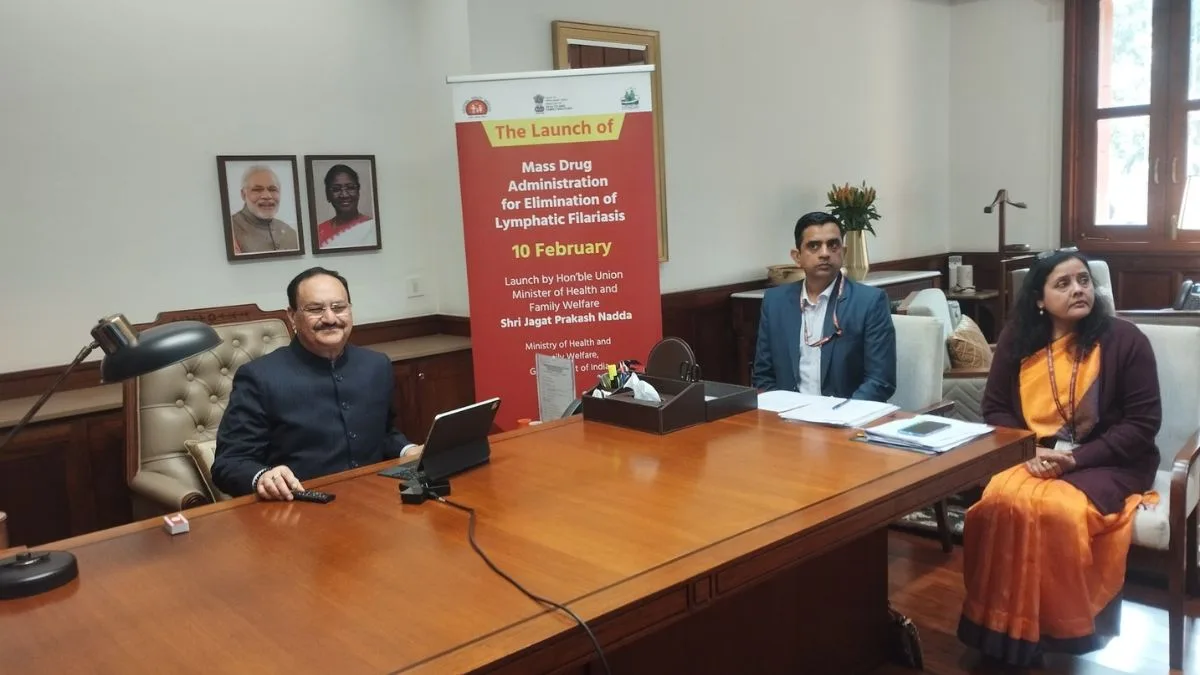
Union Health Minister Jagat Prakash Nadda on Tuesday launched the Annual Nationwide Mass Drug Administration (MDA) Campaign for the Elimination of Lymphatic Filariasis (LF) through a video conference with State Health Ministers and senior officials from 12 identified LF-endemic states, marking a significant step towards achieving the national goal of eliminating LF as a public health problem.
The nationwide campaign seeks to accelerate efforts to interrupt disease transmission, reduce morbidity, and ensure equitable access to preventive healthcare interventions for vulnerable populations across the country.
Advertisement
Lymphatic filariasis (LF), commonly known as elephantiasis (Haatipaon), is a vector-borne disease transmitted by the female Culex mosquito, which breeds in polluted and stagnant water. The infection damages the lymphatic system and can lead to chronic morbidity, disability and social stigma.
The Centre has accorded high priority to eliminating LF as a public health problem by end-2027, ahead of the global Sustainable Development Goal (SDG) target of 2030. Currently, LF is endemic in 348 districts across 20 states and Union Territories. Of these, 41 per cent (143 districts) have successfully stopped Mass Drug Administration (MDA) after clearing Transmission Assessment Survey (TAS-1), while 50 per cent (174 districts across 14 States) continue to implement annual MDA due to microfilaria rates above 1 per cent.
The remaining 9 per cent (31 districts) are at various stages of transmission assessments. As of 2024, over 6.20 lakh cases of lymphoedema and 1.21 lakh cases of hydrocele have been reported from endemic districts, underscoring the need for sustained and intensified efforts.
Addressing the gathering, Nadda reaffirmed the Centre’s unwavering commitment to eliminate Lymphatic Filariasis (LF) by 2027, well ahead of the global Sustainable Development Goal (SDG) target of 2030.
He highlighted that LF not only affects the health and quality of life of patients, but also severely impacts their livelihood, economic productivity, and social well-being, often leading to social stigma and long-term hardship for entire families. He emphasised that eliminating LF is, therefore, not merely a health objective, but a critical social and economic imperative.
The Union Health Minister also underscored the significant progress achieved through mission-mode implementation of the Mass Drug Administration (MDA) campaign, particularly through directly observed treatment, which has yielded encouraging on-ground results.
He stressed the need to strengthen the ecosystem for vector control, alongside sustained MDA, to effectively interrupt disease transmission. Highlighting last-mile challenges, he pointed out that ensuring direct observation of drug consumption and addressing public hesitancy towards medication remain key concerns, which must be tackled through intensive awareness, community engagement, grievance redressal, and trust-building measures.