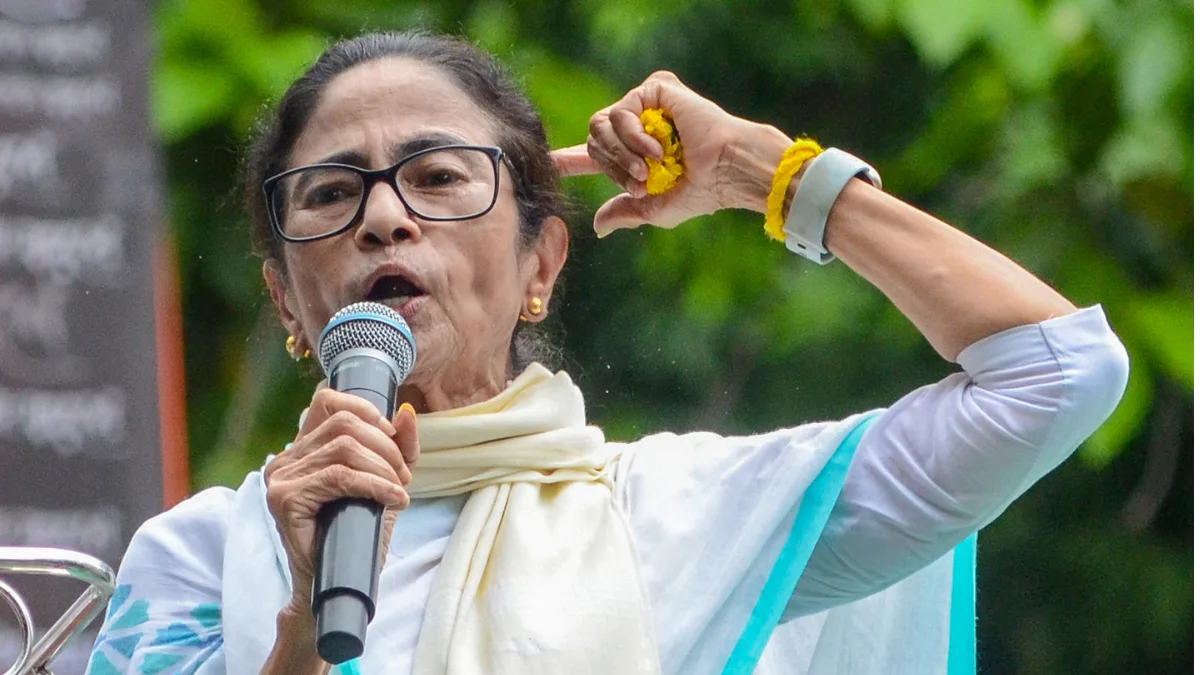
Mamata’s call for anti-BJP unity at Martyr’s Day rally junked by Congress, Left
Bengal BJP president Samik Bhattacharya said Mamata Banerjee should first focus on uniting her own party before attempting to forge an opposition alliance.
“He (Modi) dreamt of a nation rooted in Dharma yet modern in its aspirations,” the RSS noted in the article, saying wherever he went abroad, diaspora events across geographies showcased Bharat’s new pride.





RSS
Paying glowing tributes to Prime Minister Narendra Modi on his 75th birthday, Rashtriya Swayamsevak Sangh (RSS) on Wednesday said his life is a “reflection of Bharat’s transformation”.
Greeting the prime minister on the occasion, the RSS, through its mouthpiece Organiser, said that the “diamond jubilee journey” highlights how he rose from a humble background and became the entity that “redefined Bharat’s global stature”. “This Diamond Jubilee is more than a personal milestone. It is a reflection of Bharat’s transformation–from a nation once plagued by corruption, indecision, and lack of vision to a confident Vishwaguru, respected by the world and rooted in its ancient civilisation,” the Organiser said on Wednesday.
Advertisement
“He (Modi) dreamt of a nation rooted in Dharma yet modern in its aspirations,” the RSS noted in the article, saying wherever he went abroad, diaspora events across geographies showcased Bharat’s new pride.
Advertisement
The Sangh also underscored that international conferences and meetings, like the G20, BRICS, SCO, QUAD, etc., PM Modi positioned India as a “global power unafraid of tariffs, sanctions, or intimidation.” It highlighted how the prime minister went on a two-year spiritual journey at the tender age of 17. He travelled to the Himalayas, visited Ramakrishna Mission, several Buddhist centres and ashrams.
The article also recapitulated the difficult life as an RSS worker, waking up at 4:30 am, having minimal possessions and endless travel, habits which still define the prime minister as he “sleeps barely four hours, works 18-20 hours daily, and adjusts time zones instantly on foreign tours.”
It recounted how PM Modi’s political career took a “decisive turn” in 2001 after he was sent as the BJP’s relief coordinator for the Gujarat earthquake, and then became the Chief Minister of Gujarat shortly after that. “His tenure in Gujarat transformed the state into a model of governance, infrastructure, and industry. The Vibrant Gujarat summits attracted global investment, while his disaster management skills set new benchmarks,” according to the article.
By 2014, when he became prime minister, his leadership had captured the national imagination, with him promising “Minimum Government, Maximum Governance” and changing the bureaucratic culture of New Delhi.
“…once ministers and officers enjoyed foreign holidays and short working hours, now weekends are spent in the Northeast, in villages, and with the people. PM Modi made it clear: governance is not a privilege but a 24×7 responsibility,” it mentioned.
Women, too, became the PM’s “silent supporters”, while he considered birthdays to always be occasions of service, not celebration, but after his mother Heeraben died in 2022, his birthdays carried an emotional void, the article mentioned.
Talking about a “civilisation’s reawakening” under PM Modi, the RSS mentioned how the realisation of a centuries-old dream of building the Ram Mandir was fulfilled. Moreover, the Kashi Vishwanath Corridor and Mahakaal Lok fused “spiritual sanctity with modern amenities”.
PM Modi has also restored 642 artefacts since 2014, and built the new Parliament house, which symbolises Dharma with democracy. “These were not just projects but symbols of pride, confidence, and unity. From the Gujarat earthquake to floods in Assam, from Covid to international evacuations in Ukraine and Sudan, PM Modi has always been the first to respond,” it added.
Prime Minister Narendra Modi, born on September 17 1950, officially joined the RSS in 1971 but was introduced to the Sangh at a much younger age. In 1985, he was assigned to join the Bharatiya Janata Party, from where he quickly rose through the party’s ranks to become its general secretary in 1998. Three years later, in 2001, he became chief minister of Gujarat. Thirteen years after that, in 2014, he took oath as prime minister of India for the first time.
Advertisement