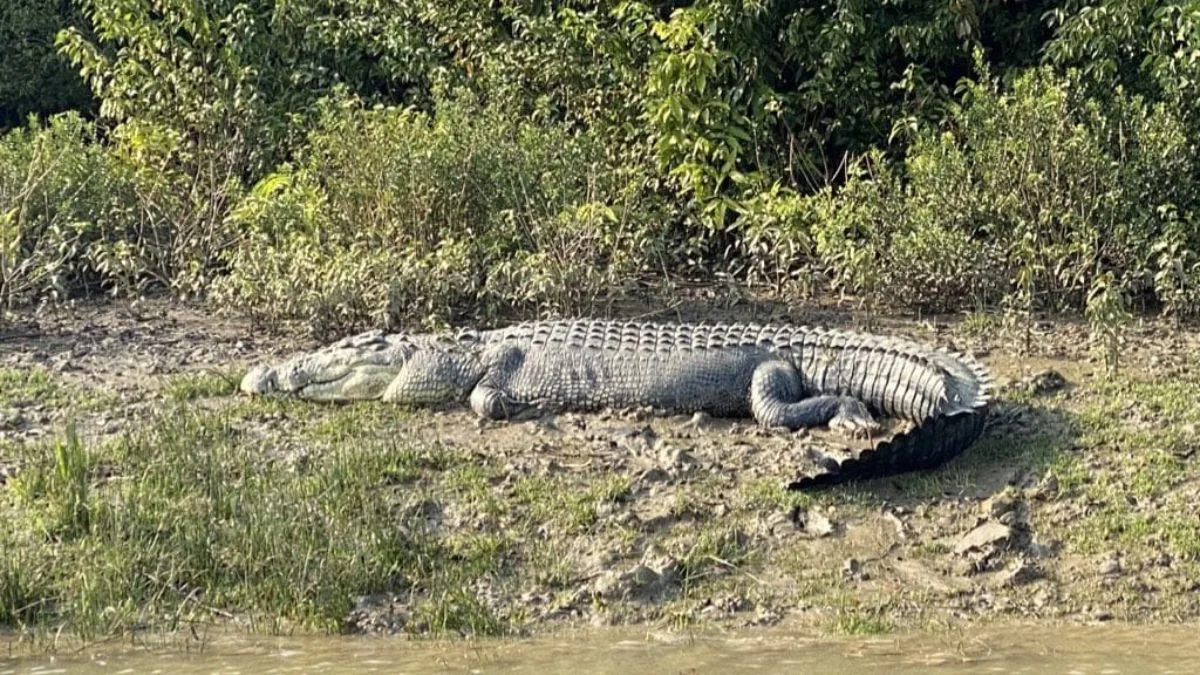
The Bhitarkanika national park, a designated Ramsar wetland site in Odisha’s Kendrapara district, has re-established itself as an ideal habitation corridor for estuarine crocodiles with their population maintaining an upward graph as per the findings of the latest census of these reptiles.
As per the salt-water crocodile estimation-2026 report released on Monday, a total of 1,858 estuarine crocodiles were recorded, indicating an increase of 32 crocodiles compared to the previous census.
Advertisement
Though the increase in population is marginal, the rise in the reptiles’ number is indicative of the fact that the national park has turned out to be a safe, congenial habitat for salt-water crocodiles, said forest officials.
The annual estimation of crocodiles was conducted from 8 to 10 January in the river systems in and around Bhitarkanika National Park and Wildlife Sanctuary, Gahirmatha Wildlife Sanctuary, Mahanadi deltaic area, and Devi river mouth area. The survey was preceded by a division-level training programme held on 7 January at Kanika Range, the report said.
A total of 24 census teams were deployed to cover 54 identified river and creek segments. The estimation was carried out using a boat-based direct observation total count method, with day and night surveys.
Day surveys focused on sub-adult and adult crocodiles, while night surveys using powerful spotlights were conducted to record hatchlings, yearlings, and juveniles.
The highest population concentration was observed in Kanika Wildlife Range, followed by Rajnagar, Mahakalpada, and Gahirmatha Wildlife Ranges.
In addition, a pilot drone-based survey was conducted in the month of December to assess the feasibility of integrating drones into future crocodile monitoring programmes.
The use of drones and camera-based identification is being explored to supplement conventional methods, reduce observer bias, and strengthen long-term population monitoring.
Incidentally, Odisha is the only state in the country having all three species — gharial, mugger and saltwater crocodile in the wild. The state government had launched a conservation programme of these crocodile species in 1975. While the conservation initiative had yielded positive results as far as saltwater and mugger is concerned, it had failed in the Gharial conservation programme.