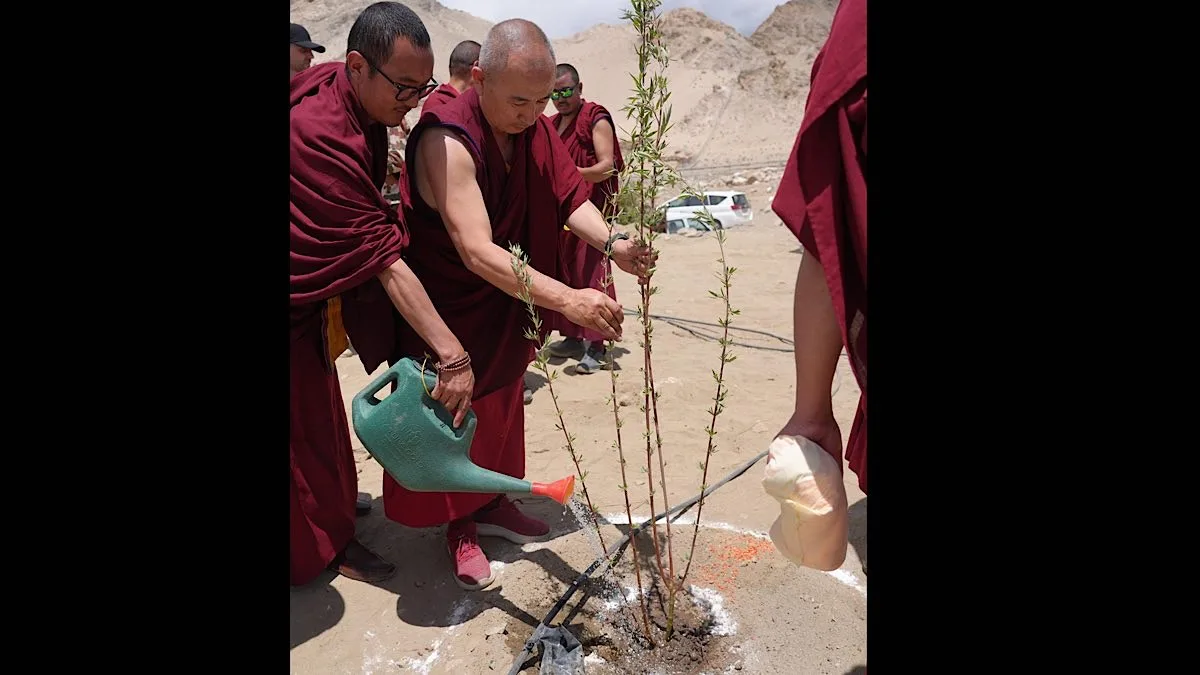
On the ccasion of World Environment Day 2026 on Frida, Lieutenant Governor of the Union Territory of Ladakh Vinai Kumar Saxena launched a mass plantation drive under the Indus River Green Corridor Initiative on land donated by Thiksey Monastery. The plantation drive was organised in line with this year’s World Environment Day theme: “Inspired by Nature. For Climate. For Our Future.”
On this occasion, 5000 saplings of species which included Salix (Willow), Poplar, Robinia, Russian Olive, Cherry, Apple, Apricot, Pear, Black Currant, Chinar and Kashmiri Juniper were planted over 7.50 hectares of land provided by Thiksey Monastery.
The initiative aims to enhance Ladakh’s green cover, strengthening ecological resilience and promoting sustainable development in the fragile high-altitude ecosystem of the region.
A large number of people, including ITBP personnel, NCC cadets, monks of Thiksey Monastery and students of Druk Padma Karpo School and Mahabodhi Residential School, had assembled to carry out the plantation drive.
Advertisement
A major highlight of the programme was the establishment of a High-Altitude Experimental Plantation Plot spread over approximately 0.12 hectares (about 1,400 sq. ft.) to study the adaptability and growth performance of selected tropical and subtropical species under Ladakh’s unique climatic conditions.
The species introduced in the experimental plot include Juniper, Russian Olive, Black Currant, Grapes, Tea Plants, Papaya and selected fruit trees. Additionally, ten Asafoetida (Hing) plants have also been introduced on a pilot basis to assess their suitability for cultivation in Ladakh. The initiative aims to evaluate growth and survival rates, assess environmental impacts, support climate adaptation strategies, promote sustainable horticulture and generate valuable knowledge for future plantation programmes in the region.
Speaking on the occasion, Saxena appreciated the contribution of Thiksey Monastery towards environmental conservation and said that such a large-scale plantation would help enrich biodiversity, improve ecological stability, and contribute to the creation of a green and sustainable corridor along the Indus River for future generations.
Saxena also highlighted the potential of Asafoetida cultivation in Ladakh, observing that the region’s high-altitude cold desert conditions are suitable for the crop, which requires relatively less water and can provide significant economic returns to farmers. He stated that if the pilot experiment proves successful, farmers in Ladakh would be trained in Hing cultivation in the future, thereby ensuring their financial sustainability.
Since assuming office as Lieutenant Governor of Ladakh, Saxena has spearheaded extensive greening initiatives across the region and has personally led the plantation of more than 35,000 saplings in different parts of the Union Territory.