Hailing the aspirational surge in youngsters, Union Minister Jitendra Singh said that the aspirations of India’s youth must be met with 3 “A”—Awareness, Aptitude and Avenue.
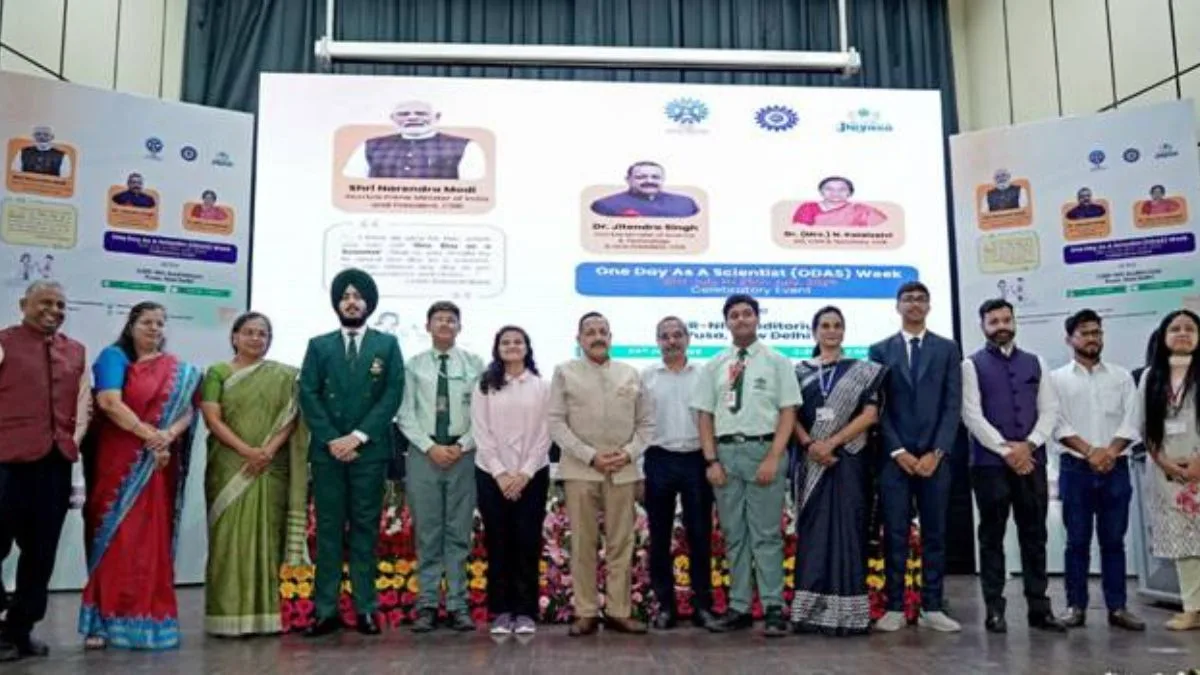
Speaking at the CSIR Jigyasa programme’s “One Day as a Scientist” (ODAS) week celebrations at the CSIR–National Physical Laboratory in Delhi on Thursday, the minister urged the youth to “stay curious, stay bold, and never stop asking questions — because in every question lies the seed of discovery.”
Advertisement
The Minister called for deeper engagement with students, schools, parents, and industry to shape the scientific future of India.
Building on that vision, Singh suggested a series of refinements to the ongoing Jigyasa initiatives. First, he proposed involving parents directly in the ODAS experience—urging CSIR labs to invite at least one parent per participant so that families can better appreciate the value of scientific exploration. He stressed that such engagement would prevent students from being discouraged at home due to lack of understanding.
He also recommended a reciprocal model titled “One Day as a Teacher”, where CSIR scientists visit the schools of participating students, especially those from smaller towns and rural areas. This, he said, would not only validate the achievements of the students but also inspire an entire school community.
Singh further advised boosting private sector involvement by encouraging industry partners—like those who supported the EPIC Hackathon—to adopt promising students or projects, providing mentorship and possibly financial support. This would help bridge the gap between school-level innovation and real-world application, he said.
The ODAS initiative that urged students to experience life as a scientist saw participation from over 14,000 students across 37 CSIR labs. Students shadowed researchers, conducted guided experiments, and interacted with experts in real laboratory environments.
A key highlight of the event was the felicitation of the EPIC Hackathon 2024 winners — an innovation challenge held under the Jigyasa programme. The top four projects showcased a compelling blend of creativity, practicality, and scientific insight.
“These students are not just experimenting—they are innovating with confidence and clarity,” said Singh, who emphasised that such projects could be stepping stones toward sustainable entrepreneurship, provided they receive timely support and mentoring.