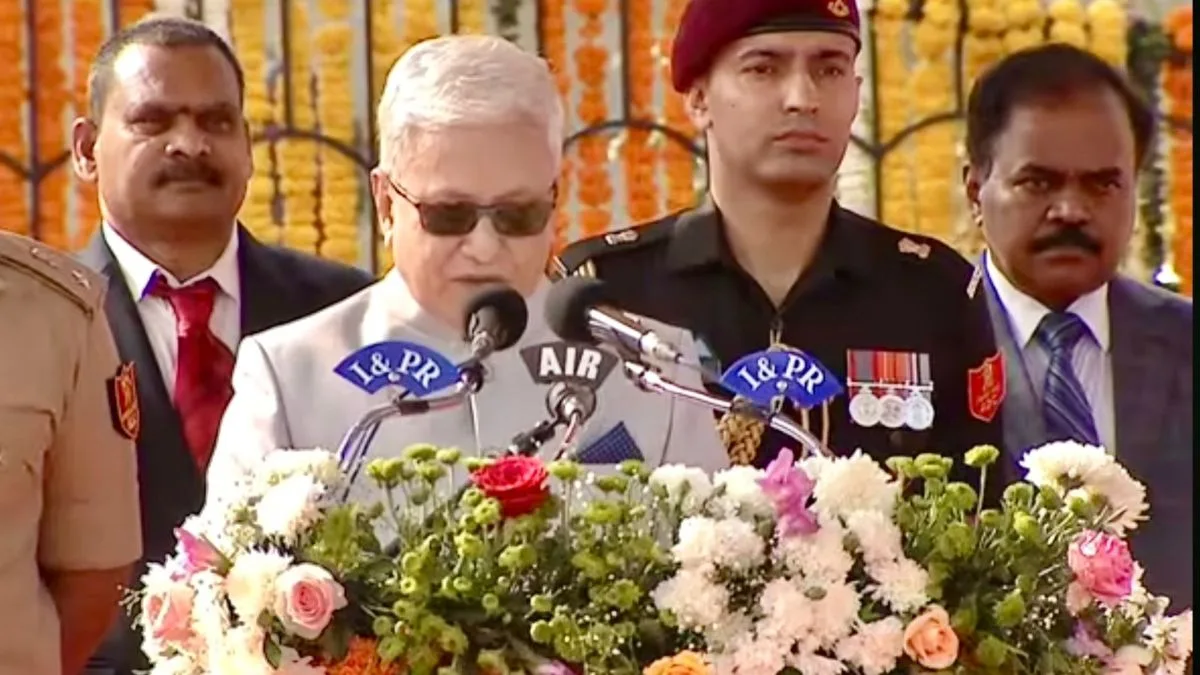
Former Telangana Governor Jishnu Dev Varma on Tuesday took the oath of office and secrecy as the 22nd Governor of Maharashtra at the Lok Bhavan in South Mumbai, overlooking the Arabian Sea, at 4.30 pm.
Bombay High Court Chief Justice Shree Chandrashekhar administered the oath of office to Jishnu Dev Varma at the Darbar Hall of the Lok Bhavan in the presence of Maharashtra Chief Minister Devendra Fadnavis, Deputy Chief Ministers Eknath Shinde and Sunetra Pawar, along with several other dignitaries.
Advertisement
After being sworn in as Maharashtra Governor, Varma was given a ceremonial guard of honour by the Indian Navy. CM Fadnavis and Deputy Chief Ministers Eknath Shinde and Sunetra Pawar congratulated the Governor by presenting bouquets.
Jishnu Dev Varma was born in Agartala, Tripura, on August 15, 1957, in the erstwhile royal family of Tripura called the Manikya Dynasty. His father, Ramendra Kishore Debbarma, was the military secretary and home secretary to Maharaja Bir Bikram Manikya of Tripura. Dev Varma is a member of the Manikya dynasty and is the uncle of Pradyot Bikram Manikya Debbarma and Kriti Devi Debbarman.
The erstwhile Manikya dynasty is not only one of India’s earliest royal families, but also among the most progressive. It introduced Tripura’s first written Constitution in 1941, aimed at promoting civic ideals such as self-help, cooperation, and devotion to the state. A key feature of Tripura’s 1942 Constitution was the reservation of seats in the legislature for minorities, backward communities, and labourers, reflecting the Manikya Dynasty’s modern and progressive vision for Tripura’s progress.
Varma studied English Literature at Calcutta University and began his political career in the Communist Party of India (Marxist) student wing called Tripura Students’ Federation (TSF). Varma rose through the ranks of the CPM-run TSF, demonstrating his leadership abilities and commitment to student welfare. He served in various key positions within the Tripura Students’ Federation, advocating for student rights and addressing their concerns.
His first major contribution came as a prominent leader within the TSF. He played a vital role in organising student movements and protests raising awareness about educational issues and demanding policy changes from the government. His involvement in these activities helped to solidify his position as a prominent student leader and a rising figure within the CPI(M) political landscape.
During his initial years, he faced challenges such as navigating the complexities of student politics, dealing with opposition from rival student organisations, and effectively mobilising students to participate in political activities.
Later in life, Varma joined the BJP in 1993. He went on to become Tripura’s Finance Minister. He spearheaded initiatives aimed at fiscal responsibility, infrastructure development, and attracting investments to the state. A landmark project was the implementation of reforms in Tripura’s financial management system, aimed at improving transparency and efficiency. His leadership was defined by his commitment to sustainable development and inclusive growth.
In 2018, Varma contested the Tripura state assembly election from the Charilam ST constituency, where he garnered an unprecedented victory, securing 89.33% of the total votes cast. After the end of 25 years of CPM-led Left Front rule in Tripura, Varma began his journey as Deputy Chief Minister in 2018, handling key portfolios like finance, rural development and power.
During his five-year tenure as Tripura’s Deputy Chief Minister, which ended in 2023, Varma focused on delivering projects, securing finances and meeting deadlines. He played a crucial role in policy formulation and coordination across various government departments.
He was also involved in key decisions related to infrastructure projects, social welfare programmes, and initiatives to promote education and healthcare. A significant challenge was navigating the diverse needs and aspirations of Tripura’s population while ensuring balanced development.
Jishnu Dev Varma was appointed as Governor of Telangana on July 31, 2024, before he was named as Governor of Maharashtra.
Varma is a poet and writer of repute in Bengali and English. His books like ‘Children of The Water Goddess’ and ‘Master of Time’ are known for their evocative and lyrical quality. He has also served as President of the Badminton Association of India between 1990 and 1993.
Varma is known to have a deep and passionate commitment to tribal development, education, health, as well as art and culture. In 1993, he was the Convener of the Tripura Chapter of the Indian National Trust for Art and Cultural Heritage (INTACH) and as Coordinator of the trust for the North-East region.