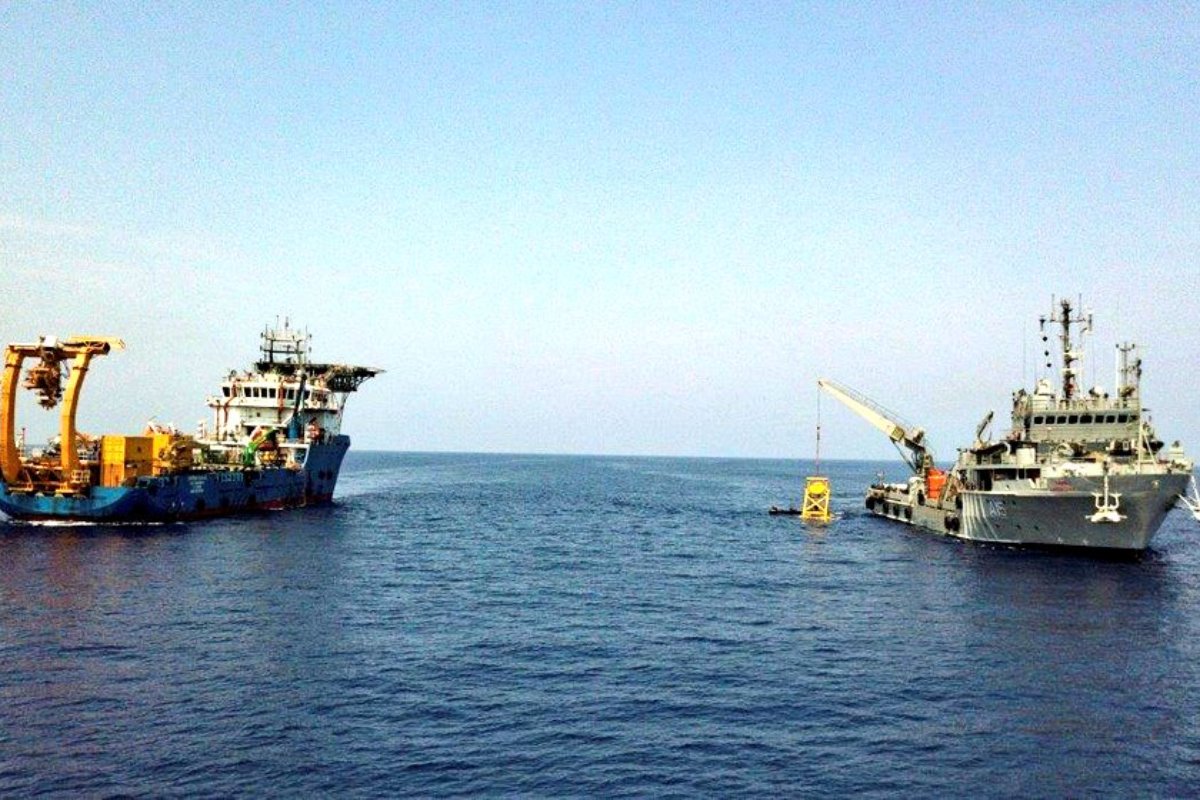
The Indian Navy on Wednesday announced that it had achieved a historic feat on Sunday when it successfully conducted the transfer of personnel from a submarine to Deep Submergence Rescue Vehicle (DSRV). This has boosted considerably India’s underwater capabilities.
The DSRV, based in Visakhapatnam, undertook the “live mating exercise” or the transfer of personnel. The personnel were transferred to submarine, using DSRV, from INS Sindhudhvaj submarine which was the ‘Distressed Submarine”.
Advertisement
Advertisement
(Photo: Twitter/@indiannavy)
The Navy spokesperson said the entire evolution done by the Indian crew marked the culmination of the training phase. This newly acquired skill by the Indian Navy and the live mating exercise was a historic achievement towards DSRV integration into the Navy and would pave the way for the force to emerge as a submarine rescue provide in the Indian Ocean region.
DSRV, a small submarine used for rescue missions, had been inducted into the Indian Navy last year. The Indian DSRV has the capability to rescue personnel from distressed submarines up to a depth of 650 metres
India plans to emerge as a centre of regional excellence for Submarine Rescue Services.
DSRV is already being used by the US, Australia, China, Japan, Singapore, UK, South Korea, Russia, France, Norway and Italy.
The three platforms: INS Dunagiri, an advanced stealth frigate; INS Sanshodhak, a Survey Vessel (Large); and INS Agray, an Anti-Submarine Warfare Shallow Water Craft, were inducted into the Indian Navy.
The Indian Navy is scheduled to commission three indigenously built frontline platforms—INS Dunagiri, INS Sanshodhak, and INS Agray—in Kolkata on June 21 (Sunday).
In a post on X, the Indian Navy said, "Responding swiftly to a distress call from MV Fareeda 5 on a likely piracy attempt in the Western Indian Ocean on 17 June 26, mission deployed INS Trikand a frontline frigate of the Indian Navy undertook prompt action to investigate and deter the threat."