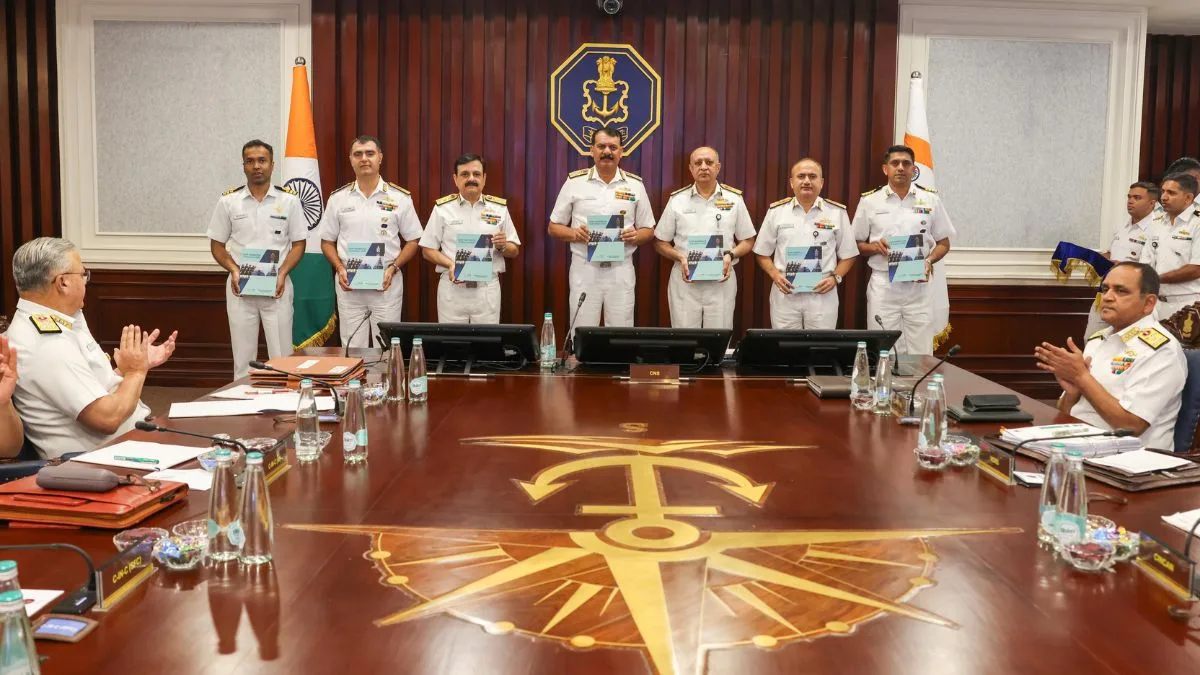
The second edition of the biannual Naval Commanders’ Conference-2025 concluded at Nausena Bhawan, New Delhi, on Friday, following three days of deliberations on operational preparedness, maritime security, capability development, and Tri-Service integration.
According to a statement by the Naval spokesperson, the conference commenced with the inaugural address by the Chief of the Naval Staff, Admiral Dinesh Kumar Tripathi.
Advertisement
Emphasising the evolving geostrategic environment, Admiral Tripathi highlighted the Indian Navy’s role in safeguarding national maritime interests through preparedness, adaptability, and regional engagement.
Reaffirming the Navy’s status as a “Combat Ready, Credible, Cohesive, and Future-Ready Force,” he lauded recent operational deployments, capability enhancements, and joint missions.
The CNS also reiterated the Navy’s commitment to achieving a fully Aatmanirbhar (self-reliant) force by 2047, driven by innovation, technology induction, and iDEX initiatives.
In his address, Defence Minister Rajnath Singh commended the Indian Navy’s vital role in protecting national interests and maintaining a high level of operational readiness and deterrence.
He stated that the Navy’s presence in the Indian Ocean Region serves as a comfort for friendly nations and a discomfort for those seeking to destabilise the region.
He further noted that a self-reliant Navy is the foundation of a confident and powerful nation, adding that the Indian Navy’s efforts in indigenisation have made it a true flag-bearer of Aatmanirbharta.
The Defence Minister also stressed the need to rapidly harness emerging technologies and tactics to outmanoeuvre adversaries, highlighting the growing significance of uncrewed and autonomous systems in modern warfare.
The Chief of Defence Staff, Chief of the Air Staff, and the Cabinet Secretary also interacted with the Naval Commanders. The CDS, in his address, underscored the importance of integration, jointness, and resource optimisation among the Armed Forces.
During the conference, five key Naval publications including the Regulations for Naval Armament Service, GeM Handbook, and Foreign Cooperation Roadmap were released.
A new digital initiative, the ‘NIPUN’ (Naval Intellectual Portal for Unified Knowledge), was also launched as a one-stop online repository of intellectual and professional work by members of the naval community.
On the sidelines of the conference, the Sagar Manthan event brought together Naval Commanders, subject matter experts, and thought leaders to deliberate on contemporary maritime and security issues.