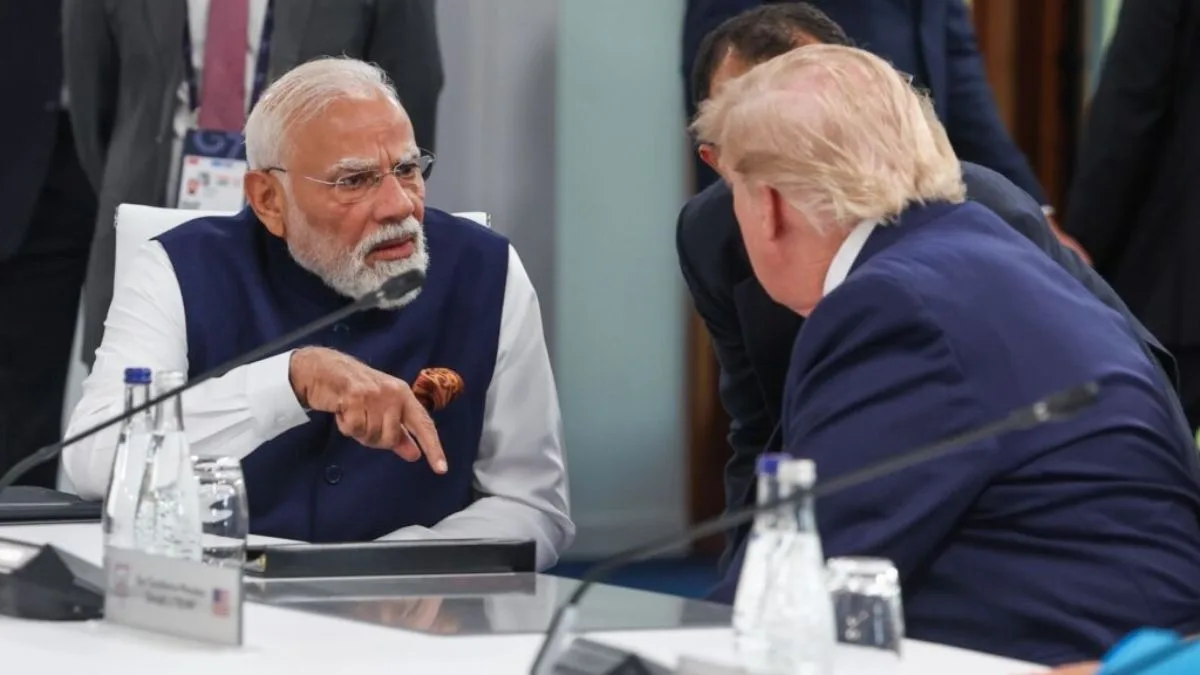
India’s primary objectives at the ongoing G7 summit, taking place in the scenic French town of Évian-les-Bains, include securing the long-term safety of maritime trade routes given the country’s heavy reliance on imported oil and fertiliser, locking in European partnerships for jointly manufacturing advanced defence equipment and small modular nuclear reactors, and urging Western nations toward structural reforms in the United Nations and global financial institutions that better reflect today’s shifting realities.
Senior Indian officials handling the negotiations said the country has already flagged its concerns regarding sailor fatalities at sea during the Gulf crisis, while also seeking to establish a framework that keeps global shipping lanes and maritime bottlenecks free from disruption due to political conflicts, “for the benefit of all stakeholders.”
Officials note that while the recent peace deal between the US and Iran may have eased Gulf tensions, the Strait of Hormuz continues to be among the most vital energy passages globally. Given that India sources 80 per cent of its oil needs through imports, smooth and uninterrupted maritime transport remains an economic priority. Europe too, dealing with its own energy vulnerabilities and political divisions, regards this route as just as essential, with the view that all concerned nations must work in tandem to safeguard it.
Advertisement
France’s proposal for a broader international maritime security patrol through UN auspices therefore offers a glimpse of a new geopolitical reality. “India is no longer merely a consumer of security. It is increasingly being asked to help provide it,” officials pointed out.
“India which has been an invitee to the G7 for many years has always been keen that it should be inside the chamber when vital issues are discussed this interest remains despite the erosion of the influence and power wielded by this powerful formation over the years,” said Rajiv Dogra, former ambassador and author of books such as India’s World, Where Borders Bleed etc.
For decades, the G7 represented a club of wealthy nations that could set the rules of globalisation. Though the ‘club’ is confronting the limits of its own power, its member states still dominate finance, technology, and military capability and India feels it can help push its objectives.
The attempt to broker a deal between Ukraine and Russia by the G7 and concerns over South China Sea are also being seen in that light as India needs to ensure safe passage for oil from Russia and fertiliser from the Black Sea region.
Officials said another issue which is being flagged at G7 is the revival of the India-Middle East-Europe Economic Corridor, or IMEC.
When the corridor was unveiled in 2023, many observers viewed it primarily as a symbolic response to China’s Belt and Road Initiative.
Three years later, after several bouts of conflicts in West Asia, the route looks increasingly like a strategic necessity. The disruptions caused by conflicts in in the region and the vulnerability of global supply chains have exposed the risks of overdependence on any single trade architecture.
“The G7’s agenda now includes artificial intelligence governance, advanced defence production, and small modular nuclear reactors and India looks to align its own needs to that agenda,” officials said. “We are looking at discussions in which India seeks co-authorship”.
On the defence front, India is near a deal for Hindustan Aeronautics and GE to co-produce F414 fighter jet engines is on as are plans to jointly produce Rafale fighter jets with India and projects for possible co-production of Scorpene class submarines besides local production of several air-to-ground weapon systems and electric propulsion system for defence equipment.
India is known to be working with France and Russia on small modular reactors, with EDF or Electricite de France’s subsidiary Nuward SMR collaborating with India’s BHEL.