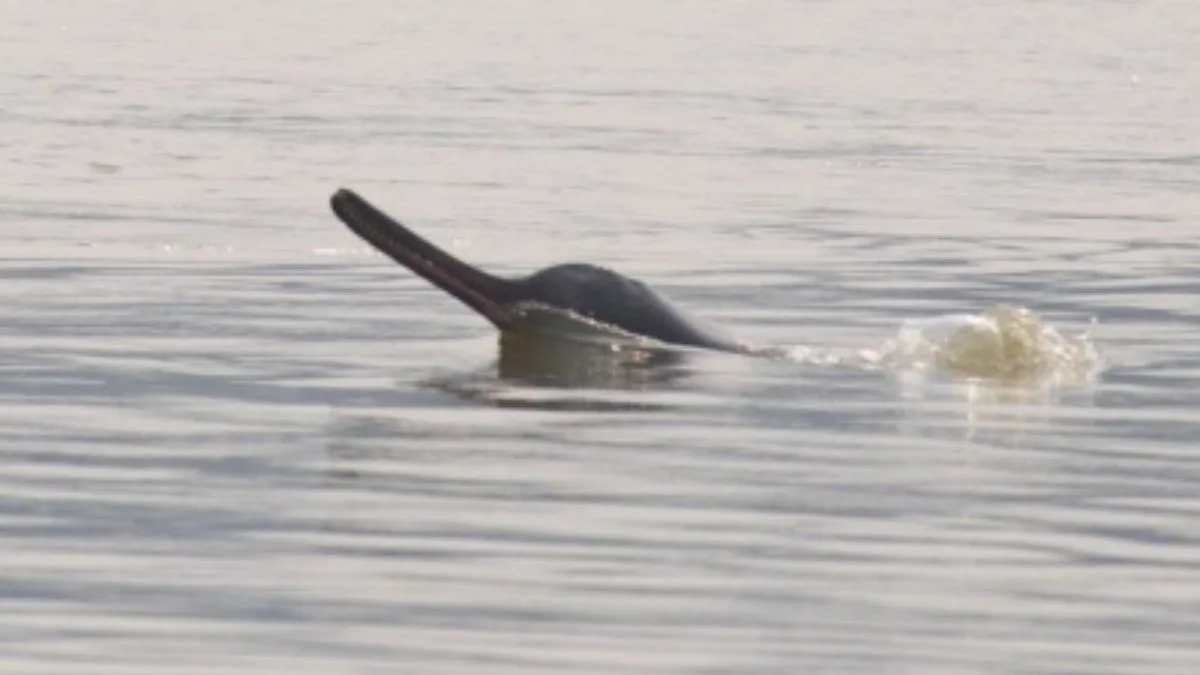
India has begun the second estimation of riverine and estuarine dolphins under Project Dolphin, marking a significant step toward strengthening conservation of its river ecosystems. The exercise was rolled out on Saturday from Bijnor in Uttar Pradesh and builds on the country’s first comprehensive census conducted between 2021 and 2023, which recorded 6,327 of riverine dolphins across major river systems.
Led by the Wildlife Institute of India (WII) in collaboration with State Forest Departments and conservation organisations such as WWF India, Aaranyak, and the Wildlife Trust of India, the survey will cover the main stem of the Ganga from Bijnor to Ganga Sagar and the Indus River in the first phase and the Brahmaputra, the tributaries of the Ganga, the Sundarbans, and Odisha in the second phase.
Advertisement
Apart from the Ganges river dolphins, the survey will assess the status of the Indus river and Irrawaddy dolphins, along with habitat condition, threats, and associated conservation-priority fauna. This initiative will generate robust scientific data to support evidence-based conservation planning and policy action for India’s river ecosystems, according to the Ministry of Environment, Forests and Climate Change.
Incidentally, riverine dolphins live exclusively in freshwater rivers with murky water, while estuarine dolphins use the brackish transition zone where rivers meet the sea. Both differ from oceanic dolphins in physique and behaviour due to unique habitats.
According to officials the second range-wide estimation follows the same standardised scientific methodology while expanding spatial coverage to update population estimates, evaluate habitat quality, identify threats, and support evidence-based conservation planning.
But counting river dolphins is challenging because they live underwater, surfacing only briefly, and lack distinctive markings that would allow individual identification.
To overcome this, researchers use a combination of visual and acoustic methods. Boat-based visual surveys have trained observers travelling at controlled speeds, scanning riverbanks to detect brief surfacing events while minimising the risk of double-counting. Visual methods are complemented by acoustic monitoring using hydrophones—underwater microphones that detect dolphins’ echolocation clicks. Since Gangetic dolphins rely on sound for navigation and hunting, hydrophones can identify their presence even when they are not visible. By combining methods and signals from multiple devices, researchers can estimate dolphin locations accurately despite their short surfacing times
The 2021–23 survey recorded an estimated 6,327 riverine dolphins, including Ganges River Dolphins in the Ganga, Yamuna, Chambal, Gandak, Ghaghara, Kosi, Mahananda and Brahmaputra systems, and a small population of Indus River Dolphins in the Beas. Uttar Pradesh and Bihar recorded the highest numbers, followed by West Bengal and Assam, underscoring the critical importance of the Gangetic basin for their survival.
This ongoing survey will additionally cover new stretches and operational areas to include Irrawaddy dolphin estimation in Sundarbans and Odisha. The data generated will guide policy decisions and strengthen river-based conservation strategies under Project Dolphin, ensuring better protection for the unique species.