Rajnath, Gadkari, Yogi inaugurate Lucknow-Kanpur Expressway
Defence Minister Rajnath Singh and Union Minister for Road Transport and Highways Nitin Gadkari inaugurated the Lucknow-Kanpur Expressway in Unnao on Monday.
Following a bilateral meeting between Indian Defence Minister Rajnath Singh and Australian Deputy Prime Minister and Minister for Defence Richard Marles, the two nations issued a joint statement.




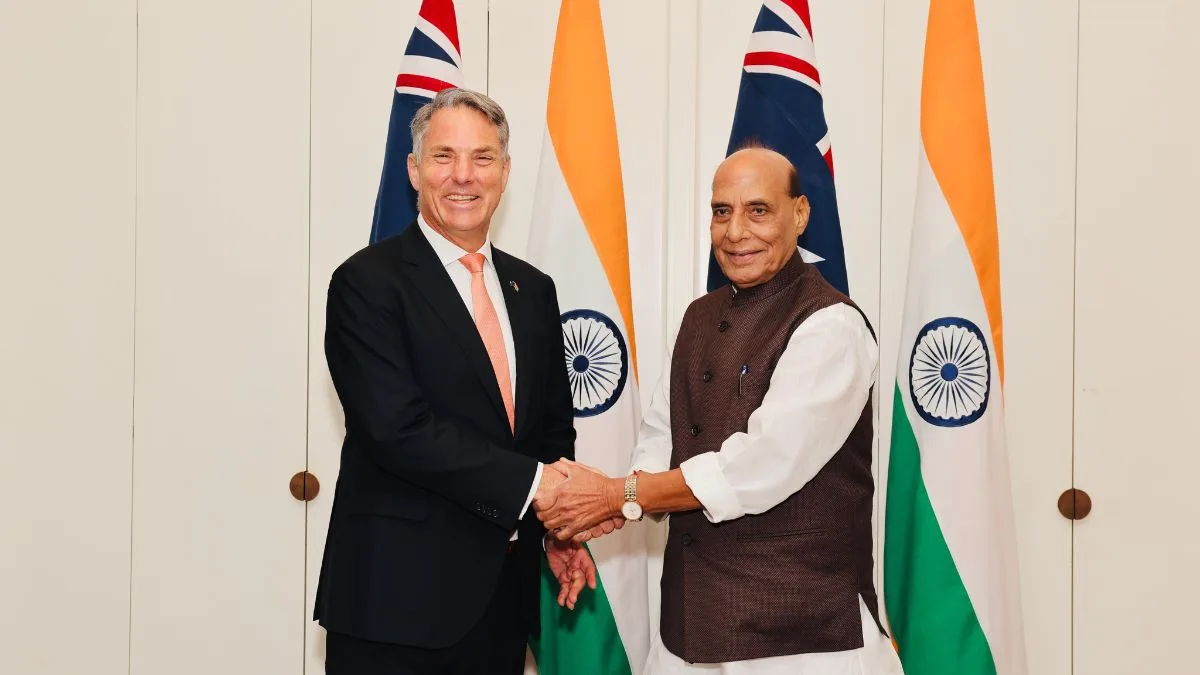
Photo: SNS
India and Australia have greenlighted the collaboration between the two nations towards enhancing collective strength, contribution to both countries’ security, and making an important contribution to regional peace and security.
Following a bilateral meeting between Indian Defence Minister Rajnath Singh and Australian Deputy Prime Minister and Minister for Defence Richard Marles, the two nations issued a joint statement.
Advertisement
Stating that the inaugural Australia-India Defence Ministers’ Dialogue reflected unprecedented progress in the bilateral defence partnership, the statement said that the ministers discussed a Joint Maritime Security Collaboration Roadmap to advance maritime cooperation, and looked forward to Prime Ministers renewing and strengthening the Joint Declaration on Defence and Security Cooperation.
Advertisement
During high-level talks, the two nations reaffirmed their commitment to expanding defence cooperation through improved consultation, joint exercises, and operational interoperability. Both sides agreed to hold an annual Defence Ministers’ Dialogue to strengthen their strategic partnership.
The ministers welcomed the signing of the Australia-India Implementing Arrangement on Mutual Submarine Rescue Support and Cooperation. They noted progress toward operationalizing the 2024 Air-to-Air Refuelling Implementing Arrangement. They highlighted growing collaboration on information sharing and praised the defence partnership’s expansion across all areas. The establishment of Joint Staff Talks was also welcomed as a way to coordinate joint exercises, operations, and interoperability initiatives.
The ministers highlighted the importance of defence education and capacity building. They welcomed increased Indian student participation at the Australian Defence College in 2026 and the first Indian position at the Australian Defence Force Academy in 2027.
Both sides stressed the strategic importance of defence industrial collaboration. They agreed to promote cooperation in modern technology through the Joint Working Group on Defence Industry, Research and Materiel and acknowledged India’s offer to maintain, repair, and overhaul Royal Australian Navy ships in Indian shipyards.
Ministers reaffirmed the importance of regional cooperation to maintain a free, open, peaceful, stable, and prosperous Indo-Pacific. They support freedom of navigation, unimpeded trade, and lawful uses of the sea in line with international law. They welcomed collaborative maritime awareness and anti-submarine warfare activities in the Indian Ocean and agreed to continue aircraft deployments to enhance operational familiarity.
The discussions highlighted growing strategic unity among Australia, India, Japan, and the United States, with commitments to improve maritime domain awareness and strengthen maritime surveillance.
Army-to-army engagement was mentioned, focusing on amphibious operations, exercises like Puk Puk, and expanding Exercise Austrahind. Ministers emphasized sharing best practices in emerging areas such as integrated air and missile defence, secure communications, uncrewed aerial systems (UAS), counter-UAS operations, and special operations.
Advertisement