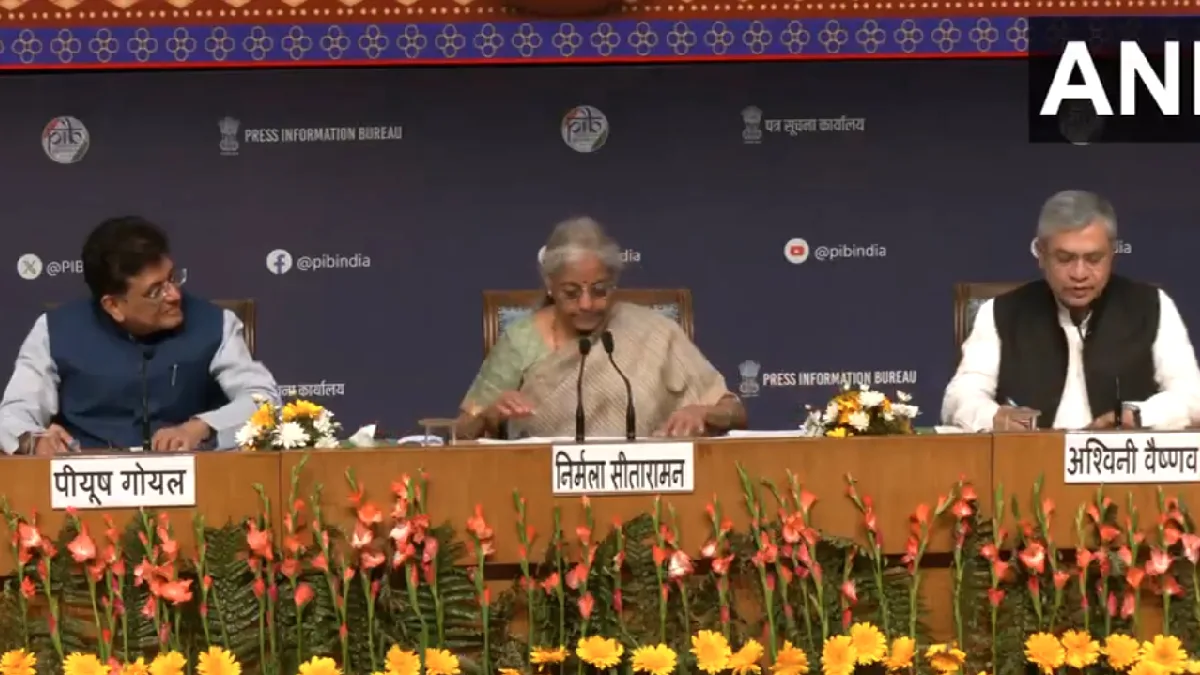
Union Finance Minister Nirmala Sitharaman on Saturday denied that GST reforms were introduced in the wake of punitive tariffs imposed by the United States, asserting that discussions on Goods and Services Tax rate rationalisation had been happening for a long time.
“This has been in the works for one and a half years. Who had thought of any tariff war at that time, and several groups of ministers were working on this. And several groups of these GOMs met again, post the Government of India’s package, which was sent to the GST council…So these are discussed at various levels at various times. So nowhere close to the tariff war. This had to happen. This was waiting to happen for quite some time. It has happened now,” she said at a joint press conference held with fellow ministers Ashwini Vaishnaw and Piyush Goyal.
Advertisement
Sitharaman also denied that the GST reforms had anything to do with upcoming elections. “This is a much-awaited relief which Prime Minister Modi has been telling us to get going with. We will have to do it. We have done it, so it has no implication on an election. However, elections keep coming. However, elections can have any impact on any policy, and policy can have an impact on the elections. Those are collaterals you will have to live with,” she stated.
Sitharaman added that the GST reforms, which came into effect on the first day of Navratri, were received very well by the people of the country.
Minister Piyush Goyal, on his part, pointed out India’s high GDP growth, stating that even international agencies are bullish on India amid global turbulence.
“Despite the international difficulties, in a very volatile, very turbulent international environment, India is progressing so rapidly that even the IMF had to revise its forecast upward to 6.6 per cent growth this year. In the first quarter, we saw a historic growth of 7.8 per cent this year,” he said.
He added that government institutions are working to keep inflation under check, which is key to ensuring healthy growth.
“The Ministry of Finance, the Reserve Bank of India, and the Monetary Fiscal Policy are taking consistent steps to ensure that India is not affected by inflation. Last month, the lowest inflation rate in eight years was 1.5%. We all saw that after 17-18 years, S&P revised India’s rating and raised it one notch, maintaining a stable outlook. Similar results were observed in the general market. Now, take a small example: car sales. Maruti Suzuki sold 165,000 vehicles in just eight days. The first eight days of Navratri,” Goyal stated.
Ashwini Vaishnaw said domestic consumption is set to receive a big boost due to the recent GST reforms.
“During the GST reform, many estimates were made about how consumption would increase, how demand would grow in the country. If we look at our GDP numbers from last year, it was Rs 335 lakh crore. Of that, our consumption accounted for Rs 202 lakh crore, and investment accounted for Rs 98 lakh crore… But because of the GST reforms, consumption will be significantly increasing, and it’s very likely that consumption will increase more than 10 per cent this year, which means there is a strong possibility of extra consumption of around Rs 20 lakh crore,” he told the media.
Vaishnaw also pointed out that India has this year surpassed China in exporting smartphones to the United States, which is a huge achievement. “Some of the biggest companies, about 20 percent of their manufacturing is now happening in India,” he stated.