The Government of India (GOI) is making concrete efforts towards accelerating the country’s transition towards next-generation connectivity through a series of strategic initiatives aimed at advancing 6G technologies.
Anchored in the principles of affordability, sustainability, and ubiquity, India’s 6G vision focuses on empowering society through indigenous innovation, advanced R&D, and global collaboration.
Advertisement
With active participation from industry, academia, and research institutions, India is positioning itself as a global hub for future telecom technologies, aligned with the broader national goal of building a Viksit Bharat by 2047.
Advertisement
The sixth-generation (6G) wireless technology, a successor to the existing 5G, is set to revolutionize the internet, making it way more faster and smoother, using higher radio frequencies than 5G, letting it handle vast data at once with almost no delay.
The 6G technology aims to send and receive information in just one microsecond, that’s 1,000 times faster than the response time of 5G.
This literally means instant connections with almost zero lag, which will be useful for things like remote medical surgeries, smart robotics, and real-time gaming.
The 6G network will also improve features like advanced imaging, precise location tracking, and creating lifelike virtual experiences.
When combined with artificial intelligence (AI), it will be smart enough to decide automatically where to store, process, and share data, making technology more efficient and responsive everywhere.
India’s 6G Vision: Positioning India as a Global Telecom Innovator
The Bharat 6G Vision manifesto aims to make India a leading supplier of advanced telecom technologies, aligned with Viksit Bharat objectives.
The rapid rollout and domestic adoption of 5G is laying the foundation for India’s 6G vision, positioning the country as a global leader in future telecom innovation. The 6G Vision is based on principles of affordability, sustainability, and ubiquity.
On March 22, 2023, the “Bharat 6G Vision” document was released, envisioning India as a frontline contributor in the design, development, and deployment of 6G technology by 2030.
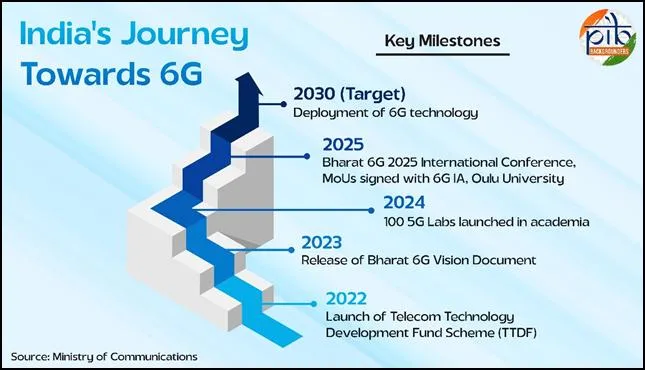
The Government has taken following initiatives to facilitate the development of 6G technology in the country:
1. Funding two testbeds namely 6G THz Testbed & Advance Optical Communication Testbed to promote R&D and innovation in the country.
2. Sanctioned 100 5G labs at academic institutions in FY 2023- 24, across India for capacity building & for building a 6G ready academic and start-up ecosystem in the country.
3. 104 research proposals have been approved on 6G network ecosystems to promote research and innovation in line with global roadmap for 6G technology.
Bharat 6G Alliance
To advance the Bharat 6G Vision, India launched the Bharat 6G Alliance, bringing together industry, academia, startups, research institutions, and standardization bodies. The alliance is focused on enabling indigenous innovation and driving global collaboration.
The Bharat 6G Alliance (B6GA) is an initiative of Indian industry, Telecom Service providers, academia, national research institutions, and standards organizations.
Supported by the government and industry, it drives indigenous 6G research and development to create a self-reliant, globally competitive ecosystem for advanced communications technologies.
With state-of-the-art labs and innovation focus on multi-chip modules, SoCs, and advanced IoT applications, India aims to lead the global 6G movement. B6GA is an industry-led body, facilitated by the government, providing a collaborative platform to technology stakeholders including public/private companies, academia, research institutions, and standard development organizations.
Bharat 6G Alliance has constituted seven Working Groups on different domains of 6G like Spectrum, Technology, Applications, Green and Sustainability and use cases.
With India’s 6G roadmap, the telecom sector is expected to contribute nearly USD 1.2 trillion to the national GDP by 2035.
The country is targeting 10% of global 6G patents, underscoring its emergence as a hub for innovation in telecom technologies. In parallel, the satellite communications market is projected to triple by 2033, strengthening India’s space-linked connectivity ecosystem.
Advertisement