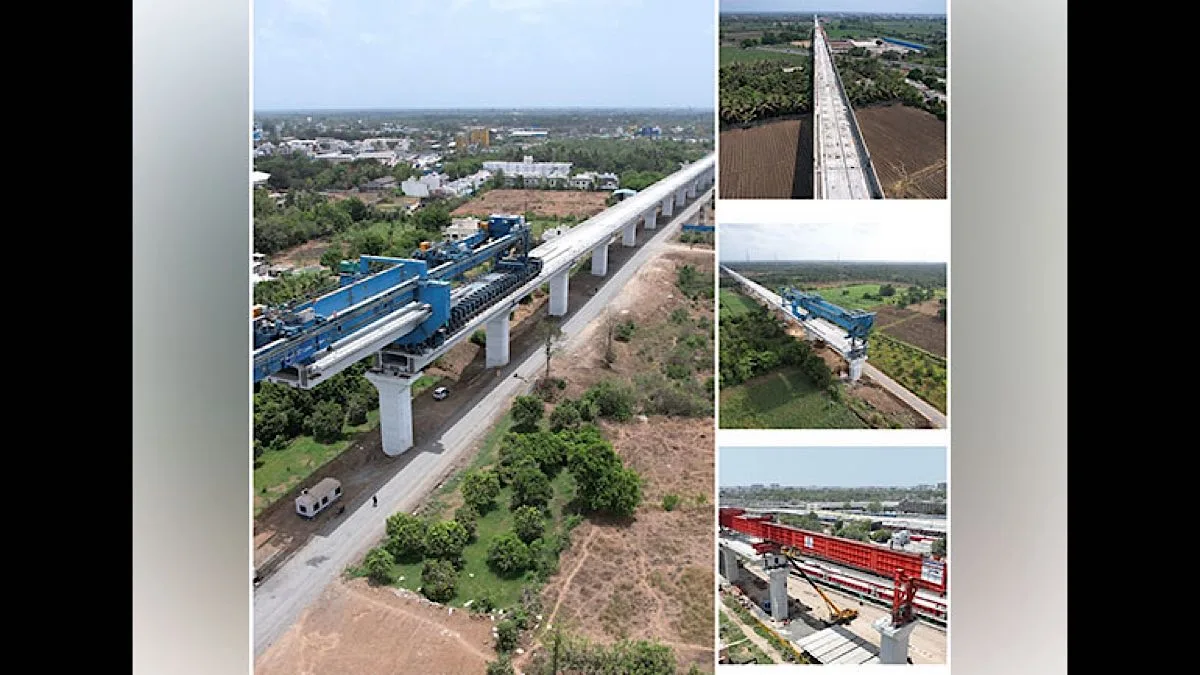
The first high-speed rail service on the Mumbai-Ahmedabad High Speed Rail (MAHSR) corridor is expected to commence in August 2027.
The corridor aims to significantly reduce travel time while enhancing passenger comfort, safety, and reliability.
Advertisement
The 508-kilometre MAHSR corridor, comprising 12 stations at Mumbai (BKC), Thane, Virar, Boisar, Vapi, Bilimora, Surat, Bharuch, Vadodara, Anand, Ahmedabad, and Sabarmati, passes through Maharashtra, Gujarat, and Dadra and Nagar Haveli.
The Mumbai-Ahmedabad Bullet Train project, which is making rapid progress, is one of the most extensive rail infrastructure programmes undertaken in India, and will connect Mumbai and Ahmedabad in about 1 hour 58 minutes.
According to the government, the MAHSR Project has a design speed of 350 km/h and an operational speed of 320 km/h. With the foundation stone laid in September 2017 it marked the beginning of India’s high-speed rail journey.
For operational purposes, high-speed rail is defined as railway systems operating at speeds exceeding 250 kilometres per hour.
At present, the highest design speed in the Indian railway network is around 180 kmph, achieved by semi-high-speed services such as Vande Bharat.
Besides providing high-speed passenger transport, the MAHSR Project will also establish for the first time, a domestic high-speed rail ecosystem.
Each station on the MAHSR corridor is designed to reflect the character and spirit of its host city. Contemporary architecture, modern amenities, and multimodal connectivity are integral to their design.
Sabarmati station is being developed as a multimodal hub linking the bullet train, metro, BRTS, and railway networks. The surrounding area is also being planned following transit-oriented development principles.
The MAHSR Project is being developed using Japanese Shinkansen technology and operational standards. The corridor incorporates advanced systems for traction, electrification, track infrastructure, and operations.
The corridor includes 25 river bridges, out of which 21 are located in Gujarat and 4 in Maharashtra.
The corridor includes about a 21 km tunnel section in Maharashtra. This section features India’s first undersea rail tunnel beneath Thane Creek. The undersea stretch extends for approximately 7 km. Tunnel construction combines the New Austrian Tunnelling Method (NATM) and Tunnel Boring Machine (TBM) technology.
The alignment comprises a 5 km NATM section and a 16 km TBM section. Both tracks will be accommodated within a single tunnel tube measuring 13.1 m in diameter.
The TBM cutter head has a diameter of 13.6 m, the largest used in an Indian railway project. Construction has advanced steadily, with 4.8 km of the undersea tunnel between Ghansoli and Shilphata already completed.
The MAHSR project will reduce travel time between Mumbai and Ahmedabad to under two hours.
The project is expected to create around 4,000 direct jobs and 35,000–40,000 indirect jobs. Approximately 40,000 workers are expected to be engaged during construction.