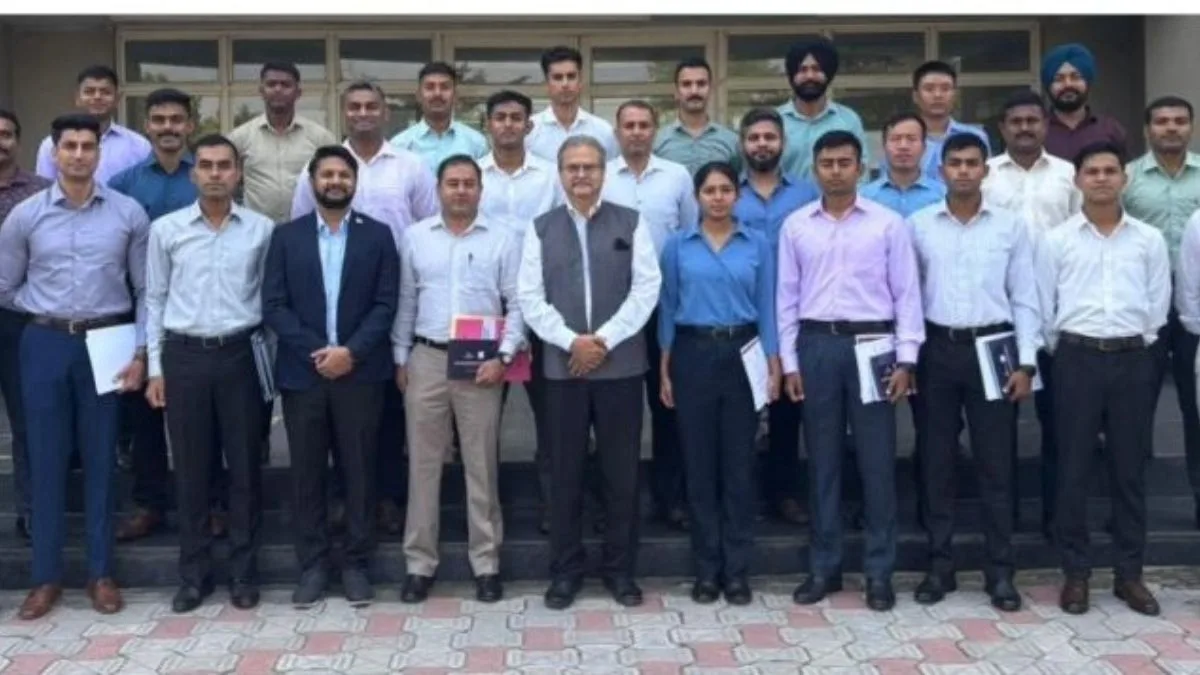
In a significant stride towards strengthening the Indian Army’s drone warfare capabilities, a batch of 25 officers and personnel from other ranks recently completed a three-week Pilot Drone Training Programme at the Indian Institute of Technology Ropar (IIT-R) in Punjab.
The training, conducted under the aegis of the Army Training Command (ARTRAC), was organised by IIT Ropar’s Centre of Drones and Autonomous Systems (DRAS) and the Defence Research Innovation Foundation (DRIF), both based at IIT-R. The training capsule was conducted from 6th to 25th October.
Advertisement
The initiative signifies a decisive shift towards self-reliant innovation and next-generation combat readiness in the evolving landscape of modern warfare.
Speaking to The Statesman, Lt Gen Surinder Singh Mahal (Retd), Director DRIF, said that a Memorandum of Understanding has been signed between IIT-R and ARTRAC for three years under which a batch of 25 officers and personnel from other ranks will be provided the training.
Notably, the MoU between the ARTRAC and IIT Ropar for carrying out the drone trainings was executed under the stewardship of Prof Rajeev Ahuja, Director IIT Ropar.
“This was the pilot batch of the trainees, which included a mix of officers and other ranks taken from different Army formations across the country. It will be conducted twice a year with 25 members in each batch. The three-week course includes everything related to drones in terms of avionics, building drones from scratch, flying counter drones, and handling FPV drones,” Mahal said.
The Director further highlighted that the training capsule also focuses on assessing and understanding the drone capabilities of potential adversaries, enabling participants to devise suitable countermeasures.
“It is a comprehensive course that includes certifications from the Directorate General of Civil Aviation (DGCA) and Geographic Information System (GIS). Upon completion, the trained personnel will return to their respective formations to impart drone training to other soldiers,” he said.
The Director also underscored the growing significance of technology in the military domain and the rapid evolution of drones as a decisive factor in modern warfare.
Speaking with the outlet, Dr Shashi Shekhar Jha, Coordinator, DRAS, said that the course will be conducted twice a year, with the next batch scheduled for January 2026. Speaking about the capsule, he said that the participants received comprehensive exposure through theoretical and practical drone training, drone building and integration, drone data processing and analysis. The course also included advanced modules, including Counter-UAS, Drone Warfare, and Autonomous Systems.
“The knowledge and hands-on expertise imparted during the course would empower the participants to further improve their operational understanding of drones as a technology game changer. This collaboration marks a significant step towards building indigenous capability and developing mission-ready drone professionals for the future,” Dr Jha said.
The Army stated that a Memorandum of Understanding (MoU) was signed with the Indian Institute of Technology (IIT) Ropar as part of its ongoing efforts to enhance professional education and capacity-building among its personnel.
“So far, seven premier institutions across the country have been engaged to train Army officers in 22 specialised courses under the Army Management Studies Board. These include the Arun Jaitley National Institute of Financial Management, National Law University, Indian Institute of Management–Indore, IIT Ropar, Management Development Institute (MDI) Gurugram, and Birla Institute of Technology & Science (BITS) Pilani. The MoU has been signed for a period of three years and may be extended further based on organisational requirements and course feedback,” the Army added.