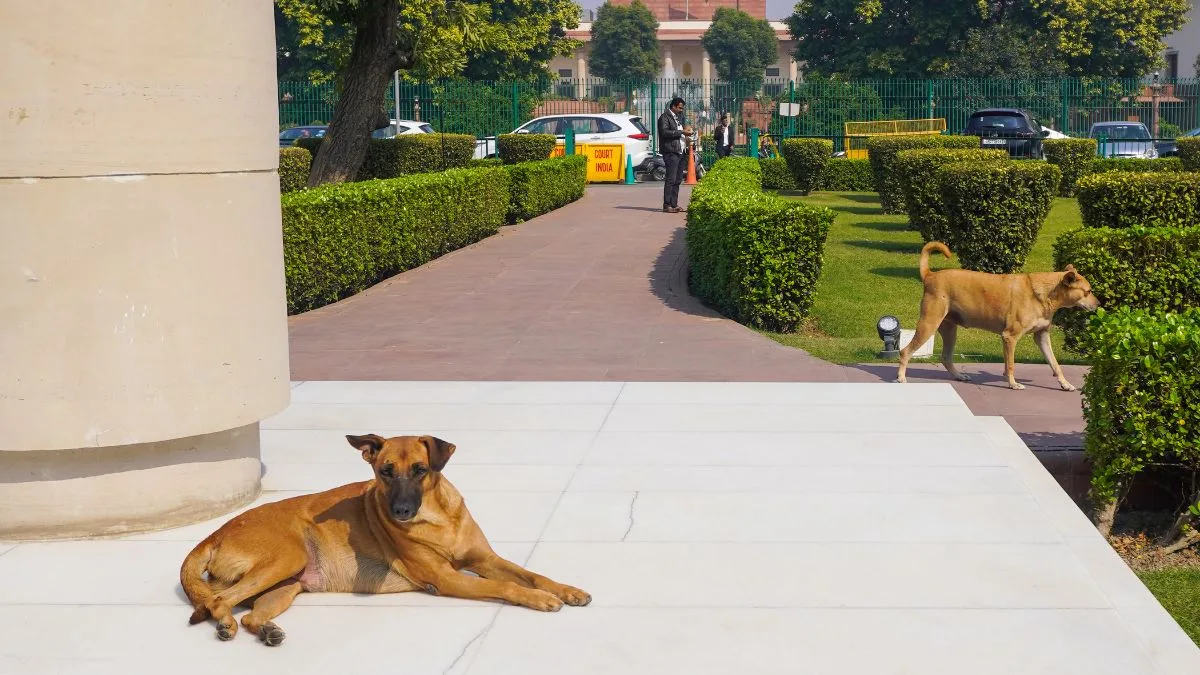
The Supreme Court on Thursday observed that dogs are capable of sensing fear in humans and may turn aggressive when they detect it, as it continued hearing a suo motu case on the growing menace of stray dog attacks across the country.
A Bench comprising Justice Vikram Nath, Justice Sandeep Mehta and Justice N.V. Anjaria made the observation while examining issues related to the rising number of dog-bite incidents nationwide and the implementation of the Animal Birth Control (ABC) Rules.
Advertisement
“The dog can always smell a human who is afraid of dogs. It will attack when it senses that. We are speaking from personal experience,” the Bench remarked.
When a dog lover present in the courtroom nodded in disagreement, the Bench responded, “Madam, don’t nod your head. If dogs know you are scared, there is a higher chance they will attack you. Even your pet may do so.”
The suo motu proceedings arise from the increasing incidents of dog attacks, particularly affecting children. The issue drew nationwide attention last year after a different Bench ordered the sheltering of stray dogs in Delhi, triggering protests from animal rights groups. That order was later modified by the present Bench, which directed the catching of stray dogs, their sterilisation, vaccination and release at the place from where they were picked up.
The Court recalled that in November 2025, it had directed States and the National Highways Authority of India (NHAI) to ensure the removal of stray animals from highways and had also ordered fencing of educational and health institutions to curb dog attacks. It had further directed that dogs removed from institutional areas should not be released back at the same locations.
Senior Advocate C.U. Singh submitted that the abrupt removal of dogs could lead to a surge in rodent populations, causing unintended public health consequences. He also cautioned that overcrowded shelters might result in disease outbreaks. “There has to be a balance. Your Lordships know what happened in Surat 20–30 years ago,” he said.
Responding humorously, the Bench remarked, “On a lighter note, dogs and cats are enemies. Cats kill rodents. Tell us, how many dogs do you want roaming around hospital corridors?”
Senior Advocate Krishnan Venugopal highlighted the lack of infrastructure under the ABC regime, pointing out that only 66 centres were accredited nationwide and that untrained persons were often carrying out sterilisations.
Senior Advocate Dhruv Mehta questioned where dogs would be housed in the absence of adequate shelters, while Gopal Sankaranarayanan argued that sterilisation and vaccination should be preceded by proper identification, census and planning. He also sought reconsideration of the Court’s earlier direction requiring financial deposits from individuals and NGOs participating in the proceedings.
Senior Advocate Nakul Dewan emphasised the need for humane solutions, suggesting microchipping and the formation of an expert committee. Shyam Divan, appearing for PETA, echoed the demand for an expert panel and cautioned against prolonged confinement of dogs in kennels.
Senior Advocate Vinay Navare suggested decentralising implementation through the High Courts, while Siddharth Luthra questioned whether judicial directions could override the statutory ABC Rules.
Senior Advocate Karuna Nundy cited IIT Delhi’s ABC model, claiming it had eliminated rabies cases and dog-bite complaints without relocating dogs. Sumeet Pushkarna, appearing for former Union Minister Vijay Goel, supported extending restrictions to residential areas and argued that dogs that have bitten humans should not be released.
The Court will continue hearing the matter on Friday, January 9, 2026.