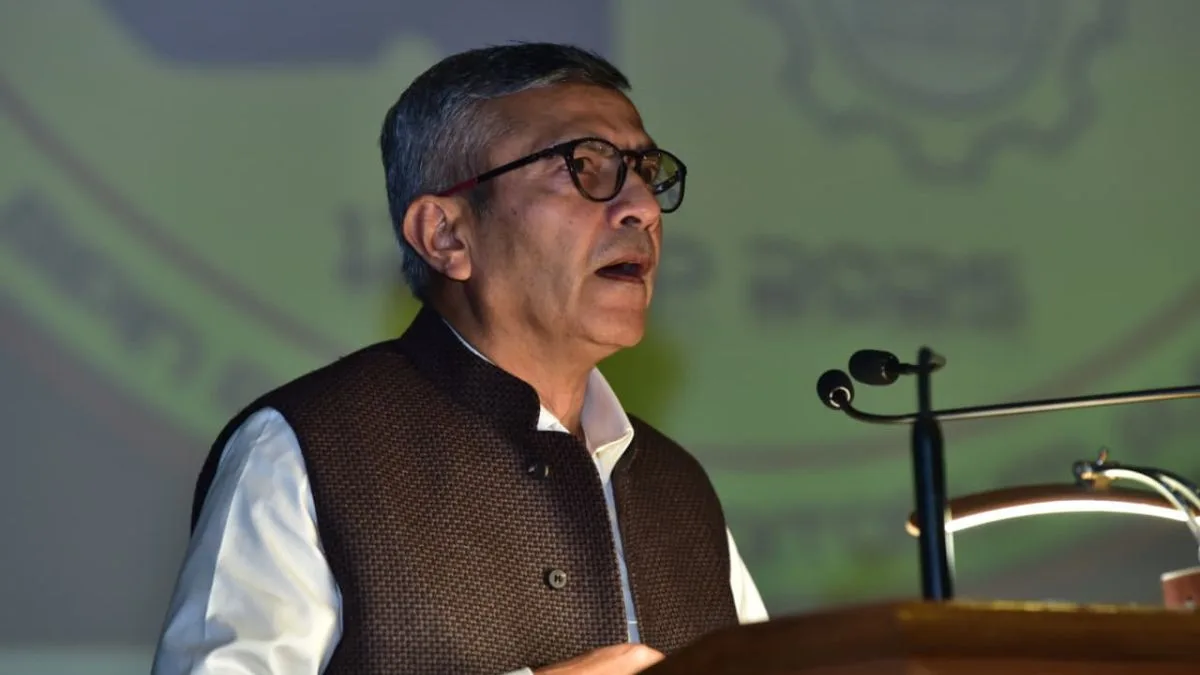
Emphasising that technological superiority and industrial strength often determine the outcome of war, Defence Secretary Rajesh Kumar Singh urged greater collaboration between public and private industry, research institutions such as DRDO, and academia to bolster the operational capabilities of the Armed Forces in today’s constantly-evolving times.
He was addressing the inaugural STRIDE 2025 seminar on the theme ‘Synergy of Technology, Research and Defence Ecosystem’ organised by Southern Command in Pune, Maharashtra, on Friday.
Advertisement
Underlining that the present technology disruption is increasingly changing not just the nature of warfare, but also the business of industry, he exhorted all the stakeholders to stay abreast of the latest technological trends and work together to achieve the goal of Aatmanirbhar Bharat.
In a statement issued here, the Ministry of Defence said that during his address the Defence Secretary emphasised that technological superiority and industrial strength often determine the outcome of war, and there is a need to ensure that the defence industry grows at pace with the rest of our manufacturing sector to achieve the goal of Viksit Bharat and USD 30 trillion economy by 2047. “The transition is critical to the broader issue of becoming a developed nation of innovation, enhancing India’s startup culture, widening our industrial base, increasing the share of manufacturing in our GDP, and generating employment and the spin-off benefits that come from the dual use of technology,” he added.
Singh further pointed out that the ongoing conflicts have resulted in competitive populism and economic protectionism around the world, accompanied by economic fragmentation, the decline of multilateral institutions, and a growing tide of nationalism. In this context, he said, “there is a need to back our soft power as hard power is becoming more and more critical.”
The Defence Secretary also spoke about the revision of the Defence Procurement Manual 2009 and Defence Acquisition Procedure 2020 to make them more dynamic, proactive, less process-heavy, and more focused on outcome. “There is a need to reduce entry barriers for the private sector and start-ups, encourage grassroots innovation, and ensure competitive bidding. The intent is to broaden and diversify India’s defence industrial base,” he said.
Appreciating the role of the private industry in bolstering the defence sector and making it self-reliant, Singh urged them to increase investments in R&D and manufacturing capacity. He pointed out that the defence sector will not be able to witness the scale of innovation and capability that the Armed Forces need, unless the private sector has the willingness to stay the mile and make investments. “Defence is a domain wherein you get orders on a sporadic basis. but if you possess the technology and engineering strength, you will be able to sustain yourself through a combination of domestic and export orders,” he said.
In his address, General Officer Commanding-in-Chief, Southern Command Lt Gen Dhiraj Seth highlighted the importance of a Whole-of-Nation approach to achieve self-reliance in defence capabilities.