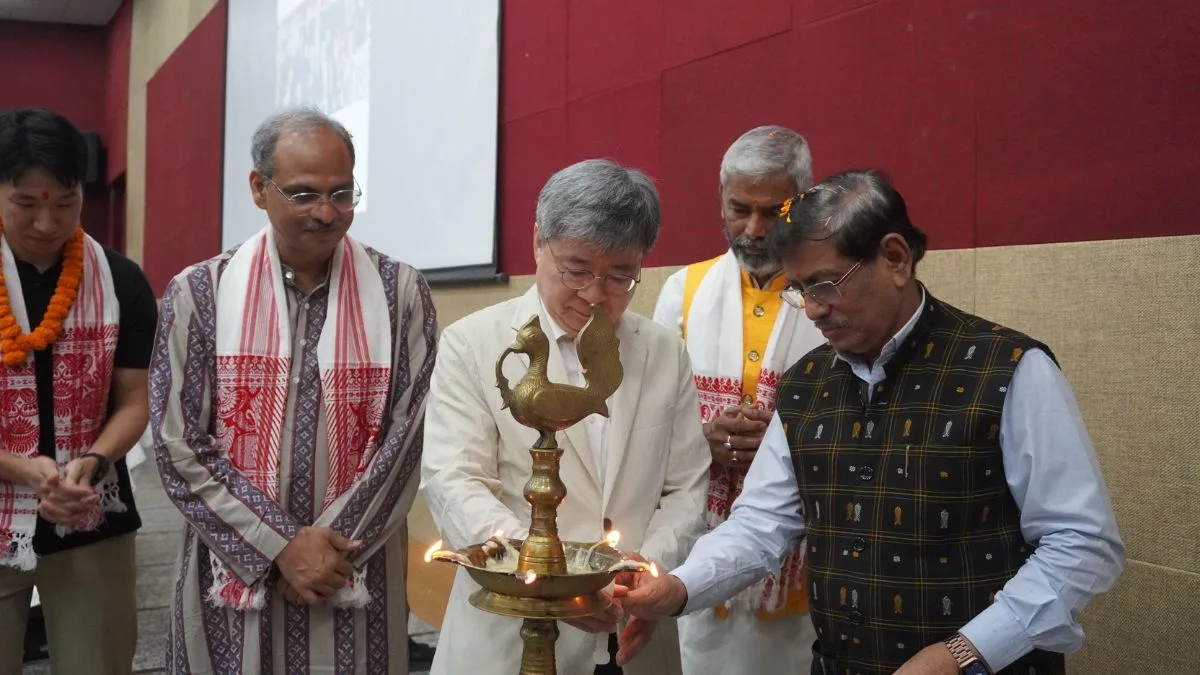
In a unique confluence of education, diplomacy, and cultural exchange, a group of 14 Korean software engineers from Samsung began an intensive eight-day training programme on Indian culture and the Hindi language at the Central University of Jharkhand (CUJ), Ranchi. The inauguration ceremony, held at CUJ’s auditorium, marked not just the launch of a language course but a moment of deepening ties between India and South Korea.
The event was graced by Jal Yodha and Padma Shri awardee Uma Shankar Pandey, senior journalist and analyst Harsh Vardhan Tripathi, Korean professors Yi Young Lee and Koh Tae Jin from Hankuk University, and CUJ Vice Chancellor Prof Kshiti Bhushan Das.
Advertisement
The Indo-Korean initiative underlines how soft power and cultural diplomacy can play a pivotal role in fostering international goodwill. This partnership between Samsung and CUJ is not merely academic; it is symbolic of the growing Indo-Korean relationship that extends beyond trade and technology to embrace culture, heritage, and language.
Prof Das, in his presidential address, emphasised CUJ’s growing global vision: “Through initiatives like these, CUJ is not just educating—it is connecting nations. Our commitment is to make Jharkhand a global cultural and educational hub.”
The programme centres around immersive Hindi language training, cultural workshops, and field visits to iconic tribal and natural heritage sites. Prof Shreya Bhattacharjee, Dean of the Language Faculty, highlighted that “language is a living medium of empathy. Teaching Hindi to Korean professionals is our contribution to global friendship.”
Professors Yi Young Lee and Koh Tae Jin, fluent in Hindi, captivated the audience with their eloquence. “We come here every year and each time we take back a deeper understanding of India’s soul,” said Prof Lee.
This collaboration is also a shining example of corporate social responsibility in action. Samsung’s continuous commitment to sending employees for cultural training reflects a progressive, human-centric corporate ethos. By partnering with CUJ, the company is not only investing in human capital but also intercultural sensitivity—a key requirement in an interconnected global economy.
Chief guest Uma Shankar Pandey, noted for his work in water conservation, took the opportunity to link cultural understanding with environmental responsibility. “Culture isn’t just about language and tradition—it’s about our relationship with nature. Water, as a shared concern for all humanity, must become central to global dialogue,” he said. He encouraged CUJ to take a leadership role in research and activism related to water sustainability.
Harsh Vardhan Tripathi, in his thought-provoking address, urged students and faculty alike to become agents of transformation. “If we want India to be a developed nation by 2047, we must draw lessons from our civilizational values and apply them with a futuristic vision. This initiative is one such step where we open our minds and hearts to the world.”
The programme also gives the visiting engineers an immersive experience of Jharkhand’s tribal culture, natural beauty, and mineral wealth. Visits are planned to Patratu Lake, Birsa Munda’s ancestral village in Khunti, and local tribal cultural sites. The curriculum includes not only spoken Hindi but also technical terminology relevant to their workplace needs.
During their stay, the Korean participants will also interact with CUJ’s Korean language students, creating a vibrant exchange of perspectives.
This initiative, launched from a state often underrepresented on the national stage, is positioning Jharkhand as a centre of international cultural exchange and academic collaboration. Through its vision and execution, CUJ is proving that global education doesn’t need to originate in metros—it can emerge from mineral-rich heartlands too.