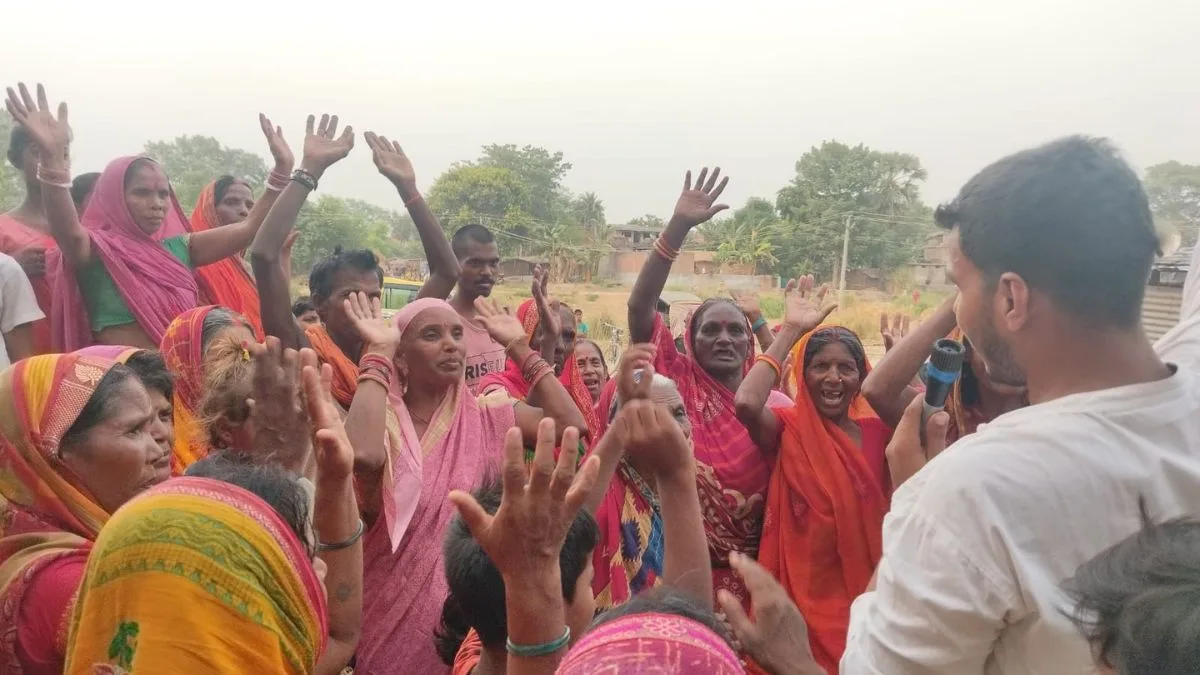
Bihar’s political landscape has seen some dramatic reshaping. This is not because of a candidate, definitely not by a manifesto, but by the quiet yet powerful presence of women at the ballot box. The first phase of the state assembly elections on November 6 saw an unprecedented surge in female voter turnout. Across 18 districts, barring Patna, women consistently outnumbered men at polling booths.
In districts like Samastipur, Madhepura, Muzaffarpur, the participation of women crossed the 76 percent mark. Samastipur registered 77.42 percent, Madhepura 77.04 percent, and Muzaffarpur 76.57 percent. Saharsa and Gopalganj also recorded a strong showing. The latter two witnessed over three-fourths of women voters coming out to exercise their democratic rights.
Advertisement
But on the other side, urban and semi-urban constituencies in Patna and Nalanda saw relatively lower female engagement. The turnout was 57.8 percent and 60.93 percent respectively. Yet the sheer volume of women voters reflected their growing electoral significance.
Overall, Bihar recorded a robust 65.08 percent voter turnout, which the Election Commission termed the “highest ever” in the state’s history. This is not merely a statistic. It is an indication of the increasing political agency of women, who now form a decisive voting bloc in one of India’s largest assemblies.
The gender gap
A closer look at the numbers reveals gender disparities. In Gopalganj, 76 percent of women voted compared to just 58 percent of men. This created a 17.71 percent gap. Darbhanga reported a similar pattern. Nearly 71 percent of women cast their ballots against 56 percent of men. Madhepura followed with 77.04 percent female participation versus 62.8 percent for men. Several other districts including Saharsa, Samastipur, Siwan, and Khagaria, also saw women outnumber men by more than 10 percent.
Women-centric policies
The Bihar government has long leveraged gender-focused welfare schemes to build trust among women voters. Chief Minister Nitish Kumar’s administration in particular has emphasized programs from education to financial inclusion and social protection.
The Mukhyamantri Balika Cycle Yojana for instance provided bicycles to school girls. Free school uniforms and supplies further lowered barriers to education. Meanwhile, the state’s liquor prohibition policy of 2016, though controversial, earned approval among many women who experienced reduced domestic alcohol-related abuse.
The latest entrant Mukhyamantri Mahila Rojgar Yojana appears strategically timed. Launched on August 29, just weeks before the elections, it provides Rs 10,000 to one woman in every family as seed money to start small businesses. Over one crore women have already benefited from the scheme.
Interestingly, NDA is reinforcing the idea of financial inclusion in the state. The proportion of women with bank accounts surged from 26 percent in 2015-16 to 76 percent in 2019–20.
Women as voters vs women as representatives
Women’s active participation in elections is not new to Bihar. But the gap between voting power and political representation remains stark. In the 2020 assembly elections, women’s turnout was 59.7 percent, higher than men’s 54.7 percent. Yet only 26 women were elected to the 243-member assembly, just over 10 percent.
Political strategies: NDA vs Mahagathbandhan
The current electoral battle has seen parties aggressively target women voters recognizing their growing influence. For the ruling NDA, financial schemes such as the Mukhyamantri Mahila Rojgar Yojana are part of a broader gender-focused strategy. The goal also puts forward the idea of creating one crore ‘Lakhpati didis’ in the state. This means women would be able to earn over Rs 1 lakh annually through self-employment.
The opposition Mahagathbandhan, meanwhile, has chosen a different approach: direct cash transfers and employment promises. Its Mai Bahin Maan Yojana pledges a monthly stipend of Rs 2,500 for women from backward and deprived sections and a one-time deposit of Rs 30,000 in their accounts by January 14 if voted to power.
Furthermore, the alliance has proposed making Jeevika self-help group workers permanent government employees with a monthly salary of Rs 30,000 and setting up women’s colleges in every sub-division.
Past experiences from other states suggest how women-centric policies can dramatically sway these electoral outcomes. Ladli Behna Yojana in Madhya Pradesh offered each woman Rs 1,250 per month. This helped the BJP increase its vote share in the state. From 41.1 percent in 2018 to 50.2 percent in 2023, the turnout was quite significant for the ruling party. They won 163 of 230 seats. In Maharashtra, the Ladki Bahin Yojana contributed to the NDA recovering from a 0.5 percent deficit in the Lok Sabha elections. This reached to a 14 percent lead in the state assembly polls.
A calculated move
Maharashtra and Madhya Pradesh suggest that well-timed pre-poll schemes can yield a 6-9 percent boost in vote share.
However, the challenge for all parties is not just to attract women voters. They have to convert their support into sustainable political engagement. While schemes definitely provide immediate incentives, long-term trust requires consistent governance, some tangible improvements in women’s livelihoods, and real opportunities for participation in decision-making.
Beyond the ballot
Bihar’s policies over the past decade have gradually shifted the role of women from passive participants to active stakeholders in governance. The 50 percent reservation in panchayats has brought thousands of women into grassroots leadership roles like mukhiya, sarpanch, and panchayat samiti sadasya. However their husbands and sons working as de-facto representatives calls for another broader discussion.
Schemes are vital but broader cultural shifts, affirmative action policies, political mentorship, and systemic support are essential to ensure that women not only vote but also govern.
Phase two and beyond
As Bihar heads into the second phase of polling on November 11, it will cover 122 assembly constituencies. All eyes will remain on women voters. Will the momentum from the first phase carry forward? Can pre-election schemes influence outcomes in key districts with tight margins? The answers could determine not just the immediate composition of the assembly but also the future trajectory of women’s political engagement in Bihar.
One thing is clear. Women are no longer a peripheral force in Bihar politics. They have become the deciding factor, and the silent yet decisive wave shaping electoral outcomes. In a state where margins have historically been razor-thin; in 2020, the NDA won by just 0.03 percent, the women’s vote could very well be the decisive factor.