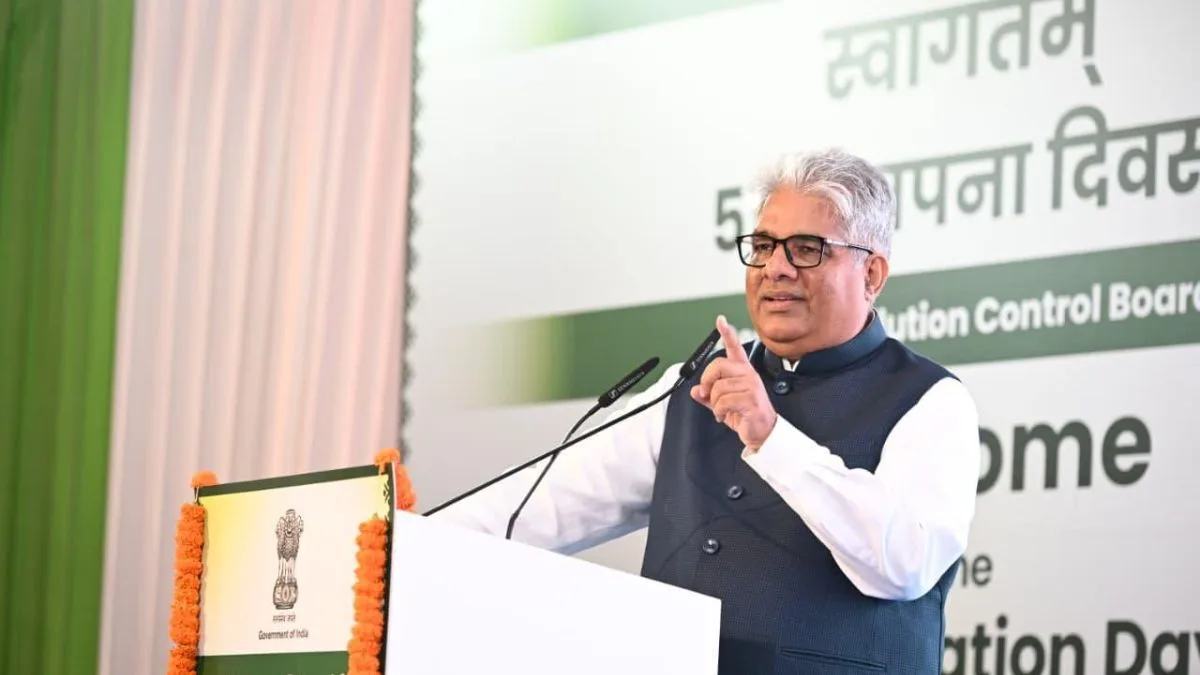
Union Minister for Environment, Forest and Climate Change Bhupender Yadav on Monday urged greater collaboration with IITs, reputed academic institutions, and leading research bodies to develop new technologies and expand environmental laboratories across India.
“We need to come out with new low-polluting alternatives and cleaner technologies for strengthening Make-In-India, along with ensuring wider availability of these technologies,” Yadav said while addressing an event organised on the occasion of 51st Foundation Day of Central Pollution Control Board (CPCB) in New Delhi.
Advertisement
Extending greetings to CPCB employees on the occasion, Yadav lauded the Board’s credibility over the past five decades, noting that its reports are trusted by both courts and citizens of the country.
Addressing the gathering, the Minister said as the country moves towards the goal of becoming a 5 trillion-dollar economy, with the roll-out of historic GST reforms to be implemented from today, there is a need to evolve environmental regulations and norms so that “economy and ecology go hand-in-hand”.
He underlined the CPCB’s critical role in building the capacity of state pollution control boards and agencies, calling for it to serve as the umbrella body and mentor on environmental matters nationwide.
Reflecting on the recent reforms brought out by the Government of India in form of the Jan Vishwas Act, 2023 (decriminalizing provisions) and Environment Audit Rules, 2025, the Minister emphasised that rules and regulations made by the Government cannot succeed without behavioural change.
“Environmental protection should be part of our collective consciousness,” he said, adding that linking social sciences with science and technology is essential to instill such change.
During the event, Yadav laid the foundation stone of CPCB’s new building. Additionally, two new laboratories at CPCB’s Regional Directorates in Pune and Shillong were inaugurated.
These facilities are equipped to monitor up to 70 and 62 environmental parameters respectively, and would respectively serve Maharashtra and the North-Eastern states of Manipur, Assam, Meghalaya, Nagaland, Arunachal Pradesh, Mizoram, Tripura and Sikkim.
The updated SAMEER App (Version 2.0) was also launched, featuring a user-friendly interface, personalized alerts, location-based services, and improved citizen engagement. The app will be available on Android and iOS platforms.
The Minister also distributed offer letters to 13 new recruits to various posts during the occasion as part of CPCB’s efforts to strengthen its workforce.
In addition, a technical report titled ‘Classification of Polluted River Stretches, 2025’ was released, based on national water quality monitoring data. Further, a manual titled ‘Identification of Non-Polluted and Polluted Stretches and Water Bodies through Freshwater Benthic Macroinvertebrates in India’ was also released by the Minister.