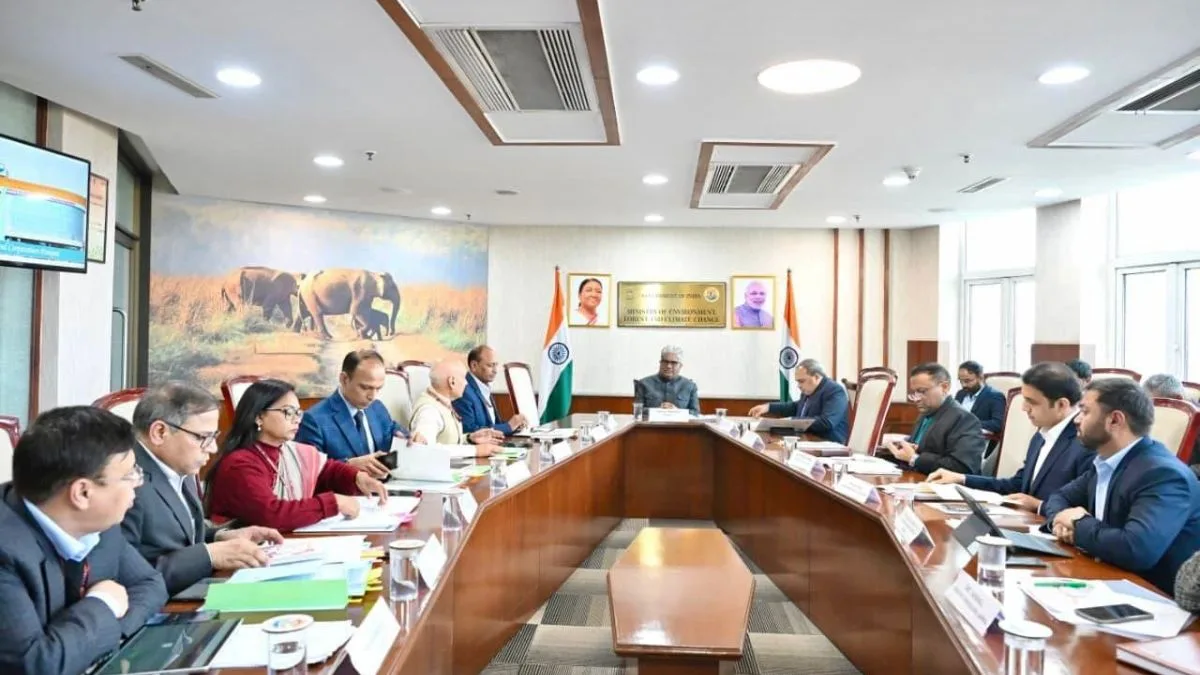
Union Minister for Environment, Forest and Climate Change Bhupender Yadav on Tuesday emphasised that all NCR cities should be brought under the National Clean Air Programme (NCAP) framework.
Chairing a high-level review meeting on the Action Plans of Rohtak, Manesar, Panipat and Karnal for tackling air pollution in these National Capital Region (NCR) cities, Yadav expressed concern over the high levels of PM10 and the persistent issues related to solid waste management, including construction and demolition (C&D) waste, particularly in industrial areas.
Advertisement
He informed that a meeting with Haryana Chief Minister Nayab Singh Saini would be convened to address these concerns, including matters related to funding and approvals, on priority.
Reviewing the presentations made by the authorities concerned, the minister called for the compilation of comprehensive data on industries operating with and without Consent to Establish (CTE) and Consent to Operate (CTO).
He directed officials to issue instructions to all District Magistrates/District Collectors in NCR to collect data on CTO/CTE permissions, total commercial electricity connections, and industrial units with GST registration. These datasets are to be correlated to identify illegally operating and non-compliant industrial units, particularly with respect to OCEMS and Air Pollution Control Device (APCD) installations.
The Minister further called for increasing the number of automated Continuous Ambient Air Quality Monitoring Stations (CAAQMS) integrated with the SAMEER App to enable real-time air quality monitoring.
He stressed the need for rigorous awareness generation among stakeholders whose activities contribute to pollution.
He observed that smaller municipal corporations should be provided with appropriately sized commercial electric vehicles for public transport, keeping in view road width and passenger footfall.
During the meeting, augmentation of public transport facilities was emphasised. The use of Mechanical Road Sweeping Machines (MRSMs) and handheld litter pickers was also stressed, with directions that only EV/CNG-based machines be procured under the Op-Ex model.
Under dust control measures, directions were issued for plantation of local bush varieties in open spaces and on pavements, along with real-time repair of potholes.
The Minister also called for submission of short-term and long-term smart traffic management plans for all the reviewed cities to reduce congestion and vehicular emissions. It was directed that C&D waste collection facilities be established in a 5 km by 5 km grid, mapped with the nearest waste processing facility.
The Minister directed officers to take ownership of the issues and demonstrate strong on-ground leadership to address the prevailing challenges through innovative and realistic solutions, while actively involving local stakeholders.
Actionable points emerging from all presentations across NCR cities will be compiled, and real-time monitoring of action taken will be carried out by the CAQM.
Targeted actions and fixing of responsibility will be undertaken at regular intervals, with the objective of achieving at least a 15–20 per cent reduction in AQI levels across NCR by 2026.