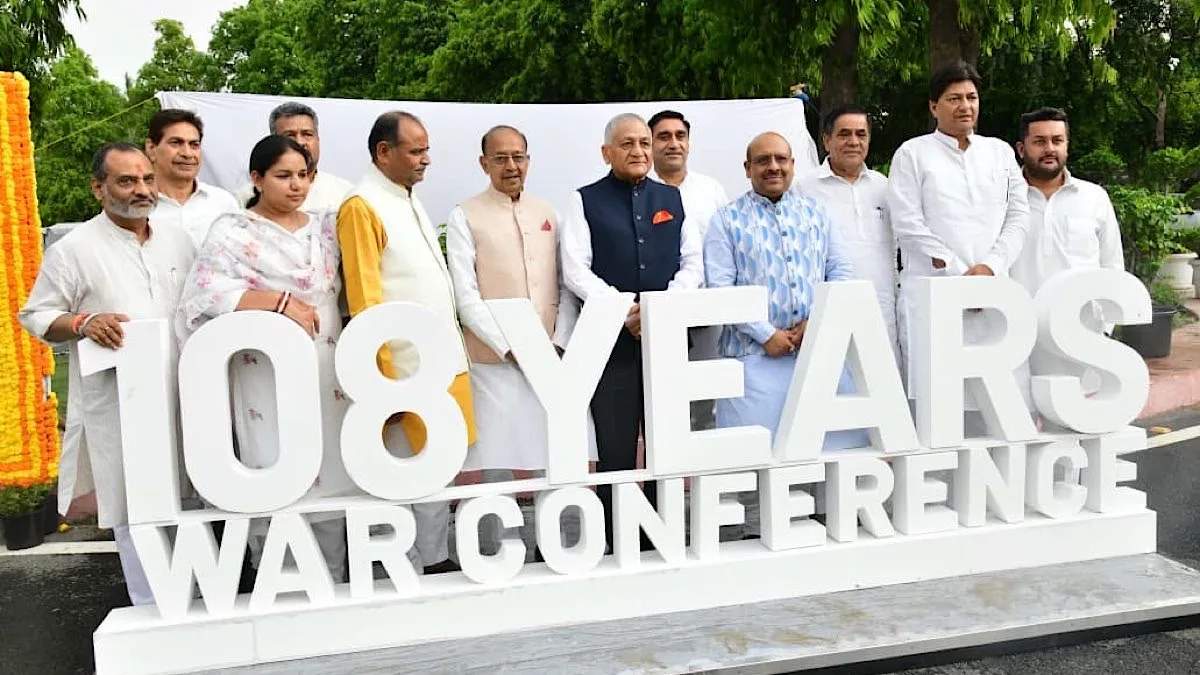
“A soldier does not fight for reward, but for duty, honour, and the belief that his sacrifice will serve the nation,” said Mizoram Governor General (Retd) Dr. Vijay Kumar Singh on Thursday said while addressing a gathering at Delhi Vidhan Sabha on the 108th anniversary of the War Conference (Yudh-Sammelan).
Speaker of the Delhi Legislative Assembly Vijender Gupta presided over the programme with the theme “Pratham Vishvayudh aur Bharat”.
On the occasion, Singh released a commemorative book “Proceedings of the War Conference held at Delhi 27th-29th April 1918”.
Advertisement
Speaking on the legacy of Indian soldiers, he reflected on the immense yet often under-recognized contribution of Indian troops in global conflicts. He noted that over 1.3 million Indian soldiers participated in World War I, with nearly 74,000 laying down their lives, whose names are commemorated at the India Gate.
He emphasized that these sacrifices went beyond manpower, encompassing financial support, logistics, and resources, highlighting India’s significant role despite being under colonial rule.
He pointed out that traditions of remembrance in the Commonwealth of Nations reflect the respect accorded to these soldiers globally, even if their contributions have not always received due recognition within India.
He underlined that Indian soldiers had fought with a deep sense of duty and honour, drawing inspiration from the philosophy of the Bhagavad Gita, not for personal gain, but for the honour of their units and the hope that their efforts would benefit the nation.
Highlighting India’s global military legacy, the Governor pointed to the role of Indian forces in theatres such as Europe, East Africa, and the Middle East, including the historic liberation of Haifa, commemorated at Teen Murti Haifa Chowk.
Speaking on the occasion, Speaker Gupta said, “A nation that does not preserve its records loses its memory, and a nation that loses its memory loses its direction.
The speaker highlighted the immense historical significance of the Assembly premises, noting that the very hall once hosted the War Conference of 1918 convened by Lord Chelmsford.
Recalling that Mahatma Gandhi was present in the same chamber, he described the transformation of the site from a symbol of colonial authority to a forum of democratic expression as one of the greatest achievements of India’s freedom struggle.
He underscored that the 1918 conference reflected both trust and betrayal, as India extended full support to the British during World War-I in the hope of attaining self-governance.
Paying rich tributes to the soldiers, Gupta emphasized that their courage and commitment form a foundational chapter in India’s journey to independence.
He noted that while history may not have fully acknowledged their contribution, it is the responsibility of present generation to preserve and honour their legacy.
Addressing the gathering, Vice Chairman of Gandhi Smriti and Darshan Smriti, Vijay Goyal reflected on the historical and institutional legacy of the Delhi Legislative Assembly, noting that it once functioned as the Imperial Legislative Council.