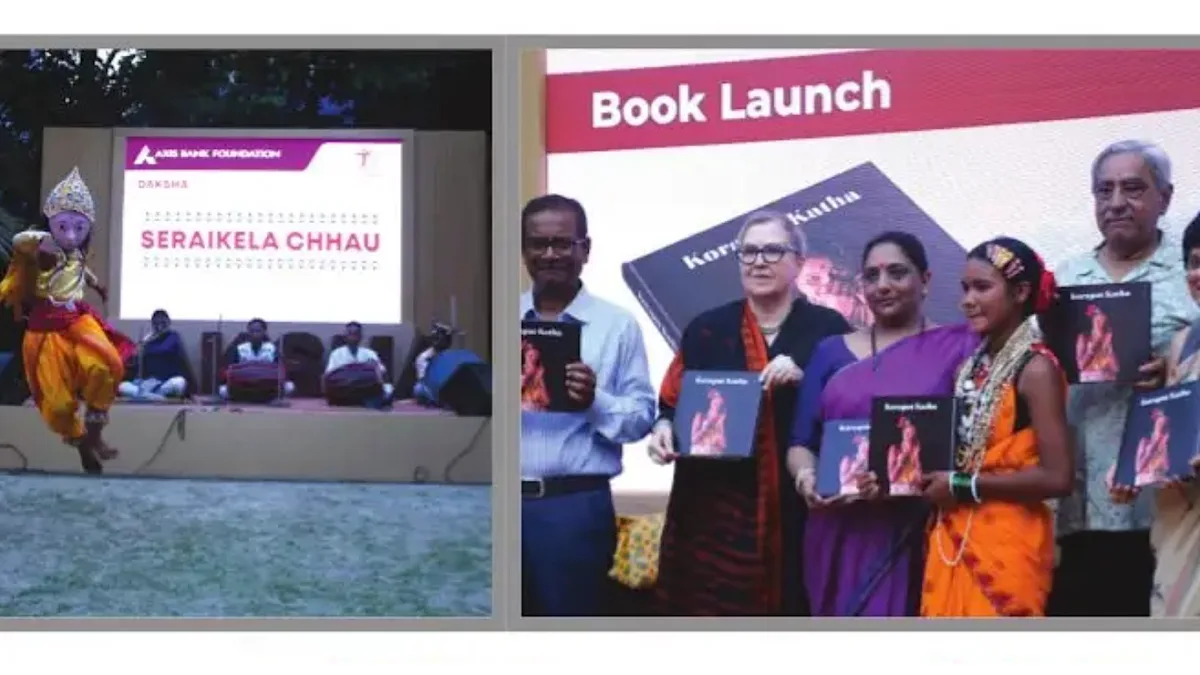
The project is titled Crafting Voices. It is not simply a static exhibition of heritages, but a negotiation ground that acknowledges that for crafts from Odisha, Jharkhand, and West Bengal, adaptation to changing conditions is an essential process for survival. As a matter of fact, according to curator Swarup Dutta, Daksha is primarily about a specific kind of dexterity, which involves thinking and making at once. As Swarup Dutta puts it, “Daksha is about a certain dexterity not only of the hand, but of the mind. The material can be of thought as much as it is of craft.”
The theme of survival surfaces in several layers throughout the exhibition. In areas like Uttar and Dakshin Dinajpur, there have been notable changes within the weaving practices associated with back straps, which were traditionally practiced on the basis of producing jute goods for subsistence purposes. The move from jute to cotton and the creation of new products such as bags and accessories demonstrate a clear change in the approach towards marketability. These shifts represent more than just cosmetic adjustments – they are deliberate strategies devised in response to economic uncertainty.
Advertisement
Likewise, in the Earth Woven in Thread exhibit, the fabrics woven using the traditional method of Kotpad, which are distinguished by their Geographical Indication stamp and produced using natural colours extracted from the aal root, are presented as a testament to survival in the face of adversity. While their vivid hues of red and brown embody the ecological wisdom of ancient traditions, their appearance in modern contexts indicates that survival entails making choices about what to preserve and what to adapt to changing times. In other contexts, Threads of Memory recasts Kantha embroidery as an activity grounded in experience.
Rooted in the historical practices of Bengali women, Kantha creates stories in fabric through stitching techniques. The items showcased in this exhibition cushions, clothing, and panels can be seen as silent repositories of memories of home, perseverance, and nurturing. In this context, survival becomes not only economic but also cultural: not only are memories stored, but they are constantly inscribed anew. However, Daksha does not present these activities as standalone practices. Rather, it places them within an ecosystem of exchanges that involve a network of designers, organizations, and city markets.
For instance, collections like Monochrome Modern, curated by Swarup Dutta, Noyanika Ray, and Sanjita Sarkar, reflect this dynamic. Taking cues from modern design techniques involving geometrical forms, repetition, and negative spaces, the collection recasts hand-woven textiles in a strikingly modern way. Nonetheless, such an initiative is not without its concerns. Questions must be raised regarding issues of authorship, translation, and power dynamics involved. How does one direct the process of adaptation? What are the gains made through visibility and access to markets and what may be lost in translation? In the case of Daksha, these opposing elements are in perfect balance.
Spatial considerations in the exhibition also highlight the complex story told at Daksha. In a setting that includes rough jute backdrops and gentle lighting, clothes and other items are displayed sparingly. This leaves room for emphasis on material aspects of the craft, as can be seen through manne quins draped in hand-woven ensembles with asymmetric designs and natural colors. However, at Daksha, beyond physical objects, there is more space devoted to performance practices that fall under Rhythms of Living Traditions. Examples include dances such as Seraikela and Mayurbhanj Chhau and musical traditions like Baul music and Chadar Badar puppetry, as well as various Koraput folk traditions. They are not side elements but part of the whole story.
As Dutta mentions, “What you see here are not final products, but moments of a longer journey”. This focus on the process is very important. Every piece comes into being through an ongoing interaction between the craftsman and the designer, the tradition and the experimentation, the local culture and the market pressures. This is exactly the essence of Daksha; it recognizes the fact that survival is not only difficult but also complicated. It not only means sustaining the existing traditions but also adapting to changing situations and compromising where necessary.
In this context, Crafting Voices refuses to portray craft as timeless and perfect. Rather, it emphasizes its vulnerability and most importantly its resilience. Survival at Daksha 2026 does not mean preserving the traditional craft in its originality. It means keeping it alive in whatever way possible. Craft does not remain static here but it adjusts and endures one stitch at a time.