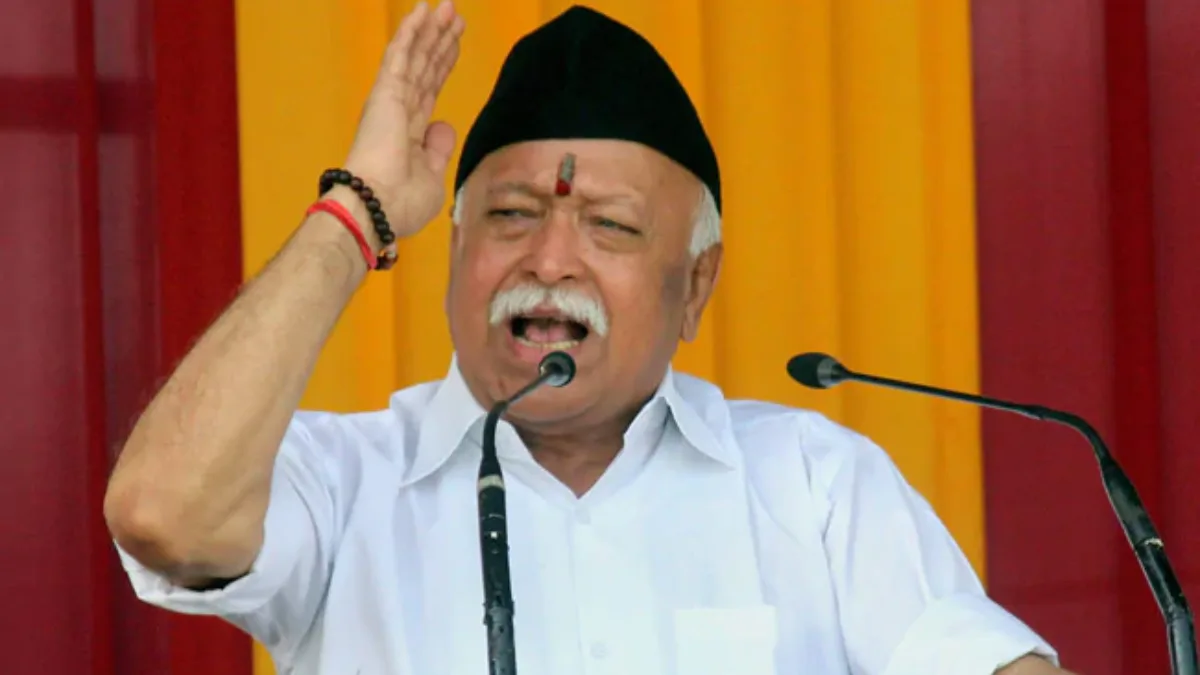
Rashtriya Swayamsevak Sangh (RSS) Sarsanghchalak, Dr Mohan Bhagwat’s two-day tour of Assam, part of the organisation’s year-long centenary celebrations, concluded on Wednesday with a message that was both civilizational and contemporary. At a time when the political discourse is saturated with noise, labels, and motivated narratives, Bhagwat’s visit served as a reminder that the idea of Bharat is far older, deeper, and more cohesive than what many modern commentators reduce it to.
Addressing a distinguished gathering of scholars, writers, editors, entrepreneurs, and cultural thinkers, Dr Bhagwat articulated the Sangh’s long-held and often misunderstood belief: Hindu is not merely a religious category but a civilizational identity rooted in thousands of years of cultural memory and collective consciousness. “Anyone who takes pride in Bharat and loves this nation is a Hindu,” he stated, cutting through decades of misrepresentation. For him, “Bharat and Hindu are synonymous,” and therefore, India does not require any externally proclaimed status of a “Hindu Rashtra”; its living civilization already embodies it. This expansive interpretation, one that includes every community that sees Bharat as its home and civilizational continuum, contrasts sharply with the reductionist lens that some intellectual circles project. In a state like Assam, where cultural heritage runs deep through the legacies of Srimanta Shankardeva, Lachit Borphukan, and the many indigenous traditions that enrich the national mosaic, the Sangh chief’s words carried special resonance. Dr Bhagwat revisited the core philosophy of the RSS: Vyakti Nirman, or individual character-building.
Advertisement
The RSS was not founded to oppose anyone, he emphasised, but to build men and women committed to national upliftment. Those who seek to understand the Sangh, he urged, should visit a Shakha instead of relying on inherited biases. “The methodology to unite Bharat amidst diversity is called the RSS,” he remarked, an idea that goes against the caricature often drawn by political adversaries. He reminded the audience that the contribution of RSS Swayamsevaks to the freedom struggle is neither recent nor revisionist.
From Dr Hedgewar’s imprisonment during the Non-Cooperation and Civil Disobedience Movements to the participation of countless volunteers in the Quit India Movement of 1942, the Sangh’s role has long b e e n interwoven with the nation’s march toward independence. When speaking of the Northeast, Bhagwat described it as a “shining example of unity in diversity,” where cultural plurality is not a source of conflict but an expression of deeper unity. In Assam’s case, demographic anxieties and cultural vulnerabilities remain pressing concerns, and the Sarsanghchalak addressed them directly. He reiterated the need for vigilance against illegal infiltration, a long-standing existential question for Assam, and spoke of the necessity for a balanced population policy, including a three-child norm for Hindus.
He highlighted the corrosive impact of aggressive religious conversions and urged communities to remain firmly rooted in their identity and land. Social media, he noted, is a double – edged sword , particularly for youth. While it empowers, it also misinforms, divides, and distracts, making responsible engagement vital. Central to Bhagwat ’s message were the five social transformations: Panch Parivartan (social harmony, Kutumb Prabodhan (strengthening of the family), civic discipline, self-reliance, and environmental protection. Of these, he placed particular emphasis on restoring the integrity of the family as a cultural institution. Families, he argued, should preserve ancestral stories and instill pride and responsibility in younger generations, an antidote to rootlessness. At a youth conclave on 19 November, Dr Bhagwat’s message became sharper. He appealed to young people not to form opinions about the RSS based on propaganda. Nations rise only when societies rise, he said, and societies become strong only when they invest in unity and excellence.
Citing the history of developed nations, he reminded the audience that their first century of growth was built on strengthening their internal social fabric. Bharat, too, must evolve in this direction, and the RSS’s centenary theme of Panch Parivar tan reflects this philosophy. With a direct appeal to place “India First ,” he encouraged young people to engage with RSS activities as per their capacity, time, interest, or ability. The Sangh, he asserted, is not an external organisation but an inseparable part of society itself. In the Northeast, he noted, the RSS’s groundwork is steadily becoming stronger, aligning with its broader civilizational mission. Dr Bhagwat’s Assam visit underscored a simple yet powerful truth: Bharat’s strength lies not in political labels b ut in a shared civilizational identity that transcends the divides of language, region, and faith. His message to remain rooted, vigilant, united, and confident resonates deeply in a region that has long been at the forefront of cultural resilience and national integrity.
(THE WRITER IS A TECHNOCRAT, AUTHOR, AND POLITICAL ANALYST FROM ASSAM)