Defining modern economics
An Inquiry into the Nature and Causes of the Wealth of Nations by Adam Smith (1723-90) was published on 9 March 1776. It met with instant success.
Classical economists, Adam Smith and David Ricardo, had laid the intellectual foundations for this assumption much earlier with their theories of absolute and comparative advantage, showing how nations benefit from specialising and trading rather than competing.




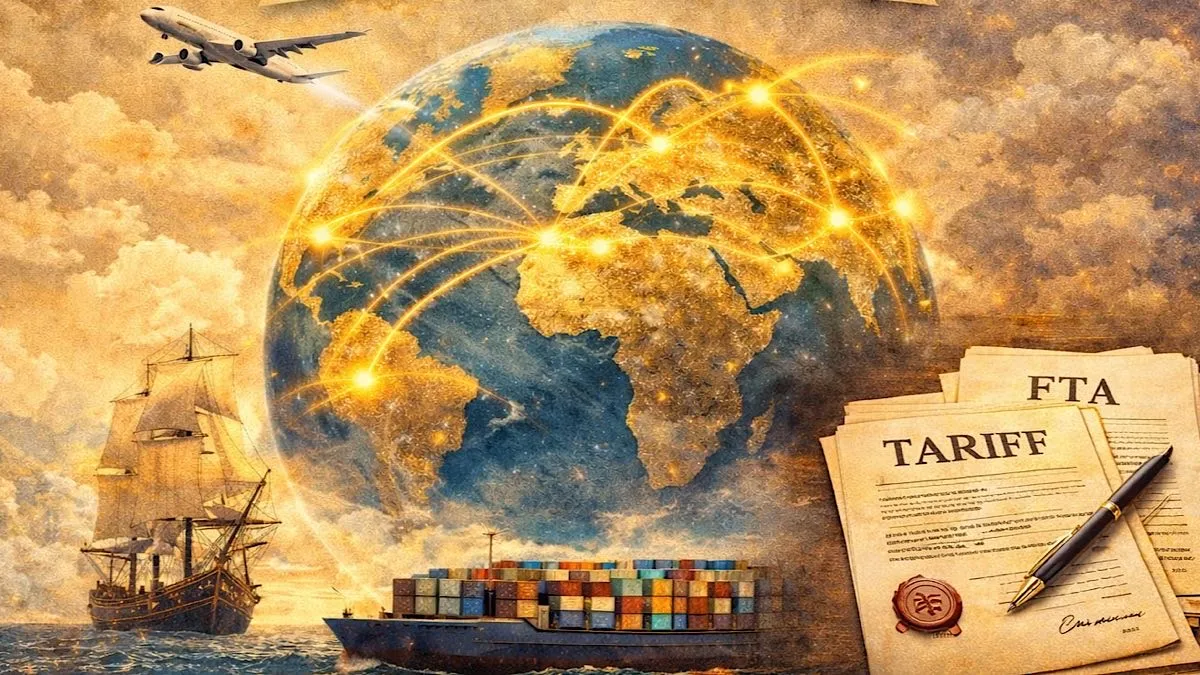
Photo:SNS
In his book The Great Illusion, Norman Angell, argued that war in the industrialised era was an “economic impossibility”. A century later, Thomas L. Friedman echoed this idea with a more recent analogy when he wrote in The New York Times in 1996 that “no two countries that both have a McDonald’s have ever fought a war against each other.” Both statements were based on the same assumption that economic interdependence between nations is likely to create peace.
Classical economists, Adam Smith and David Ricardo, had laid the intellectual foundations for this assumption much earlier with their theories of absolute and comparative advantage, showing how nations benefit from specialising and trading rather than competing. Thus, the idea of Doux commerce slowly became a central pillar of the liberal international order.
Today, the pillar is showing signs of weakness.
Advertisement
Trade and international finance are going through major churns as they are increasingly being used as tools of coercion rather than acting as a force that binds nations together. A striking example is the recently advanced Sanctioning Russia Act of 2025, a bipartisan U.S Senate bill that would enable tariffs of up to 500% on countries that purchase Russian oil, gas or uranium. It is a measure that will not only choke Moscow’s revenue but also threaten its partners such as China and India. Recently, U.S. political leadership also threatened escalation of tariffs on multiple European NATO members unless Greenland is effectively brought under U.S. control, triggering sharp pushback from EU leaders, warning that such coercive actions would “undermine transatlantic relations and risk a dangerous downward spiral”[1]. These developments show how economic interdependence that once was seen as a tool for peace has now become a weapon for economic siege warfare. Compounding this are the geopolitical instabilities in countries like Venezuela and Iran, where foreign economic interests have led to internal crises, further undermining the role of economic linkages as a path to peace and stable global governance.
Advertisement
So what next?
Should countries go back to autarky, adopt protectionist and inward-looking policies or should international governance structures be strengthened to ensure that the rules of trade and economic interdependence are not unilaterally violated?
Post Covid, the terms “de-globalisation” and “re-globalisation” dominated many international forum debates as countries started moving towards greater self-sufficiency in energy resources and food. The pandemic, coupled with rising geopolitical tensions, exposed vulnerabilities in global supply chains, prompting a shift towards security and resilience. This led to the re-shoring of supply chains and the formation of new economic partnerships, signalling a transformation in the architecture of global economic integration.
Closer home, in recent years, India has sought to recalibrate its position within the global economy by pursuing a series of free trade agreements alongside domestic initiatives such as Make in India and Atmanirbhar Bharat. These efforts reflect a dual objective: to deepen international economic engagement while simultaneously enhancing domestic capabilities. Over the past decade, India has concluded significant economic partnerships with countries including Mauritius, the UAE, Australia, EFTA, the UK, and Oman, and most recently finalised an FTA with New Zealand in December 2025. These agreements signal a strategic attempt to broaden export opportunities and reinforce India’s role in an evolving international trade landscape.
Complemented by domestic trade policy realignments focusing on export-oriented quality manufacturing, supply chain resilience, attracting foreign direct investments and boosting MSME and startup ecosystem in India, India has balanced liberalisation with self-reliance and protection of security and economic needs. Further, long awaited India–EU Free Trade Agreement, “Mother of all Trade Deals”, was also successfully concluded last week during the visit of EU leaders to India for Republic Day celebrations. These partnerships hold the potential to reshape India’s export landscape and decentralise trade concentration away from the US market.
It could be argued that the “great illusion” Norman Angell described was not that economic interdependence could not reduce conflict. Instead, it assumed that rationality would always win over territorial ambitions and the pursuit of power. However, a distinct shift in global order in recent years has been observed due to the weakening of economic interdependence as a tool for peaceful coexistence. International trade is now increasingly mixed with power politics, strategic rivalry, and coercion, turning economic ties from sources of stability into tools for geopolitical advantage.
Today, as countries reassess their economic relationships, the key question is not whether economic interdependence/globalisation must continue, instead the question is how these concepts need to be reshaped. Can international trade be managed in a way that balances openness with sovereignty, efficiency with resilience, and interdependence with trust? Or will the future see the world breaking into competing blocs with constant economic conflict? The answers to these questions are still unclear, but they will shape not only the future of doux commerce but also the prospects for stability and peace worldwide.
(The writer is a professional working at the intersection of economics, public policy, and international relations. The views expressed are personal.)
Advertisement