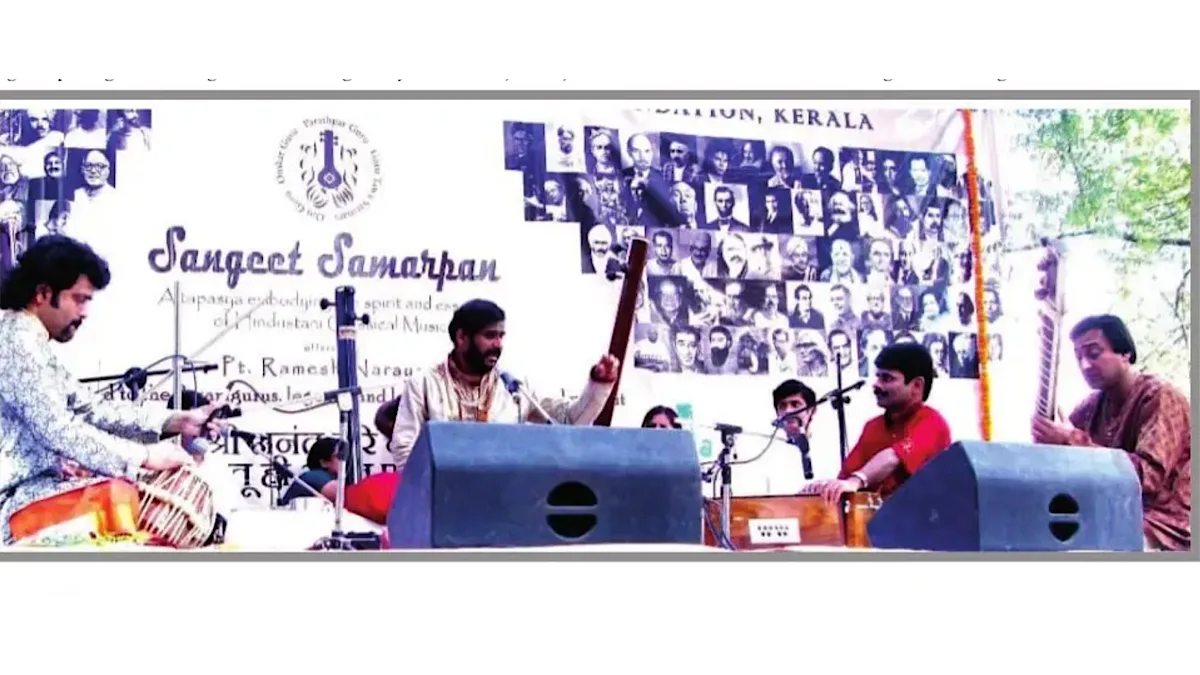
In an age of shrinking attention spans and algorithm- driven playlists, four Indian musicians chose endurance over instant applause, immersion over interruption. At a music festival in Pune, a remarkable ensemble of classical musicians etched their names into the Limca Book of Records by performing Indian classical music continuously for 36 hours, a feat as demanding spiritually as it was artistically.
The marathon performance was led by acclaimed musicians Pandit Ramesh Narayan, Pandit Aditya Narayan Banerjee, Sandip Banerjee and Kaustav Rana Sarkar, alongside few other accompanying artistes. Together, they created a seamless river of melody that flowed through changing hours, moods and ragas respecting the timeless grammar of Hindustani classical tradition. What made the p erformance extraordinary was not merely its duration, but its adherence to the ancient “Prahar” system of Indian classical music, where ragas are aligned to specific phases of the day and night.
Advertisement
As dawn dissolved into noon, and twilight deepened into midnight, the musicians altered ragas accordingly moving through meditative morning ragas, contemplative afterno on compositions and deeply evocative nocturnal renditions with effortless command. For the audience gathered in Pune, the experience was less a concert and more a spiritual continuum. At the rhythmic heart of the performance was Pandit Aditya Narayan Banerjee, one of India’s distinguished tabla exponents, known for accompanying the legendary Pandit Jasraj. Banerjee occupies a rare place in Indian musical history: he is the only Indian musician to have performed at the White House during the Diwali celebrations in the United States, a landmark moment for Indian classical music on the global stage.
Advertisement
His tabla playing, marked by precision, emotional depth and dazzling improvisation, has earned admiration across continents. Sharing the stage at Pune FTI, was sitar virtuoso Sandip Banerjee, whose intricate string work lent both serenity and dramatic flourish to the marathon recital. Equally adept in classical purity and contemporary collaborations, Banerjee has been performing extensively across Europe, North America and Asia, carrying the resonance of the sitar to diverse audiences.
Kaustav Rana Sarkar, noted music director, composer and arranger, added another dimension to the record breaking performance through his nuanced understanding of orchestration and musical transitions. Sarkar’s ability to bridge classical structures with modern sensibilities has made him a respected figure among younger audiences and global fusion circles alike. Besides the Pune performance, the ensemble by these musicians also, otherwise, features Amitaditya Sanyal and members of the musical collective “MuSix” comprising Pandit Aditya Narayan Banerjee, Kaustav Rana Sarkar, Sandip Banerjee and others, a group known for pushing the boundaries of collaborative Indian music while retaining classical authenticity. Together and individually, the artists have performed across prestigious venues worldwide, earning acclaim for their technical brilliance and innovative interpretations. Towering above the ensemble in stature and experience was Pandit Ramesh Narayan, the celebrated music director originally from Coimbatore, Kerala. Revered for his contributions to Indian music across genres, Narayan has won several national and international honours over the decades. His career reflects a rare blend of classical scholarship and cinematic sensitivity, making him one of the most respected names in contemporary Indian music. The 36-hour recital was not simply a record-breaking event. It was a reminder that Indian classical music remains a living, breathing tradition expansive enough to endure sleepless nights, shifting ragas and relentless rhythms, yet intimate enough to touch the human soul. In Pune, the musicians did not merely perform music. They inhabited time itself through sound.
Advertisement