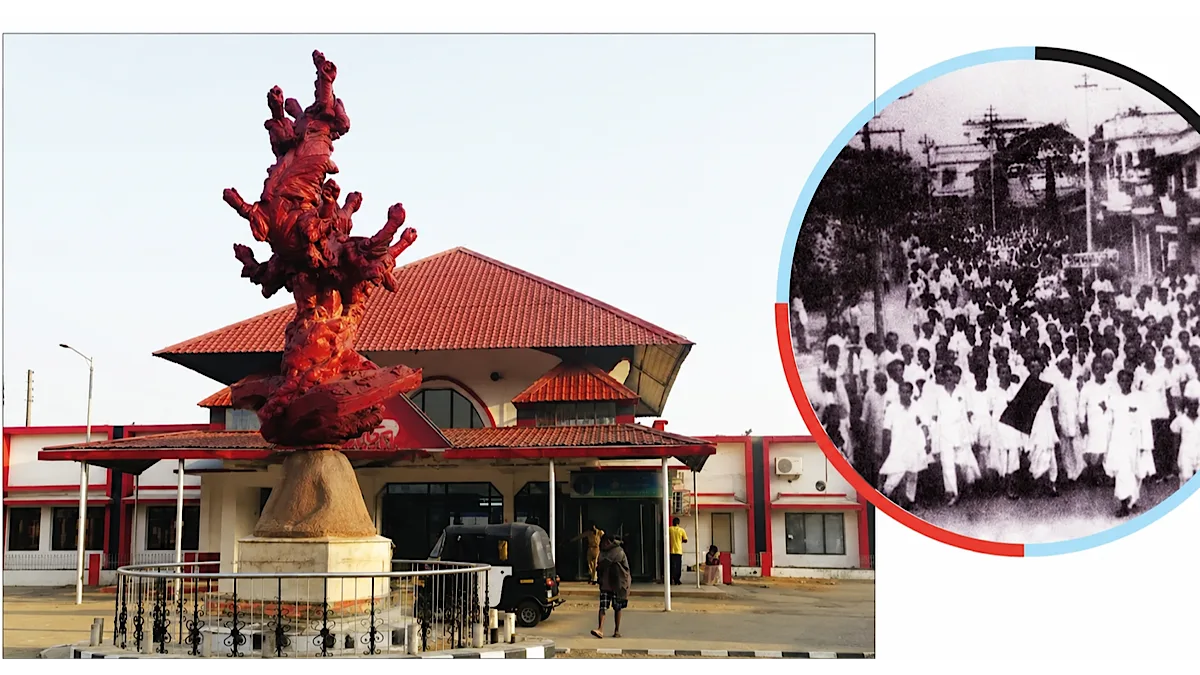
Tomorrow, on 19 May 2026, 65 years will have passed since 11 individuals attained martyrdom in Silchar. Kanailal Niyogi, Chandicharan Sutradhar, Hitesh Biswas, Satyendra Deb, Kumud Ranjan Das, Sunil Sarkar, Tarani Debnath, Sachindra Chandra Pal, Birendra Sutradhar, Sukamal Purakayastha, Kamala Bhattacharya ~ they were killed during a mass mobilisation demanding recognition for the Bengali language in Barak Valley, an episode that would go on to occupy a defining place in Assam’s linguistic history. Commemorated each year as Bhasha Shahid Divas, their deaths continue to resonate far beyond memorial observance, returning annually to illuminate unresolved anxieties regarding the politics of belonging.
The enduring afterlife of 19 May lies in the fact that the movement was never solely about language. In fact, it emerged from a historical moment in which language became inseparable from deeper contestations surrounding territory, migration and representation in postPartition Assam. In the decades following Independence, the question of linguistic identity in the state increasingly acquired an existential character. Refugee inflows from erstwhile East Pakistan profoundly altered the demographic imagination of the state, aggravating tensions surrounding indigeneity, cultural continuity and political marginalisation. The Assam Official Language Act of 1960, which advanced Assamese as the sole official language of the state, was thus interpreted in Barak Valley not merely as legislative reform, but as an assertion of cultural primacy.
Advertisement
The violence that unfolded in 1961 was therefore not an isolated rupture, but the culmination of a far deeper foundational unease. When viewed through the prism of the present, the past reveals an early articulation of insecurities that continue to permeate the region’s sociocultural consciousness. In Barak Valley today, linguistic identity persists as a layered site of negotiation, shaped simultaneously by inherited memory, citizenship discourse and the perception of cultural precarity within Assam’s larger political subconscious. Professor Arup Ratan Acharjee of Seth Anandram Jaipuria College, University of Calcutta, an eminent academician and independent researcher specialising in Assam’s sociology, situates the movement within a much longer continuum of political and cultural dilemmas in the state.
Advertisement
“The origins of Assam’s linguistic anxieties cannot be understood outside the demographic and administrative transformations initiated during the colonial period,” he observed, “with the consolidation of tea plantations and the expansion of the colonial bureaucracy, a huge number of Bengali-speaking officials from Calcutta came to occupy influential administrative positions, while successive waves of labourers and agrarian communities migrated into the province from undivided Bengal”.
“Over time, the visible concentration of administrative and economic influence within Bengali-speaking sections deepened insecurities among segments of the Assamese population, subsequently transforming language itself into a site of political contestation and civilisational assertion,” he added. Prof. Acharjee strongly argued that the insecurities that gradually accumulated across colonial and postcolonial Assam underlie the sentiments behind the Bongal Kheda movement, as linguistic identity became intertwined with Assamese apprehensions surrounding sociocultural preservation. Over the following decades, language evolved into a recurring site of identity negotiation, shaping broader conflicts surrounding legitimacy, territoriality and belonging within the state. By the mid-twentieth century, these inherited insecurities had begun to crystallise into organised linguistic assertion across Assam.
The Assamese Language Movement, which gained considerable momentum during the 1950s, reflected far more than a debate surrounding official communication alone ~ it embodied a broader desire to reclaim cultural visibility and administrative authority. The passage of the Assam Official Language Act in 1960 marked a decisive institutional expression of these anxieties. In Barak Valley, however, the legislation generated profound resistance among Bengali-speaking communities, who interpreted the move as an attempt at linguistic imposition and an encroachment upon their cultural legitimacy, ultimately triggering the counter-mobilisation that culminated into the violence of 19 May 1961 during Bimala Prasad Chaliha’s chief ministership.
“The recognition of Bengali in Barak Valley and Assamese in the Brahmaputra Valley addressed the institutional dimension of the linguistic conflict, but it left the problem of demographic transformation fundamentally unresolved,” Prof. Acharjee remarked. “The ruptures of 1971 and the massive refugee influx generated by the Bangladesh Liberation War further sharpened Assamese apprehensions surrounding territorial precarity, political visibility and the perceived erosion of indigenous authority”. Citing Diganta Sarma’s Nellie 1983, he pointed to the 1972 decision to shut down the Bengali Language and Literature Department at Gauhati University, which provoked protests among Bengalispeaking groups and led to the killing of SFI leader Bacchu Chakraborty during the agitation.
The episode, he suggested, reflected the continuing volatility of linguistic identity within Assam’s larger political landscape. By the late 1970s, the politics of linguistic insecurity in Assam had mutated into the far more expansive politics of the Anti-Foreigners Agitation, also widely recognised as the Assam Movement. Under the leadership of Prafulla Kumar Mahanta, who emerged as president of the All Assam Students’ Union (AASU) in 1979 and later became Chief Minister, the movement acquired unprecedented intensity. The period witnessed some of the most violent manifestations of anti-Bengali hostility in Assam, including episodes of ethnic violence and mass displacement in regions such as North Kamrup (1980), Goreswar (1983) and Khoirabari (1983).
In Goreswar particularly, nearly 50,000 Bengalis were repor- tedly forced to flee towards West Bengal amid escalating violence and intimidation, in what many continue to interpret as the Bongal Kheda Movement at its historical peak. The turbulence of the Assam Movement ultimately culminated in the signing of the Assam Accord on 15 August 1985, in the presence of then Prime Minister Rajiv Gandhi. Conceived as a historic settlement between the Government of India and the leaders of the agitation, the Accord attempted to impose closure upon a movement that had already witnessed years of violence, displacement and the reported deaths of more than 855 individuals.
The agreement accepted migrants who had entered Assam prior to 1 January 1966, while simultaneously providing for the detection and deportation of those arriving after 25 March 1971. It further mandated intensified border securitisation through fencing, patrol deployment and physical fortification along the Indo-Bangladesh border. In many ways, the Accord laid the foundations for the citizenship verification politics that would re-emerge through the NRC process decades later. Reflecting on the enduring politics of infiltration in Assam, Prof. Acharjee recounted a personal memory from his childhood in the late 1990s.
He recalled travelling through Karimganj with his father when a cycle-rickshaw puller admitted that although he worked in the town daily, he did not actually reside there, instead crossing over each morning from Sylhet in Bangladesh before returning at night through informal crossborder channels. This anecdote raises a larger question that continues to haunt Assam’s citizenship discourse ~ who precisely constitutes the real perpetrator within this system ~ the economically vulnerable migrant crossing the border, or the institutional and political apparatus that permits such movement to persist across generations? “The discussions have persistently fixated upon the migrant as the sole visible offender,” the professor noted, “while far less attention has been directed towards the administrative failures, political complicities and the networks that continue to enable such infiltrations.”
The tensions surrounding migration eventually re-entered Assam’s political centre through the updating of the National Register of Citizens (NRC), initiated under Supreme Court supervision between 2013 and 2019. Published on 31 August 2019, the final list included nearly 31 million names out of approximately 33 million applicants, leaving around 1.9 million individuals excluded from the register. The process reopened and further intensified Assam’s longstanding politics of identity. According to Prof. Acharjee: “Language and migration have repeatedly been weaponised within competing political narratives, particularly through the construction of Bengali-speaking populations as electorally convenient symbols of infiltration, vulnerability and territorial foreboding”. “The convergence of language, migration and electoral politics has historically enabled the construction of Bengalispeaking populations as recurring political scapegoats,” he remarked.
As Barak Valley commemorates 65 years since the killings of 19 May 1961, the movement’s continuing relevance perhaps emerges from the larger sociological realities of the Northeast itself. Writing in Troubled Periphery: Crisis of India’s North East, Subir Bhaumik notes: “With an area of about 2.6 lakh square kilometre and a population of a little over 39 million, the seven states of North East and Sikkim is a conglomeration of around 475 ethnic groups and sub-groups, speaking over 400 languages/dialects”.
Within such a profoundly heterogeneous landscape, language in Assam has evolved into far more than a communicative medium, repeatedly transforming into a site of ethnolinguistic contestation. The memory of the 19 May martyrs therefore returns each year not merely as a ritual of remembrance, but as a continuing reminder of the unresolved fractures and competing historical inheritances that remain inseparable from Assam’s evolving realities of coexistence and its political ethos.
Advertisement