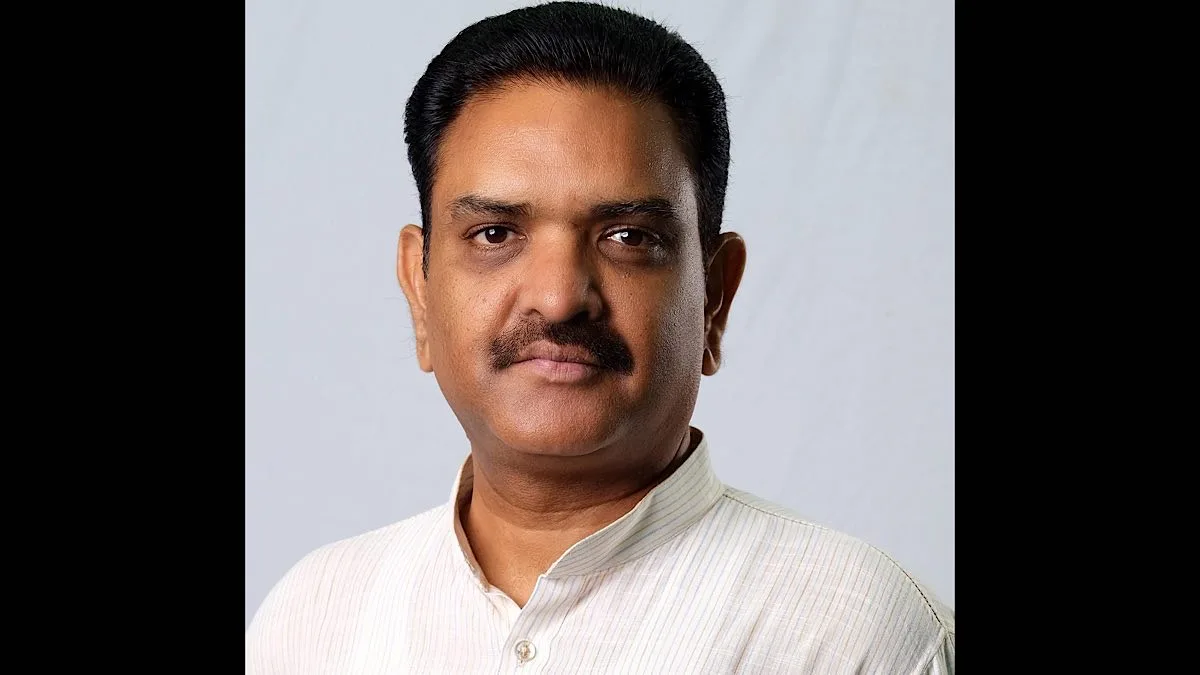
A police-officer-turned politician, Asim Arun is currently the Minister of State (Independent Charge) for Social Welfare and SC/ST Welfare in the Yogi Adityanath ministry. He is the BJP government’s prominent Dalit face as the saffron party seeks a third consecutive term in the crucial Uttar Pradesh Assembly elections scheduled for early next year.
An MLA from the Kannauj Sadar constituency since 2022, from where SP President Akhilesh Yadav is the Lok Sabha MP, Asim Arun is playing an important role in leading the BJP’s offensive against the Opposition. He earned the distinction of being the first IPS officer (1994 batch) to volunteer and successfully complete the NSG’s Black Cat Commando Course. He is credited with conceptualising the Dial 100 (now 112) police helpline in Aligarh in 2008, which was later expanded across UP. During the Covid period, he transformed the Police Helpline and modified its operations to become the primary agency responsible for receiving requests for humanitarian aid and providing the same through its Police Response Vehicles and Police Stations’ vehicles.
Advertisement
He also received the Police Medal for Gallantry for leading the operation in which ISIS terrorist Saifullah was killed during his tenure as ATS chief. He also received the President of India’s Police Medal for Distinguished Services, the President of India’s Medal for Meritorious Service and the UN Medal for service in Kosovo. He left the civil service on 8 January 2022, to begin his political career with the BJP. He won the 2022 UP Assembly polls from the Kannauj Sadar constituency, a long-time stronghold of the SP. In a candid conversation with Manoj Bhadra, Asim Arun shares his vision and dedication to serve the people of his state.
Q: Law and order, which was a major challenge before 2017, is now under control. How was this achieved?
A: The BJP government is a systematic problem-solving machine. The law-and-order issue has been addressed on multiple fronts. While police encounters have been used as a strategy, that is only a small part of the story. Under the Yogi government, the UP Police gained the confidence that they could return fire ~ bullet for bullet. Secondly, large-scale systematic improvements have been made, and resources have been significantly enhanced. The UP Police have recruited around 2 lakh personnel, and more recruitment is planned. The police stations now have adequate resources. Earlier, many police stations were poorly equipped; they either lacked vehicles or, if they had vehicles, then often they did not have fuel to operate them. Such issues have been addressed. The next step toward further improving law and order is strengthening the judicial machinery. The UP Police are pursuing Operation Conviction, under which a large number of convictions have been secured. The objective is to reinforce respect for the rule of law and deter those who have become accustomed to taking the law into their hands.
Q: Having served as a strict and efficient police officer throughout your career, how do you view your new role?
A: As I transitioned from police service to politics, I promised myself that the strong pillars that my father handed over to me would be performed with absolute honesty and integrity, courtesy and doing things with perfection and creating systems. These are strong pillars of conviction that I have held through my life and will continue to do so. Politics, elections, winning, losing ~ all that is around these very pillars. There is no question of compromising on them. Hence, core values have not changed at all, but the approach has changed slightly. While in police, the general mode of functioning is order within quotation marks, whereas in politics, the mode of communication is persuasion, ‘agraha’ (plead) and ‘anurodha’ (demand). However, the approach in both the roles is to take India towards being a developed country. And I believe the most important element of India being a developed country would be our ability to build systems. In the police, I tried to build systems in the form of 112, the anti-terrorist squad, and the special weapons and tactics team. Now, as Minister for Social Welfare, I have been working hard on bringing social sector schemes into automatic mode.
Q: Atrocities against Dalits were a major concern before 2017 but have reportedly declined significantly. Many credit you for playing a key role in this change. What do you see as your contribution?
A: Yes, that is true. The SC/ST atrocity FIR cases have come down drastically. There are a number of reasons for that. First, of course, there has been strong police and prompt judicial action, in cases involving atrocities. Second, there has been faster social and economic advancement of the deprived classes. A large number of people have moved from acute poverty toward self-reliance. Economic empowerment is a crucial factor, as it gives confidence to individuals to stand up against any form of oppression. The Social Welfare Department is responsible for providing ex gratia payments in cases of atrocities against members of the SC/ST communities. We have been promptly processing these payments. Also, the Modi government introduced a new provision under which, if the breadwinner of a family is murdered in an SC/ST atrocity case, then the affected family receives a monthly pension of Rs 5,000. A large number of families are benefiting from this scheme.
Q: Your department has been at the forefront of introducing welfare schemes for Dalits and other backward classes. What’s you approach and plans?
A: Personally, I don’t believe in vote banks. I believe in policy, positive policy influence. Talking specifically about the community double engine, the government has left no stone unturned to help them move up the social ladder through education, selfemployment schemes, skill development, health sector support, and free rations. As a result, we don’t hear of any farmer suicides or similar unfortunate incidents as we used to under earlier governments. These minimum living requirements are taken care of by the government, and whatever families earn, they spend on expanding their incomes.
Q: Dalit vote bank is always a major factor in UP, and now, as the Assembly elections are a few months away, can you say that this time the community will vote en masse for the BJP?
A: We are doing everything for the Dalits and other oppressed classes. In terms of money spent, the largest chunk goes to scholars from different communities. This year a record number of 66.5 lakh students received scholarships. Education is the most important thing for a ‘Vikshit Bharat’. We also support 67.5 lakh senior citizens by giving them old-age pensions. This number is steadily growing and we are in a saturation mode. No senior citizens should be left behind. Other schemes, wherein we give loans, so that the youth from poorer families can set up their own business and move forward. As of future plans. Modi ji and Yogi ji always insist that we should look for people who are discriminated against, and we might be missing them. For example, ‘double-engine Sarkar’ has been working overtime to support the transgender community. We also notice and acknowledge that there are a large number of people who are involved in begging. We have taken up this issue and are in the process of solving it systematically. Manual scavenging, wherein people were dealing with human faeces with bare hands. This is something which has almost completely come to an end, no? So the idea is to find out who is being discriminated against and who is deprived and, through government policies, help them cross these barriers and have a good, respectable living socially and economically.
Q: Taking lessons from the 2024 Lok Sabha elections, what is the BJP doing to address Dalit issues ahead of the 2027 Assembly elections?
A: In 2024, Congress and the Samajwadi Party created confusion in the minds of some voters that the Constitution and reservation would end and created other fake obstacles. However, such fake political narratives only create confusion for once, and now people have seen very clearly that the government, the Centre and state have only strengthened social justice, including reservation in government, education and jobs. The government has provided jobs within the sectors like skill development, loans, education and employment, and symbolically speaking, the opposition’s fake claim failed. Now the BJP and the Yogi government have turned into the champions of social justice from the bedrock of a policy for the marginalised and other deprived groups.
Q: Reservation has always been a contentious issue in the country. What are your views on it, and do you think the creamy layer principle should be enforced?
A: The Supreme Court has ruled that there can be quotas within quotas, and a creamy layer may be introduced, I believe. But at the same time, the Supreme Court said any changes in reservations must be based on empirical-level evidence and data. It should not be based on political exigencies, and it should not be based on who’s turning up a ground political movement. In the post-census, this evidence would be available, and the country would be entering a whole new phase of social justice as castes and tribes underrepresented in government would now have solid evidence to present their cases. I’m sure that by 2047, as the country becomes a ‘Vikshit Bharat’, there will be even greater social equity, very low disparities, and almost zero discrimination.
Q: Coming to Kannauj. What changes have you brought in your constituency and in the entire district?
A: Kannauj is my Matrabhoomi as well as Karmabhoomi. But , I was not born in Kannauj; my father was posted in Kannauj, and my responsibility lies there. The first step has been to end corruption, because I believe that without getting rid of corruption, no policy is going to succeed in Kannauj. For this, I had taken several harsh steps to take action against several officials and brought in an efficient one to accelerate the pace of development. My motto being: Saccha Kam hoga, to pucca kam dikhega. I have given priority to education, health, social welfare and senior citizens in my constituency and district. My focus is on primary schools and health systems at the primary level. I have set up Arogya centres that use AI systems to take care of health issues.
Q: As a prominent Dalit face of the BJP in UP, with the added experience of serving in the police, how do you see your role in serving society, particularly the oppressed sections?
A: As Dr B R Ambedkar said, achieving social equality requires political equality, which he gave us through the Constitution in the form of the principle of “one person, one vote, one value”. As economic equality improves, social equality also advances substantially. The BJP’s approach toward the deprived classes, particularly the SCs, has been to help them move up the economic ladder while ensuring adequate representation through ministerial positions, election tickets, and key organisational posts. This being that people from all communities have developed a sense of belonging in the BJP-led government. That, is why BJP enjoys support from virtually every community.
Q: Now, the Ram Temple’s theft issue is in the limelight. What is your comment on the entire issue and your reaction as a police officer?
A: It is very sad to know about the incident, and I am sure that very soon a transparent system will be evolved after analysing the entire case to prevent such things in the future. It is a big offense in a place of worship, and our government is committed to punishing the culprits.
Q: What is your wish as a minister that needs to be fulfilled to end the atrocities among the masses and to punish the culprits?
A: As a minister, I have come down very heavily on corruption. There are around one and a half dozen corrupt officials whose files were hidden somewhere by the babus. I like to symbolically put my uniform back with the police department, and I have not deposited the ‘danda’; it is still in my hand to crack or to use against corrupt Samajwadi Party leaders in Kannauj. For example, a senior SP leader, Nawab Singh Yadav, who used to rule the roost in the SP regime, had been convicted by the court in the sexual assault case of a minor girl, and his illegal properties have been confiscated under the Gangster Act. Such action is in the offing, such action against the other remaining mafia of the Samajwadi Party, who had illegally occupied the land of the Schedule Caste and other backward communities. My effort will be to chase these goons from the land they grabbed and hand it over to the people who are the real owners of these lands.