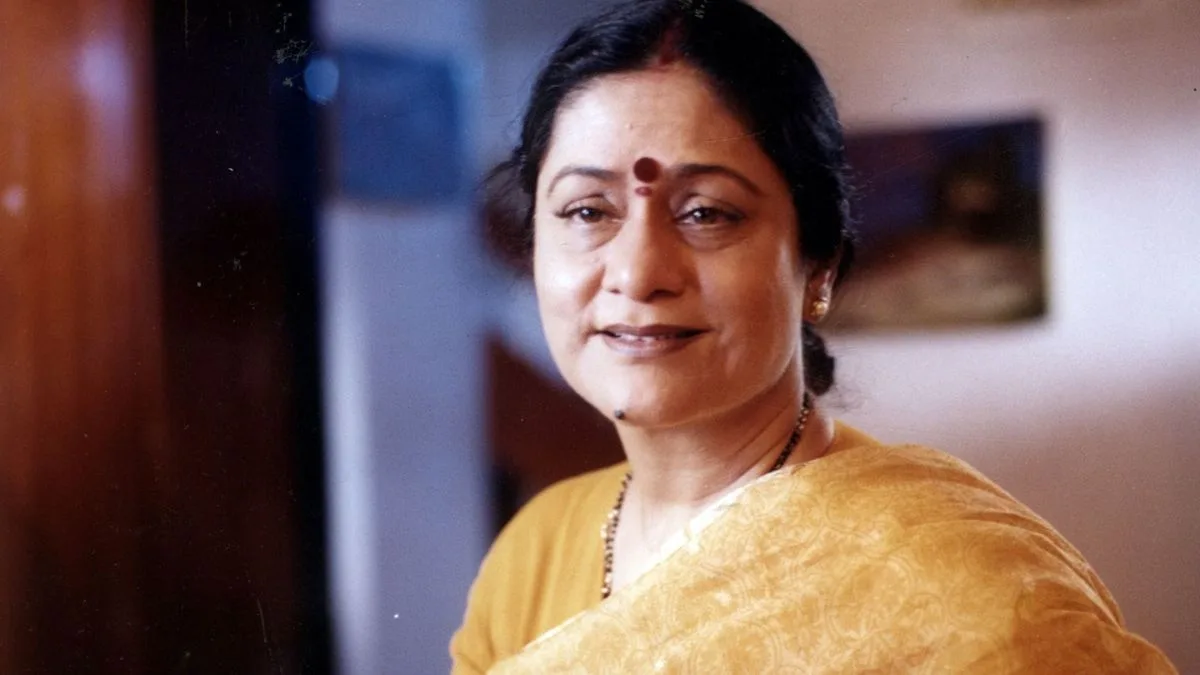
Veteran actress Aruna Irani recently spoke about one of the darkest phases of her career, three years without work, and a Marathi film that changed everything.
Let’s delve into it, chronologically.
Advertisement
A Career That Began in Childhood
Aruna Irani was born on 18 August 1946 in Bombay. Her father, Faredun Irani, ran a drama troupe, and her mother, Saguna, was an actress. The performing arts were part of her household from the very beginning.
Advertisement
Aruna Irani made her debut in the movie Gunga Jumna (1961) at nine years old. The classic song “Insaf ki Dagar pe” in Dilip Kumar’s Gunga Jumna was picturised on her. From that point, she kept working steadily as a child artist.
After doing several small roles in films like Jahanara (1964), Farz (1967), Upkar (1967), and Aaya Sawan Jhoomke (1969), she was building a name for herself. The bigger break, however, was still a few years away.
Also Read: 5 Ram Charan films to watch before ‘Peddi’
The Blockbuster Years With Caravan and Bombay To Goa
The early 1970s brought Aruna Irani her most high-profile work. She shot to fame with her performance as an aggressive gypsy woman in the superhit Caravan (1971), where she also danced with Jeetendra in tracks like “Chadti Jawani Meri Chaal Mastaani” and “Dilbarr Dilse Pyaare.”
Then came Bombay To Goa in 1972. Aruna Irani played the role of Mala in the film, opposite Amitabh Bachchan who played Ravi Kumar. Shatrughan Sinha and Mehmood were also part of the cast.
Aruna herself has recalled this period with pride. She said that both Bombay To Goa and Caravan were blockbusters. Both films ran for years in Super Cinema and Dreamland theatres. She was at the top of her game, working alongside one of Hindi cinema’s biggest rising stars.
The Sudden Fall: Three Years Without Work
Then, without warning, the work stopped.
Aruna Irani has opened up on the toughest phase of her life when she was out of work for three consecutive years, and how a once leading actress had to dance for just Rs 2,500 to earn a livelihood.
Speaking on the reality show Tum Ho Naa, she recalled how abruptly things changed after two back-to-back hits. After Caravan and Bombay To Goa, there were suddenly no offers. No calls. No roles. She has described sitting in studios and waiting for someone to notice her as something she refused to do.
The success as a heroine eluded her, and ironically, the newer actors and actresses who she supported became stars while acting with her — Jeetendra in Farz (1967), Rishi Kapoor and Dimple Kapadia in Bobby (1973), Jayaprada in Sargam (1979), Kumar Gaurav in Love Story (1981), and Sanjay Dutt in Rocky (1981).
Her memorable performance in Caravan had already typecast her in vampish and supporting roles. The film industry had effectively moved on from her as a leading lady.
Accepting a Lavani for Rs 2,500
When work finally came, it was not what she had been known for. It was a Lavani performance in a Marathi film. The pay was Rs 2,500.
She performed a Lavani in a Marathi film and did it with courage. She told herself she had to go and show people she was still alive. She could not just sit in a studio and ask to be cast.
The film was Dada Kondke’s Marathi film Aandhla Marto Dola. She told herself she had once been a heroine opposite Amitabh Bachchan and was now doing a Lavani for Rs 2,500. But she chose to go anyway.
This was not a decision made out of comfort. It was one made out of necessity and a firm refusal to disappear from the industry quietly. She has spoken about this with no regret, describing it as the choice that saved her career.
The Turning Point: Meeting Raj Kohli
That Marathi film did more than give her a paycheck. That decision turned out to be fruitful because there she met people who would change her career. She met Raj Kohli ji, and from there work started coming her way again.
This meeting opened new doors. The roles returned. The industry noticed her again.
A Career That Reinvented Itself
Rather than fade away, Aruna Irani adapted. In the late 1980s and 1990s, she focused more on motherly characters in films like Shahenshah, Chaalbaaz, and Phool Aur Kaante. That approach struck the right formula when she played an elderly character in the 1992 release Beta.
Beta earned her the second Filmfare Best Supporting Actress Award. She had won her first Filmfare Best Supporting Actress Award for Pet Pyaar Aur Paap (1984).
In her later career, Irani switched to television and also took up the direction and production of tele-serials such as Mehndi Tere Naam Ki, Des Mein Niklla Hoga Chand, Rabba Ishq Na Hove, and Vaidehi.
On 19 February 2012, she was awarded the Filmfare Lifetime Achievement Award.
She married Bollywood film director Kuku Kohli in 1990. Aruna Irani is also the sister of filmmaker Indra Kumar.
Advertisement