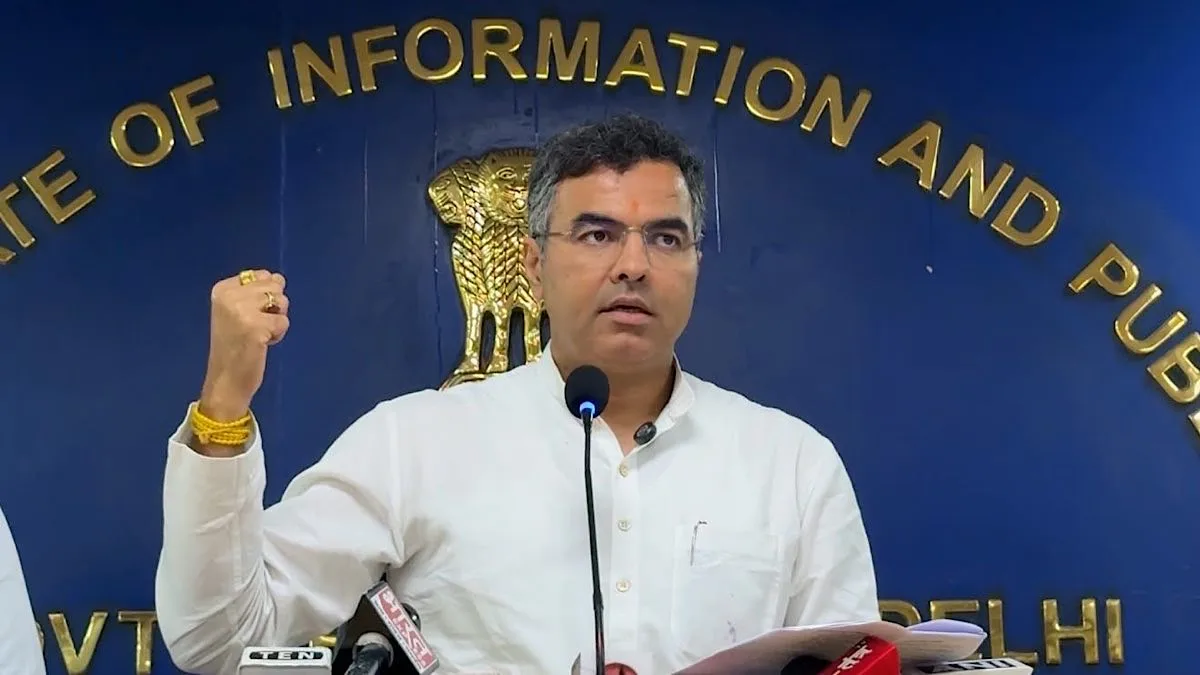
The Delhi government has launched a series of transformative reforms to ensure equitable water distribution by reducing water losses , modernising infrastructure and promoting reuse of treated water to secure the future of the national capital with its lifeline. Continuing with these efforts, the water board led by Minister Parvesh Sahib Singh introduced several initiatives for overhaul of water management system, which have not been done since decades.
Addressing the media on Tuesday, the Minister said Delhi’s water demand continues to rise every year while the available water resources remain limited. During the peak summer, Delhi requires nearly 1,250 MGD of water. However, a prolonged dry spell in the Yamuna has reduced water production by nearly 100 MGD over the past several days, that has affected supplies in some parts of the national capital. However, despite the challenges, government is continuously working on both short- and long-term solutions to ensure that every resident receives a fair share of water, and does not have to suffer.
Advertisement
The minister shared that the government is building a system that can serve Delhi not just today, but also for decades to come. “In 12 to 13 Assembly constituencies, majority of water-related complaints are received every summer. At the same time, there are areas receiving comparatively higher water supply.”
According to Parvesh Sahib Singh, the imbalance has existed for years, and now the government is working on a “Water Rationalisation Project,” to ensure that every citizen, irrespective of where they live, gets equitable access to water.
The minister informed that the water rationalisation project will scientifically assess population density, demand patterns, supply levels and infrastructure availability across different parts of Delhi.
He shared that the objective is to have efficient distribution system to ensure no locality is left underserved.
The minister pointed that the ageing pipelines of the city are the biggest obstacle in the way of efficient water distribution. “Out of Delhi’s 16,634-kilometre water distribution network, nearly 5,500 kilometres of pipelines are more than 30 years old,” the minister informed.
He said that such old pipelines are prone to leakages and contamination, resulting in water loss, even before it reaches consumers. “We have started a mission to replace these old pipelines and strengthen the entire distribution system,” he added.
He alleged that the current challenges before the city is the result of years of underinvestment in critical infrastructure, adding that the work that should have been done 10 or 20 years ago is being taken up on priority at present.
The DJB is also moving ahead with projects aimed at reducing Non-Revenue Water (NRW), which refers to treated water lost due to leakages, theft and inefficiencies in distribution.
Verma also talked about a major initiative being considered on the conversion of the open DSB Canal into a closed pipeline-based system. “Today, nearly 40 to 45 per cent of water is lost through the DSB canal system. IIT Roorkee has been engaged to conduct a feasibility study. Once the canal is converted into a pipeline-based system, water losses will reduce drastically and supply efficiency will improve significantly,” the Minister added.
He shared that study is ongoing to introduce Dual Piping System, wherein highly treated recycled water will be supplied through a separate pipelines for non-potable uses like toilet flushing, horticulture, landscaping, construction and vehicle washing, while freshwater will be reserved for drinking and household use.
Minister asserted, “Delhi cannot afford to flush drinking water down toilets. Every day, large quantities of potable water is used for purposes that do not such quality drinking water,” adding that millions of litres of fresh water can be saved on a daily basis.