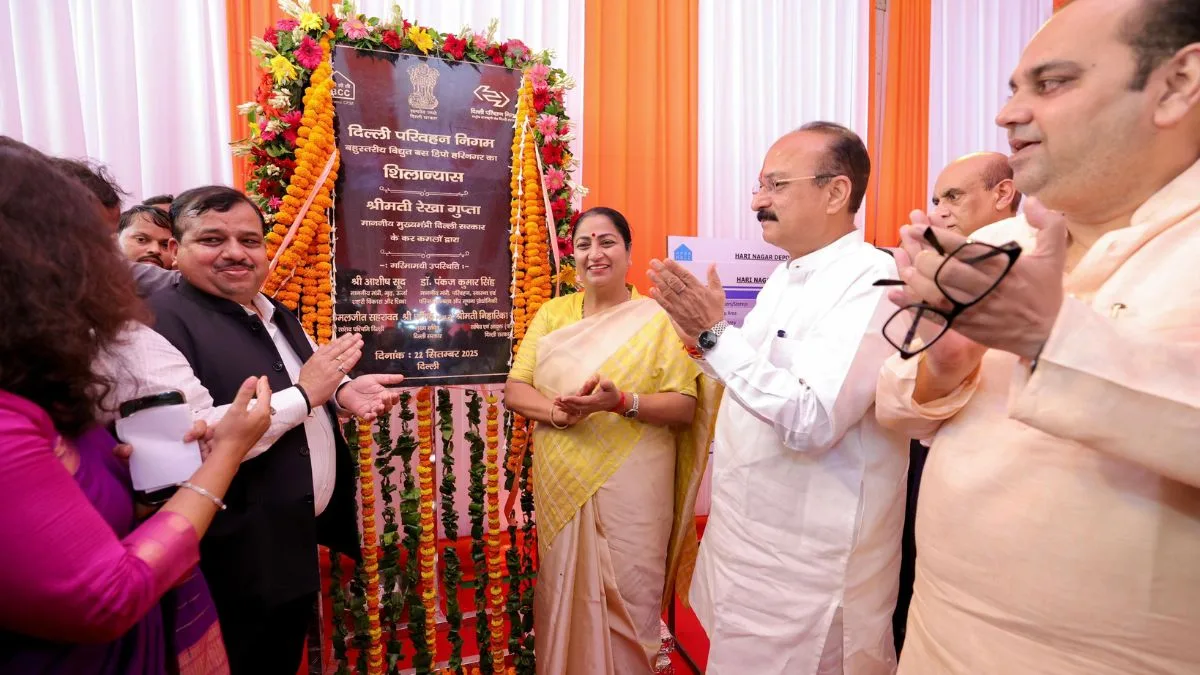
In a step towards modernising the national capital’s transport infrastructure, Chief Minister Rekha Gupta on Monday laid the foundation stone of the Multi-Level Electric Bus Depot of Delhi Transport Corporation (DTC) at Hari Nagar in West Delhi.
Gupta hailed the project as a milestone in the transport corporation’s history and noted that the depot will redefine working conditions for the DTC employees while providing world-class facilities for commuters.
Advertisement
The CM said, “Delhi is witnessing the dawn of a new era in public transport. With this depot, capable of housing around 400 e-buses and equipped with state-of-the-art charging infrastructure, our government reaffirms its commitment to clean, efficient, and sustainable mobility.”
“This project is not just a bus depot—it is the foundation of a greener, more efficient Delhi,” Gupta added.
The inauguration was part of the ongoing service fortnight that began to commemorate the birthday of Prime Minister Narendra Modi.
Delhi transport minister Dr. Pankaj Kumar Singh and Power Minister Ashish Sood were also present on the occasion.
The CM underlined that the facility is being developed as a financially self-sustainable model, with around 2 lakh sq ft of retail and commercial space to be integrated into the complex, generating revenue to offset project expenses.
Additional features include 324 car parking slots, 104 two-wheeler spaces in the basement, 26,257 sq ft for DTC offices and dormitories, and a modern commercial hub comprising malls and office space.
Gupta further highlighted the project’s green credentials, adding that the depot will install a 500 KW rooftop solar power plant, a 170 KLD sewage treatment plant, and a rainwater harvesting system to recharge groundwater.
In her address, Gupta also touched upon the broader vision of the Delhi government, stating that, “Our priority is to ensure last-mile connectivity in Delhi and to expand the electric bus fleet from 3,000 to 6,000 in the coming year.”
She also acknowledged challenges faced by DTC employees during the transition to electric buses, including pension and employment-related concerns, and assured that the government is working on long-term solutions.
Referring to the Shadipur Depot project, she announced that residential colonies are being developed to provide housing for DTC families, ensuring better living conditions for employees.
She also drew a sharp contrast with the previous government, which she alleged left DTC in financial distress and neglected employee welfare.
Delhi Transport Minister Pankaj Kumar Singh, in his address, emphasised the government’s commitment to enhancing public transport in every corner of Delhi.
He said, “We had promised the people of Delhi that public transport would not just expand but transform—and this foundation stone is proof of that promise in action. Our efforts are directed towards modern, reliable, and eco-friendly mobility solutions. Very soon, Delhi’s citizens will see positive changes across the transport network, from last-mile connectivity to cleaner buses and better facilities,” Dr Singh added.
He further informed that the Hari Nagar depot will be able to accommodate 384 electric buses compared to the 230 CNG buses it currently handles. It will feature 81 advanced EV charging stations capable of fully charging a bus in just 40 minutes.