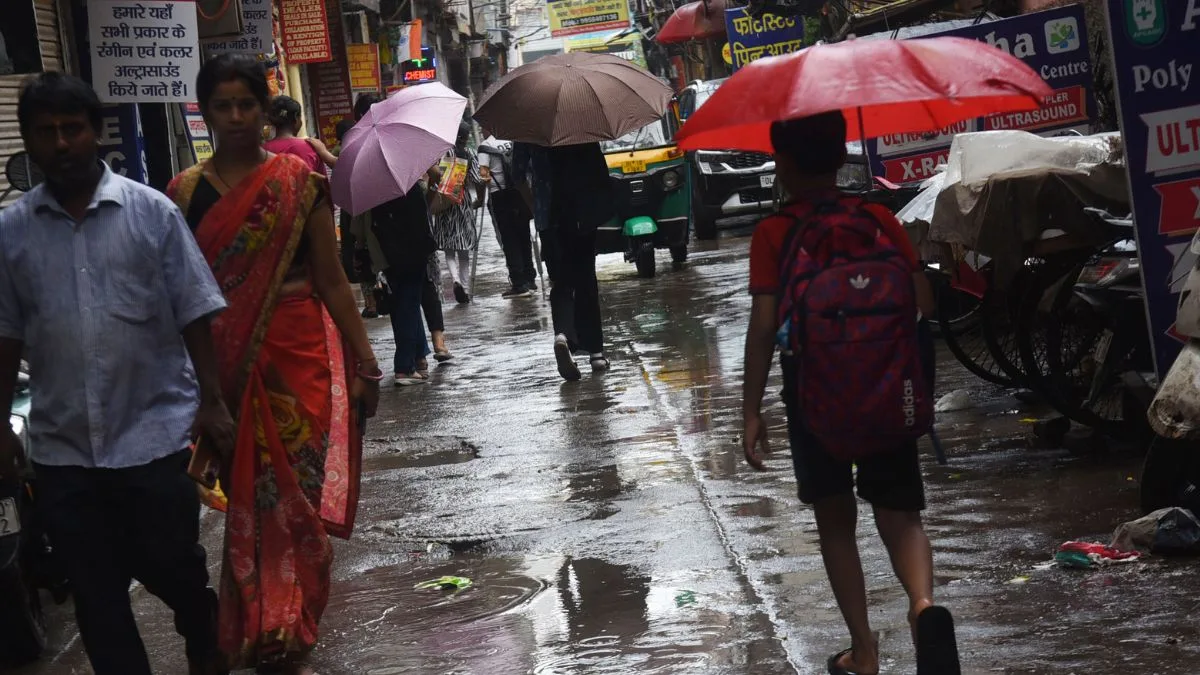
Delhi and parts of the National Capital Region (NCR) were battered by relentless rain on Friday morning, leaving several key roads submerged and severely disrupting traffic.
Safdarjung, the city’s base station, recorded 63.7 mm of rainfall—classified as ‘heavy rainfall’—while Lodhi Road registered 36.6 mm, categorised as ‘moderate’, according to India Meteorological Department (IMD) data recorded until 5:30 pm.
Advertisement
Light showers were reported at Mayur Vihar and Ayanagar stations, which recorded 15.5 mm and 11.8 mm of rainfall, respectively. However, even these spells left several motorists stranded as waterlogging hit multiple parts of the city, including Sangam Vihar, Vinod Nagar, and Pratap Nagar.
Following the downpour, commuters faced massive traffic snarls across several major stretches, with vehicle movement badly affected on the Delhi-Noida-Direct (DND) flyway, Mathura Road, Vikas Marg, ISBT, Geeta Colony, and Rajaram Kohli Marg. A long queue of vehicles was also reported from Badarpur to Ashram, causing major inconvenience to office-goers and school buses.
Videos circulating on social media showed locals wading through waist-deep water to cross inundated roads in east Delhi. Passengers from stalled RTV buses were seen being rescued on the roofs of rickshaws, which were almost fully submerged, as seen in clips shared on X.
The morning showers also pulled down Delhi’s maximum temperature by over five degrees, settling at 30.2°C and narrowing the gap with the minimum temperature. Just a day earlier, the difference between the two had been nearly ten degrees. On Friday, the minimum temperature was recorded at 26.2°C, according to the IMD.
The Met department has forecast the prevalence of an active monsoon with the possibility of light to moderate showers over the next four days.
The rains also improved Delhi’s air quality. The city’s Air Quality Index (AQI) dropped from 120 to 98, bringing it into the ‘satisfactory’ category.
According to the Central Pollution Control Board (CPCB), the capital’s average AQI on Friday stood at 98—a fall from the previous day’s 120, categorised as ‘moderate’. PM10 and PM2.5 remained the major pollutants at 37 of the 39 monitoring stations.
As per CPCB classification, an AQI between 0 and 50 is ‘good’, 51 to 100 ‘satisfactory’, 101 to 200 ‘moderate’, 201 to 300 ‘poor’, 301 to 400 ‘very poor’, and 401 to 500 ‘severe’.
Meanwhile, following incessant rainfall in Delhi’s upstream catchment areas—including Punjab, Jammu and Kashmir, and Himachal Pradesh—the Yamuna crossed the danger mark for the second time this monsoon.
On Wednesday, August 27, at 8 p.m., the river rose above the danger level of 205.33 metres and remained so for nearly 32 hours. The water level began to recede by Thursday afternoon.
By Friday, August 29, at 4 p.m., it was recorded at 204.58 metres—just above the warning level of 204.5 metres—according to data from the Central Water Commission (CWC).