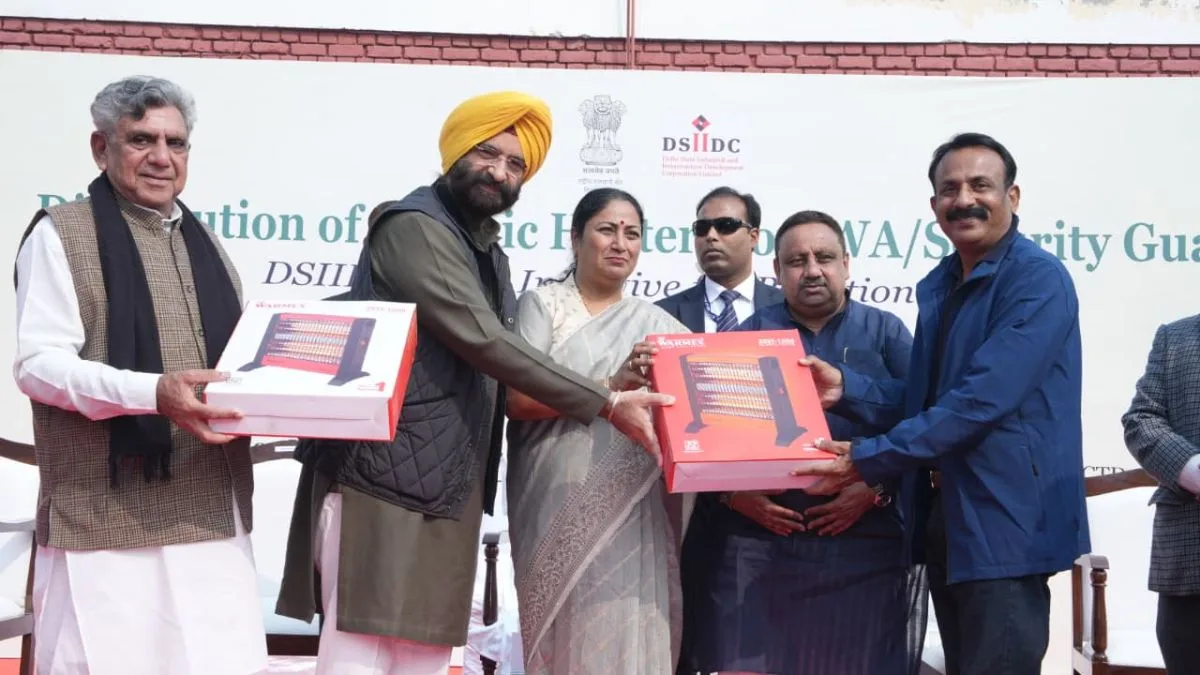
In a bid to prevent pollution caused by biomass burning during winters, such as the use of coal, firewood, and conventional braziers, the Delhi government has launched an initiative to distribute electric heaters to Resident Welfare Associations for use by security guards and staff.
Notably, many security guards in residential colonies use small bonfires, braziers, and other traditional methods to keep themselves warm during night duties in the chilly winter months.
Advertisement
These traditional methods produce smoke and worsen pollution due to the open burning of solid fuels.
Chief Minister Rekha Gupta on Saturday distributed electric heaters to RWAs near Dilli Haat, Pitampura, stating that this initiative will not only provide relief to night guards during the cold but will also help reduce air pollution by curbing the open burning of traditional fuels such as wood and coal.
According to the CM, the state government is working on a multi-dimensional strategy to control pollution in the capital, and the entire administration is taking strong and effective measures to bring it under control.
On this occasion, the CM also said that open burning of wood, waste, and coal is a major cause of pollution in the capital.
As part of the scheme, more than 10,000 electric heaters will be provided to various RWAs through CSR funding.
She added that this humane measure represents a new model of public participation, adding that the government will now encourage ironing workers to shift from coal-based irons to gas or electric irons, and families in slum clusters will be provided LPG connections through the Ujjwala Scheme.
She emphasised that the fight against pollution can only be won when citizens, institutions, and RWAs contribute equally.
Gupta said that this step strengthens the collective resolve to make Delhi cleaner and healthier.
She also shared that all her cabinet colleagues, public representatives, and government officials are continuously monitoring cleaning and sanitation drives that are underway across the city, and modern equipment is being deployed to improve cleanliness, which will eventually help reduce pollution.
She also assured that rapid progress is being made towards electrifying Delhi’s public transport system, and that by the end of 2026, 100 per cent of the Delhi government’s buses will operate in electric mode.
Commenting on the policies of previous governments, she said that despite being in power for over 11 years, the former government failed to deliver on fundamental issues such as pollution control, cleaning the Yamuna, eliminating landfill mountains, improving roads, and constructing schools and hospitals.
In contrast, she claimed that the present government is preparing long-term solutions with honesty and a scientific approach.
Speaking on the occasion, Delhi Environment Minister Manjinder Singh Sirsa said that the government has given a new direction to the fight against pollution over the past eight to nine months.
He explained that Delhi’s circumstances are unique compared to the rest of the country and that pollution here is at times also affected by neighboring states.