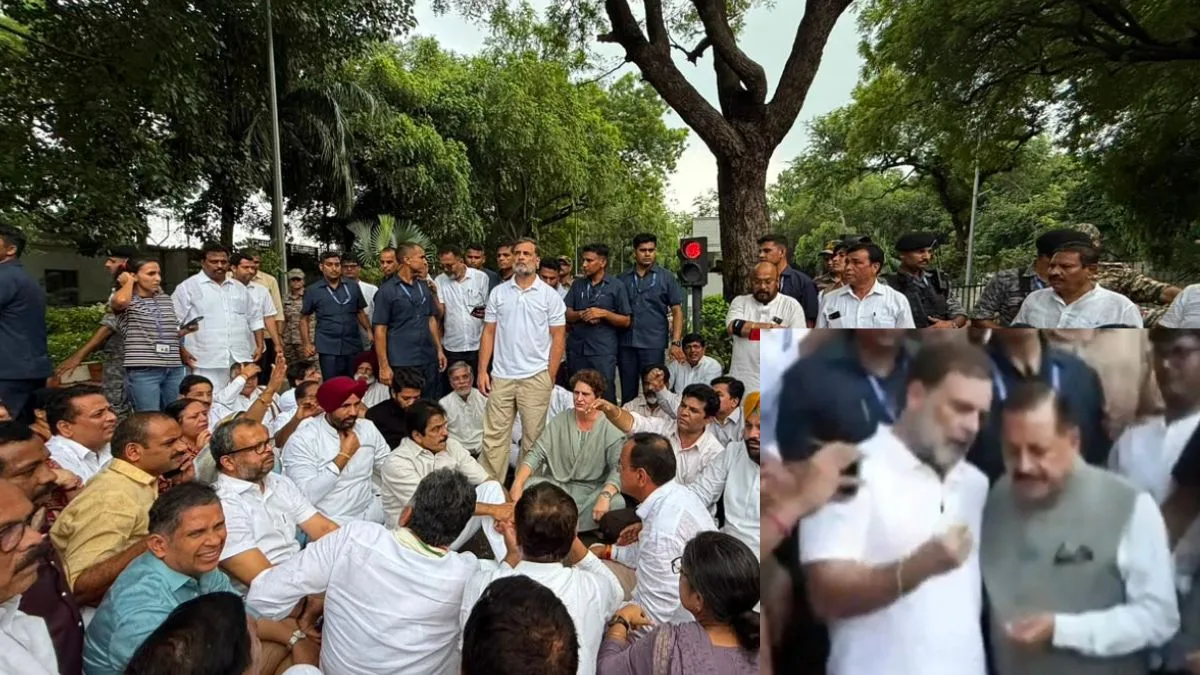
CJP’s Parliament march loses its script at Jantar Mantar, splinters into scattered protests
Student groups and Opposition workers formed a sizeable crowd, but the promised procession towards Parliament never emerged as one organised march.
According to the minister, the credit for this turnaround goes to the leadership of Prime Minister Narendra Modi and the effective on-ground execution by Chief Minister Rekha Gupta.





File Photo
With nearly three months still remaining in 2025, Delhi has already recorded 199 clean air days this year, compared to 110 such days in the entire year of 2016, marking a significant improvement, Delhi Environment Minister Manjinder Sirsa said on Sunday.
According to the minister, the credit for this turnaround goes to the leadership of Prime Minister Narendra Modi and the effective on-ground execution by Chief Minister Rekha Gupta.
Advertisement
He said the momentum reflects an integrated, technology-driven strategy that translates policy into consistent and measurable execution across all seasons.
Advertisement
Sirsa remarked, “This is not an outcome of chance or weather but is the result of continuous, coordinated action. Under CM Rekha Gupta’s leadership, Delhi has moved from paper-based promises to tech-based performance. From road dust control to landfill bio-mining, from mechanized sweeping to misting and plantation — work is happening round the clock. Results are bound to follow when intent is clear and actions are coordinated.”
The minister noted that the city’s Air Quality Index (AQI) on Sunday stood at 167, showing a notable improvement from the previous day.
He attributed this to daily environmental vigilance across the capital, including efforts in dust control, waste management, and vehicular pollution monitoring.
“Every clean day in Delhi today is earned — through the efforts of thousands of workers, engineers, and officers working together within a system of accountability. This is governance that delivers, not just promises that sound good,” Sirsa added.
Sharing data from the past 24 hours, Sirsa said 10,729 metric tonnes (MT) of garbage were removed, 6,414 km of roads swept, and 2,172 MT of construction and demolition (C&D) waste lifted. Additionally, 1,247 km of roads were sprinkled with 605 kilolitres (KL) of water.
Under vehicular pollution checks, a total of 12,068 challans were issued. Bio-mining of legacy waste amounted to 15,277 MT, processed across sites — Bhalaswa (6,572 MT), Okhla (3,970 MT), and Ghazipur (4,734 MT).
Sirsa further said that the government’s Winter Readiness Plan is already operational, focusing on controlling road dust, ensuring mechanized sweeping, enforcing strict norms at construction sites, and deploying mist sprayers in air pollution hotspots.
“We are ready for winter with a strong enforcement and monitoring system. Every ward is being tracked, anti-smog guns are operational at major construction projects, and our landfill bio-mining teams are working at full capacity,” he said.
The minister concluded that Delhi’s 24×7 Environmental Action Plan, which includes road cleaning, misting, green plantation drives, and hotspot monitoring, has made pollution control a year-round mission, rather than a seasonal campaign.
Advertisement