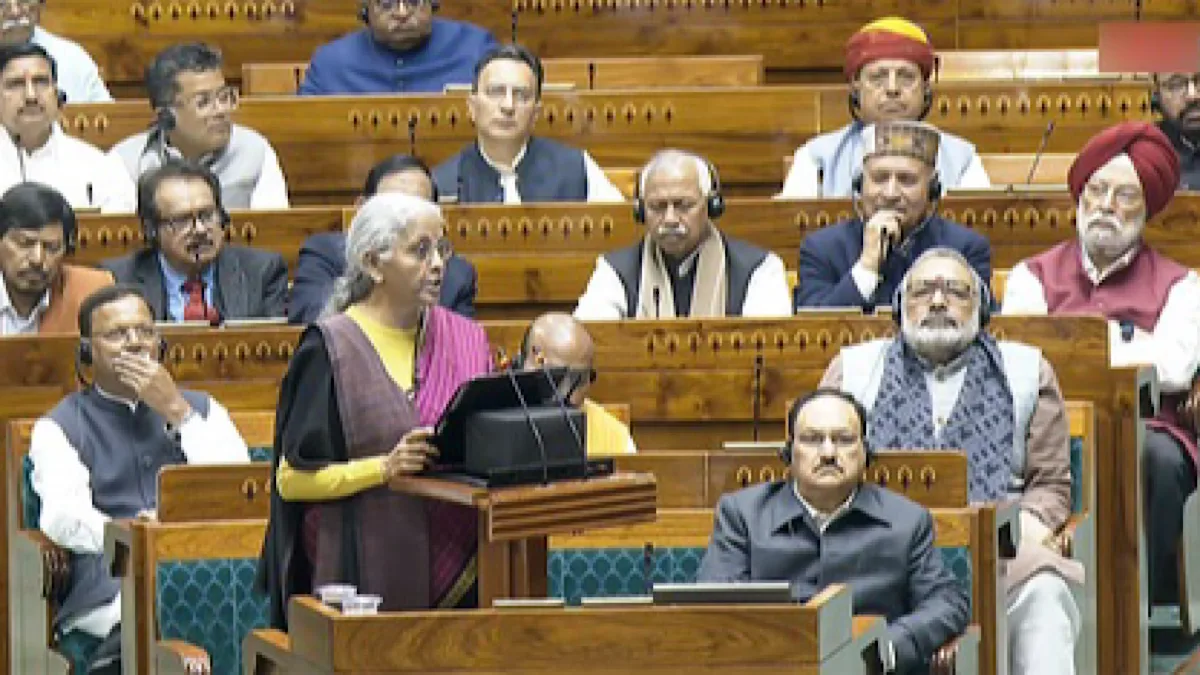
Finance Minister Nirmala Sitharaman, in her ninth Budget speech, announced a sharp increase in capital expenditure for the Financial Year 2027, raising it to Rs 12.2 lakh crore, a figure that would have seemed aspirational a decade ago, when public capital expenditure barely crossed Rs 2 lakh crore.
Capital expenditure, the lifeblood of long-term economic infrastructure including roads, railways, ports, power projects, urban infrastructure—is not merely a number on a sheet. It determines the pace at which jobs are created, productivity rises, and economic growth takes root. Sitharaman noted that this allocation has jumped from Rs 11.21 lakh crore in the previous fiscal to Rs 12.2 lakh crore, claiming that the government seeks to “continue the momentum.”
Advertisement
Sectors such as steel, cement, power and transportation are expected to see immediate benefits, analysts say. Divam Sharma, Co-Founder of Green Portfolio PMS, added that “robust double-digit growth signals a strong policy focus on infrastructure development.” Yet, as anyone who has tracked India’s infrastructure cycles knows, announcements are easier than execution.
Sitharaman emphasised Tier II and Tier III cities, promising continued investment in urban centres with populations over 5 lakh. Over the past decade, instruments like Infrastructure Investment Trusts and Real Estate Investment Trusts have been introduced to fund these initiatives, but whether they have transformed the ground reality is still a question for auditors and commuters alike.
Beyond roads and rails, the Finance Minister announced rare earth corridors linking Odisha, Kerala, Andhra Pradesh, and Tamil Nadu, a strategic nod to electric vehicles, renewable energy, and defence technology. The intent is clear: reduce import dependence and position India as a manufacturing hub in critical sectors.
Market watchers pointed out that the fiscal roadmap for FY27 is expected to balance the capex push with fiscal prudence, with projections suggesting the fiscal deficit could be maintained around 4.2‑4.4 per cent of GDP as the government seeks to gradually consolidate public finances.
Rating agencies and bankers have emphasised the importance of continued high public investment to crowd in private sector activity, even as some caution that execution challenges in project implementation remain.
The broader budget presentation also outlined plans to support strategic initiatives such as dedicated freight corridors and other major infrastructure programmes, signalling that capital investment will remain at the forefront of the government’s policy priorities in the coming year.
Economists said the FY27 capex push comes against the backdrop of efforts to enhance India’s competitiveness, improve logistics efficiency and accelerate project implementation timelines, with increased allocations likely to bolster long-term economic growth.
Sitharaman also stressed technology, artificial intelligence, and a strong financial sector as tools to sustain macroeconomic stability. Yet, the question lingers—can these lofty goals match execution capacity on the ground? Analysts remain cautiously optimistic, noting that capex alone cannot substitute for systemic reforms and timely project delivery.
In short, the Budget projects ambition and scale. Whether the promise of Rs 12.2 lakh crore translates into tangible change, or remains another line in the annals of Budget speeches, will unfold in the months to come.