How Union Budget 2026-27 sets the stage for India as an AI powerhouse
Budget 2026–27 proposes a long-term tax framework and semiconductor push designed to attract global AI and cloud infrastructure investment, and anchor digital value chains in India.
Statesman News Service | Mumbai | February 14, 2026 1:49 pm
India developing world’s first AI-driven risk modelling platform ‘Agni Kawach’
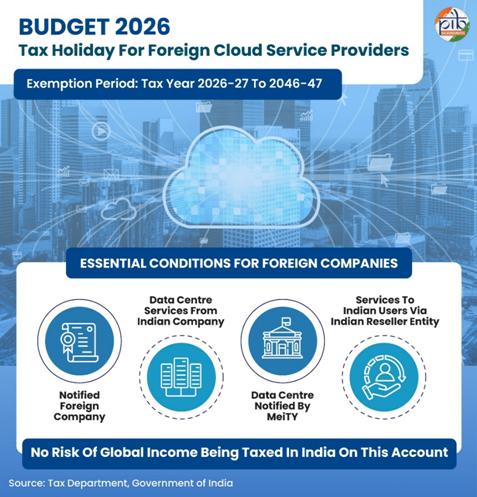
The Union Budget 2026–27 has made a clear pitch: India wants to become a global base for cloud computing and artificial intelligence infrastructure. The government has proposed a tax holiday till 2047 for eligible foreign cloud companies that run their global operations through data centres located in India.
The move is aimed at attracting long-term investment in AI data centres, which can be described as massive facilities that power everything from chatbots to advanced research systems. At a time when countries are racing to secure AI capacity, the government is offering policy stability for more than two decades to anchor that infrastructure in India.
Advertisement
What exactly has been proposed?
Under the plan, foreign cloud service providers that use India-based data centres for their global business will not have to pay Indian tax on income earned from those global operations, provided certain conditions are met.
Advertisement
However, services offered to Indian customers must be routed through an Indian reseller company. This ensures domestic business remains taxable in India.
Indian data centre companies that provide services to global cloud players will continue to be taxed like any other domestic company. If the data centre is a related entity of the foreign company, a 15 per cent safe harbour margin on cost has been proposed to avoid tax disputes.
The tax holiday would apply from 2026-27 to 2046-47. That gives companies long-term certainty, something which is critical for projects that involve billions of dollars in upfront investment.
Pic courtesy: PIB
Why this matters in the AI race
AI data centres are expensive. They need powerful chips, a heavy electricity supply, cooling systems and skilled engineers. Once built, they operate for years. Companies will not invest at that scale without policy stability.
Globally, the race is intense. According to the United Nations Conference on Trade and Development (UNCTAD), data centres accounted for over one-fifth of global greenfield investment projects in 2025, with announced investments crossing USD 270 billion.
The United States has recently moved to fast-track large AI data centre approvals. China, too, is expanding its AI and cloud infrastructure rapidly.
In that context, India’s long tax window till 2047 is meant to signal seriousness. It tells global cloud companies that they can plan here for decades.
Pic courtesy: PIB
More than just a tax break
The Budget does not stop at cloud services. It connects the tax holiday to a broader technology strategy.
India Semiconductor Mission 2.0 has been launched, with Rs 1,000 crore allocated for 2026-27. The focus is on chip equipment, materials, design, and talent development.
The Electronics Components Manufacturing Scheme has seen its allocation raised from about Rs 22,000 crore to Rs 40,000 crore. The government says 149 applications have already been received.
These measures are important because AI data centres depend on semiconductors and electronic components. Without strengthening manufacturing, cloud ambitions cannot hold.
IT services reforms also part of the plan
India’s IT exports cross USD 220 billion. The Budget proposes grouping various IT services under one category and offering a common safe harbour margin of 15.5 per cent.
The threshold for safe harbour eligibility has been raised significantly. The approval process is expected to be more automated and faster.
This aims to reduce tax uncertainty and give IT firms a smoother operating environment, something that complements the push for AI infrastructure.
Pic courtesy: PIB
Where India stands today
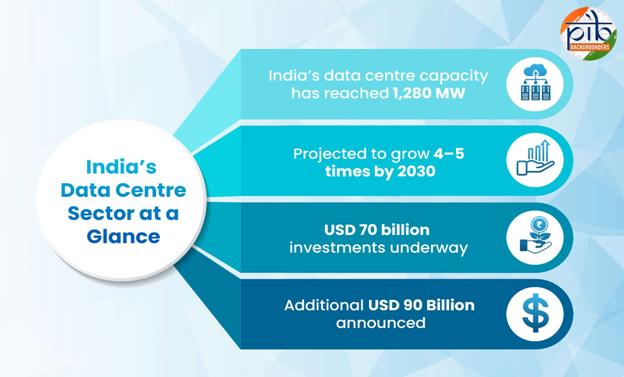
Industry estimates suggest India’s data centre capacity has reached around 1,280 MW. It could grow four to five times by 2030.
Nearly USD 70 billion in data centre investments are already underway, with another USD 90 billion announced.
The government’s GI Cloud (MeghRaj) platform already supports public sector digital services. The new Budget measures aim to build on that base and attract global AI workloads into India.
The bigger picture
This is not just about tax savings. It is about positioning India in the global AI supply chain.
By offering long-term tax certainty, boosting semiconductor capability and simplifying IT tax rules, the government is trying to create a full ecosystem, from chips to cloud to AI services.
Whether global giants shift major operations to India will depend on execution, energy supply and regulatory speed. But with a 2047 horizon, the message is clear: India wants to be more than just a user of AI; it wants to host it.
Krishnan also credited US President Donald Trump for prioritising AI and technology policy, saying the administration's leadership had been instrumental in keeping the United States at the forefront of AI development.
Currently, around 60 notorious gangsters are estimated to be operating from abroad, using encrypted applications and virtual numbers to coordinate crimes in Punjab.
Trump says US strikes have crippled Iran’s military and dismissed reports of damaged American assets, while Tehran insists it has not asked for a ceasefire and will continue fighting.