Dhamsa-Madol unveiled as election mascots in Purulia
Incidentally, Dhamsa and Madol have been chosen as the new election mascots by the Election Commission of India (ECI) for the Assembly polls in Purulia district.
Recently, the Department of Bengali at Bikramjit Goswami Memorial College, Purulia, organised a two-day National Seminar with financial support from the Indian Council of Social Science Research (ICSSR).




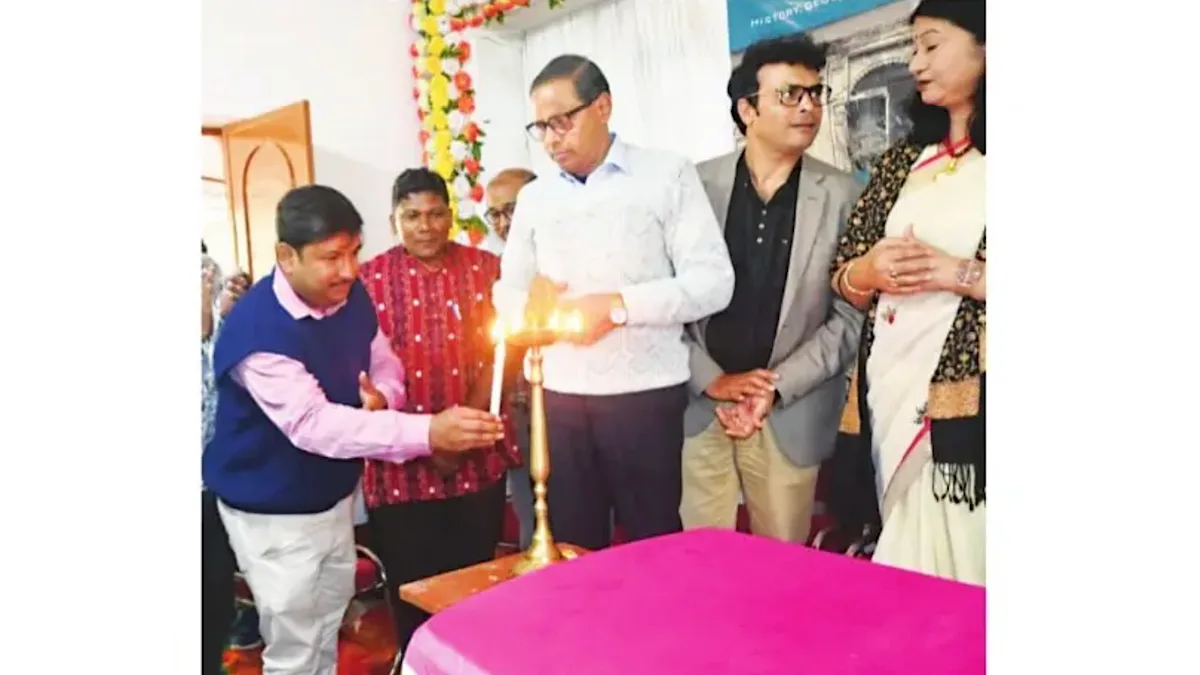
Photo:SNS
Recently, the Department of Bengali at Bikramjit Goswami Memorial College, Purulia, organised a two-day National Seminar with financial support from the Indian Council of Social Science Research (ICSSR). The seminar, titled “Exploring Manbhum in a Globalised World: History, Geography, Language, Literature, Culture, and Socio-Economics,” sought to examine Manbhum and its culture within the frameworks of accommodation and conflict in an era of rapid change. The seminar was inaugurated by the Hon’ble Vice-Chancellor of Sidhu-Kanhu-Birsa University, Prof. Pabitra Kumar Chakraborty.
The keynote address was delivered by poet, Prof. of English at the University of Burdwan, and former Eastern Region Secretary of the Sahitya Akademi, Angshuman Kar. Among the distinguished participants over the two days were eminent writer and former Secretary of the Sahitya Akademi Ramkumar Mukhopadhyay; Prof. and Dean of the Faculty of Arts at Diamond Harbour Women’s University, Tapan Mondal; Prof. of Bengali at Sidhu-Kanhu-Birsa University, Milon Kanti Shatpathy; Associate Prof. of Chemistry at Sidhu-Kanhu-Birsa University and Chairperson of the West Bengal School Service Commission (Western Region), Sadhana Khawas; renowned poet and celebrated Jhumur lyricist Shri Sunil Kumar Mahat; Assistant Prof. of English at Sambalpur University, Odisha, Ajit Kumar Kullu; and Sahitya Akademi Yuva Puraskar–winning poet and journalist Shri Abhimanyu Mahat, among other dignitaries. Snigdhadip Chakraborty, Convener of the seminar and Assistant Prof. in the Department of Bengali of the college, conducted the entire programme.
Advertisement
The Hon’ble Vice-Chancellor’s inaugural remarks set a tone that resonated throughout the subsequent deliberations like the sustained melody of a many-stringed veena. Although the district of Manbhum no longer exists in the contemporary political map, the Manbhumiya language and culture continue to bind the people of the region in an intimate bond of life and identity—an aspect that emerged strongly during the two-day discussions. Repeated political re-demarcations, administrative complexities, and the pressures of modernity have not been able to erase completely the pristine forest-dependent life-patterns of the indigenous Santal, Sabar, and other Adivasi communities. The Birhors, the original inhabitants, still live with a distinct sense of identity deep within the forests of Manbhum. Historically, the Manbhum region is multidimensional. Its past is filled with events and struggles—from the Chuar Rebellion to the Santal Revolt, from the Sepoy Mutiny to Giru Gandhi’s Congress-led movements, from the Language Movement of 1956 to Charaibeti—the tradition of unceasing forward journey.
Advertisement
The papers presented at the seminar highlighted Manbhum’s rich linguistic, social, political, and cultural diversity, and emphasised the importance of preserving its core essence along with a balanced understanding of the region’s hopes and anxieties. Quoting Bharat Chandra, poet Angshuman Kar observed in a slightly altered manner that “what is not in Manbhum is not in India.” He remarked that for a long-time, urbanisation and mechanisation had been projected as the sole markers of civilization. Yet , the counter-voice against this narrative has now gained legitimate ground.
In the reconstruction of modernity, an awareness of inheritance and legacy is gradually reasserting itself. This message of renewed expectation echoed through the discussions of other speakers as well. In a world filled with tensions, the challenge is not merely to survive but to live with dignity—honouring the glories of the past , understanding the demands of a changing time, and deciding how much transformation is desirable and how much is unwarranted. These sensitive and often debated questions animated the college’s elegantly arranged seminar hall throughout the two-day event.
Advertisement