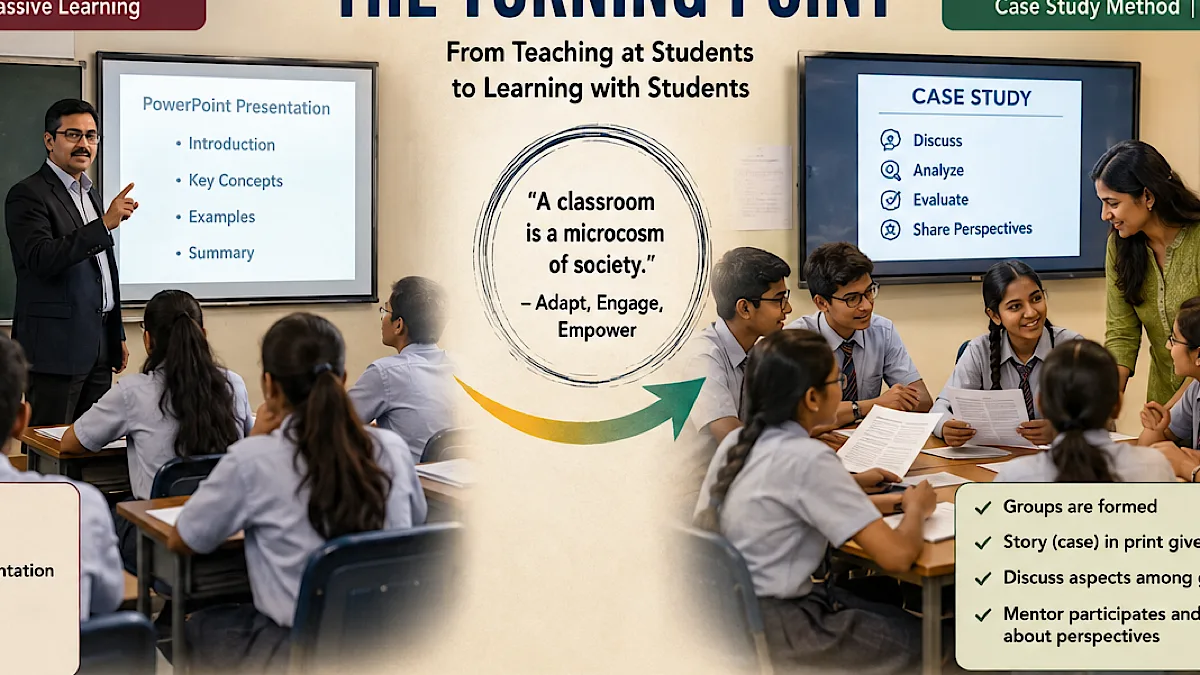
Imagine a scenario when your teacher walks in and defines a concept, draws a diagram, shares a PowerPoint Presentation and solves three tasks with you. Then he assigns a short exercise as an exit ticket. Now imagine another classroom scenario when your mentor walks in, assigns groups, hands out a story in print to each group and asks you to discuss a few aspects amongst your group members. Subsequently, he walks up to each group, participates in your discussions and inquires about your perspectives. Which method would you define as traditional, lecture method and which situation would you define as interactive, learner centric, modern day case study methodology?
The Turning Point When I first started teaching in a classroom, back in 1995, I used to follow the old school method ushered in through the top-down approach. The figure near the blackb oard knows everything attitude gave me a superficial confidence. But it also proved that I had failed to understand the needs of my learners. Time and experience helped me adapt till I discovered the latter method used by my MBA aspirant students in 2004. My horizons expanded. How does it develop critical thinking and problem solving skills? However, there was a catch. What works for L aw and Business Management students need not necessarily work for Literature students at school level. Or will it? Aristotle, in his Poetics, had talked about imitation being the first basis of learning.
Advertisement
I couldn’t resist experimenting when I joined school level teaching. Over years, I had already practised Project Based Teaching and Group assignments. I decided to try a new method. I adapted the case study approach. The Strategy I formed groups with learners having varying abilities. Subsequently, I handed them brief roles. They had to read a lesson, summarise and share their findings. Questions on plot structure, character traits, literary devices, themes, techniques etc. were asked. Students worked in groups, brainstormed and responded. Poems and short stories became ‘cases’. My noisy classroom resembled a fair where groups huddled to exchange opinions, scribble notes and persuade peers. Obser vers wondere d at their enthusiastic engagement.
Even the reticent candidates were drawn in by their classmates – either through writing or through reading. Benefits Engagement was high. Emotions ran higher. Knowledge was shared. Learners became active participants. Opportunities for research was allowed through the use of internet linked smartscreen in the classroom. They read the literature, asked questions, solved puzzles, formed opinions and shared their experiences. Learners evolved. TeacherÊs Role From being a speaker, my role shifted to one who engaged in conversations. I met groups, explained concepts, encouraged debates and allowed contradictions. I even shared digitised checklists to ensure all learners understood and critically appreciated lessons.
Conclusion A classroom is a microcosm of society. The learners have multiple interests and varie d levels of understanding. A one size fits all attitude does not help. It requires extensive planning & effective designing in order to prepare students to learn how to discover uniqueness, think critically, analyse lesson, evaluate content, identify problems, solve issues tactfully & practically and of course, be motivated to create original stories or poems. Students become lifelong learners, and grow confidence in inductive thinking. Reference: (Bonney, 2015; Brslin, 2008; Herried, 2013; Krain, 2016)
(THE WRITER IS COORDINATOR, MAHADEVI BIRLA SHISHU VIHAR; SERIES EDITOR, ENGLISH PRESS; MEMBER, IPPL)