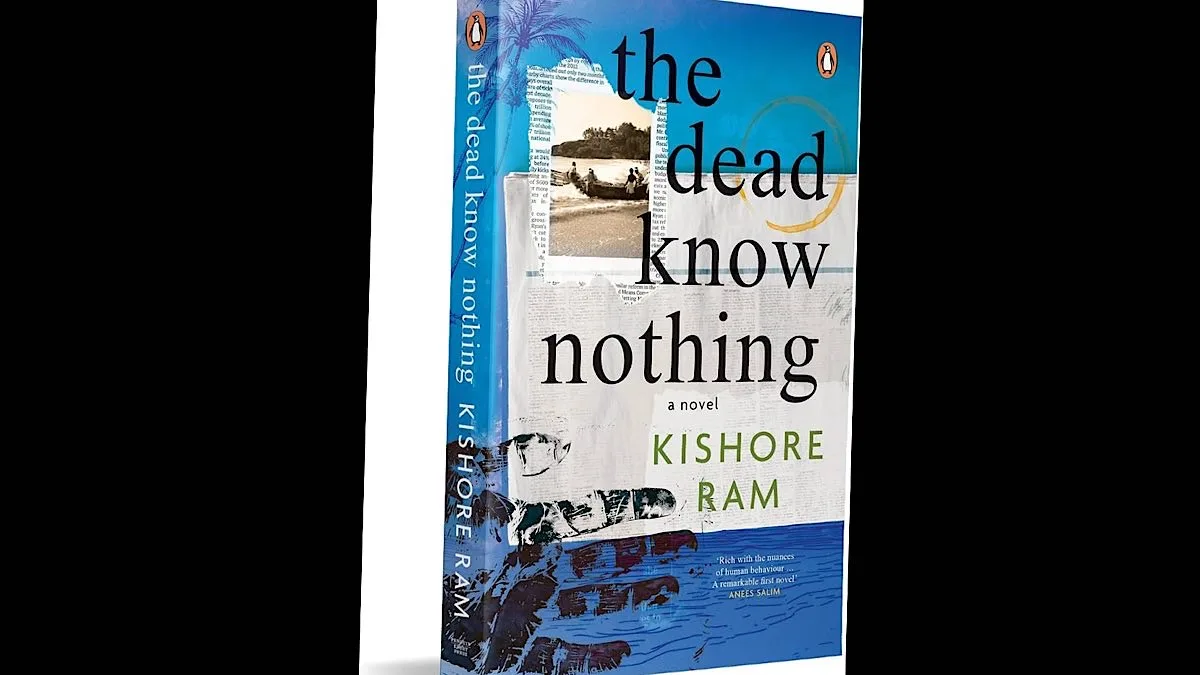
The tautologous title and two and half pages of acknowledgements serve to advertise the fact that this is a first novel by the author, something underlined by the redundant words ‘a novel’ on the front cover following the title. And yet this first-time product by Ram ‘The Dead Know Nothing’ is well worth the time spent in reading it, being a multi-layered and evocative work that will stimulate considerable thought while and after reading.
What is it with our Malayali brethren and Indian literature and innovation these days? Jeet Thayil, Arundhati Roy, Shashi Tharoor and Shinie Antony fill the pages with luminous prose and two actresses from Kerala starred in ‘All We Imagine as Light’ that won the Grand Prix at Cannes last year. Kishore Ram, also a Malayali and writing about Kerala, has a good future as an author of fiction.
Advertisement
The main character in the plot of this dense and sometimes challenging novel is former Christian seminarian Thankachan and the whole web of personal interactions and intrigue swirls around him. He is a Candide-like figure in the sense that he suffers great privations throughout the story, though his environment remains largely rooted to one Kerala island and is no world traveler like Voltaire’s anti-hero. A failure in examinations, sometimes through no fault of his own, he is overshadowed by Mathappan his elder brother with a dubious reputation, and he is cruelly used by nearly everybody he comes across. He is obliged to become a fisherman like his father and brother for want of any other career option, and becomes involved willy nilly in the murders and disappearances in the adjacent seas.
Ram introduces various salacious sections such as masturbation, homosexual eroticism, voyeurism and prostitution, though some such episodes appear to be introduced as artifices, seemingly as if the author felt it was necessary to add periodic spice to the text by picturing a degenerate scenario for his characters. These add little to the main narrative and often detract from it. In addition, the portrayal of extreme police brutality and their propensity to inflict torture and beatings on every man and woman who is unfortunate enough to fall into their ken, has more than an element of gratuitousness about it.
More serious still for this first novel, there is a multiplicity of characters, mainly male, in the narrative, which is helpful to set the scene but which can be somewhat overwhelming for any reader seeking to plot the complicated story line with attention. Another issue is the use of romanised text for the Malayali language. There is an age-old unresolved debate as to whether Indian words should be transcribed phonetically or whether texts in the English language should be rendered as translations into English. Ram’s book can be seen as a cautionary tale as far as the use of the vernacular is concerned.
One might have thought that the many luminaries that Ram has acknowledged might have advised him otherwise about these pitfalls, or perhaps he did not solicit their views. There are few women of any consequence in this novel. There is Thankachan’s mother, a formidable figure as a fish seller and matriarch but in the novel’s action she is still on the periphery. There is also Bushra, a Muslim woman who appears towards the end of the book as a putative widow whom Thankachan falls for but the marriage is thwarted (yet another tragedy for Thankachan) by the unexpected appearance of her husband who was presumed dead. One might critically say that the main females in this book are either harridans or sex objects. Thankachan’s two sisters hardly appear in the story.
All the above is not to say Ram’s book lacks merit. It definitely does not; on the contrary, despite the pervasive gloom, the setting is skillfully narrated and with considerable expertise in topography and fishing. The Hindu-Christian-Muslim underlying tension is well managed without being brought to the fore; similarly with the Tamil-Malayali persons, the main male characters whether appealing or otherwise, are deftly traced, the relevance of the Christian ethic and the frailties of the clergy are perfectly described without any condescension or compromise. Especially moving and realistic is the anxiety and helplessness of the fisherfolk when they come to know that they are being uprooted as illegal occupiers from their ancestral island as a consequence of not having legal title – which is the last thing they would have thought of or even managed to obtain – and their plight is due to the machinations of money men, real estate developers and crooked officialdom.
This is a dark novel, hardly light reading either in style or content. The picture Ram paints is both moving and harrowing and there seems to be little happiness in store or prospects for a better life for Thankachan or his associates in this portrayal of island life. This may indeed reflect the sad reality of the fisherfolk that Ram has drawn upon. Candide was driven in the end to reject the Panglossian view that “All’s for the best in the best of all possible worlds” — a phrase from Voltaire’s Candide used to contest the optimistic philosophy of Gottfried Leibniz, who argued that God must have created the perfect world, meaning all suffering is part of a grand plan. Ram does not permit his fictional Christian characters to reject Leibniz and draw the same conclusions as Candide, but they can be forgiven if they did so.
The Dead Know Nothing
By Kishore Ram
Ebury Press, Gurugram, 2025, pp 247, Rs 399/=
(The writer is a former foreign secretary)