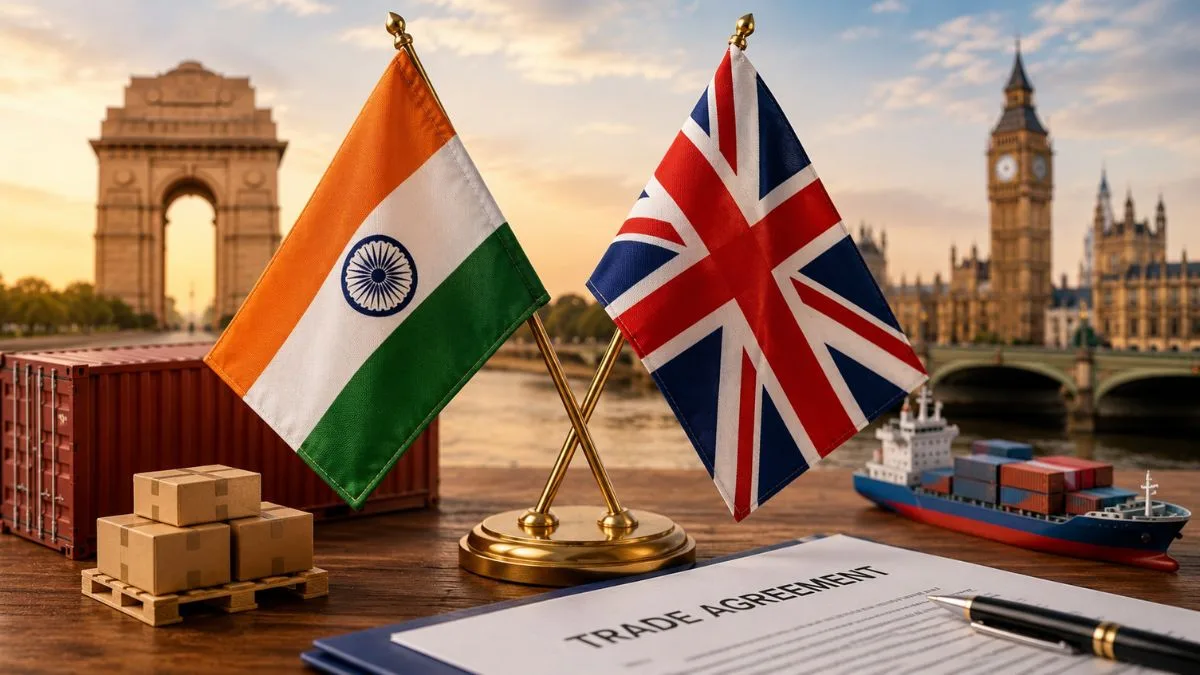
The India-United Kingdom Free Trade Agreement ~ that took effect on Thursday ~ is being hailed as a landmark achievement, but its true significance lies less in the tariff schedules than in what it signals about India’s evolving place in global commerce. At a time when protectionism is rising and supply chains are being redrawn, New Delhi has secured preferential access to one of the world’s largest consumer markets while reinforcing its credentials as a reliable trading partner.
The immediate beneficiaries are easy to identify. Labour-intensive sectors such as textiles, garments, footwear, leather goods and marine products stand to gain from the elimination of duties that had long eroded India’s competitiveness. For years, exporters from Bangladesh and Pakistan enjoyed preferential access to the British market, forcing Indian manufacturers to compete at a structural disadvantage despite comparable production capabilities. That imbalance has now been addressed.
Advertisement
Yet it would be premature to view the agreement as an economic windfall. Free trade agreements create opportunities; they do not guarantee outcomes. India’s experience with previous trade pacts has demonstrated that tariff concessions often remain underutilised because businesses, particularly smaller exporters, struggle with rules of origin, documentation requirements and compliance procedures. Unless industry associations and government agencies actively help firms navigate these complexities, the headline gains may remain confined to a handful of large exporters.
Nor have all barriers disappeared. Britain’s continuing safeguards on sensitive sectors such as steel and the impending Carbon Border Adjustment Mechanism illustrate how modern trade policy is increasingly shaped by environmental standards and domestic industrial priorities rather than tariffs alone. As developed economies tighten climate-linked trade rules, Indian exporters will have to improve energy efficiency and reduce carbon intensity if they wish to preserve their competitive edge. The agreement also reflects a broader geopolitical reality. Since Brexit, the United Kingdom has sought to redefine its commercial relationships beyond Europe, while India has become more willing to negotiate comprehensive trade arrangements with trusted partners after years of caution.
This convergence of interests has produced a pact that extends beyond merchandise trade to investment, services and long-term business confidence. Consumers on both sides should benefit from greater product choice and lower prices in selected categories. However, the larger prize lies in investment decisions that may now favour India as a manufacturing base for exports to the UK. Businesses expand capacity not merely because tariffs fall, but because policy certainty encourages long-term planning.
Ultimately, the success of this agreement will not be measured by the celebratory announcements that accompanied its signing, but by export volumes, factory employment, investment flows and market share over the coming years. If Indian industry responds with greater competitiveness and the government ensures effective implementation, the pact could become a template for future trade negotiations. If not, it will remain another well-intentioned agreement whose promise exceeded its