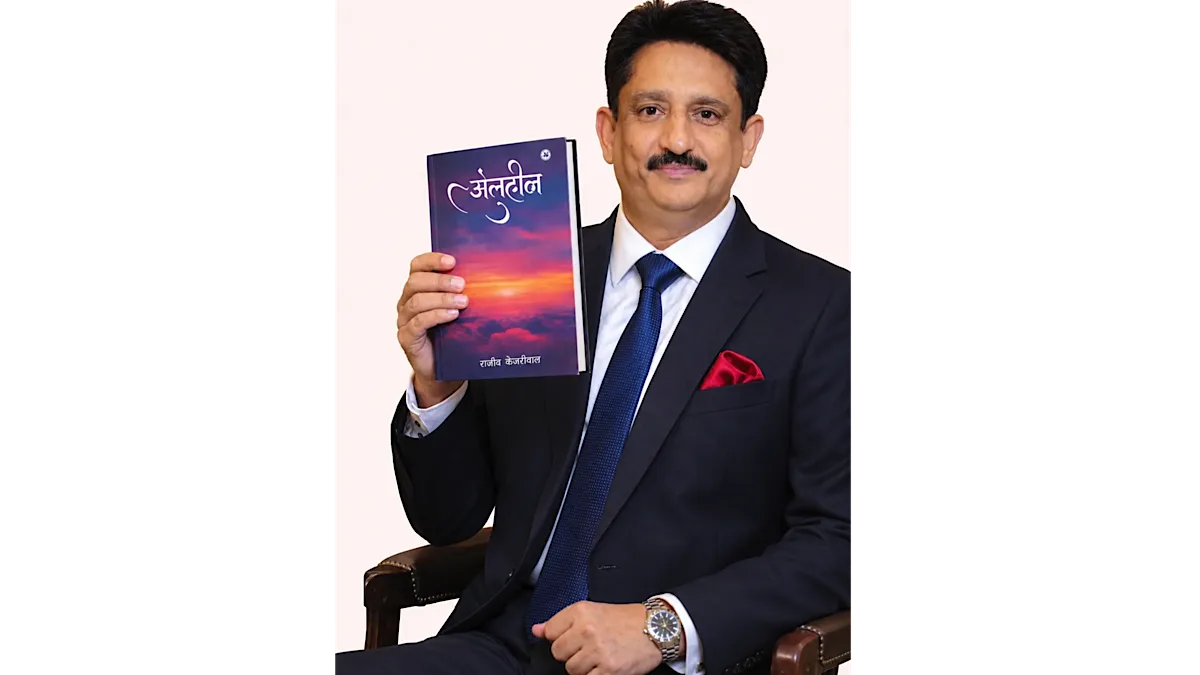
Rajeev Kejriwal’s Antheen occupies a special niche in the contemporary Hindi poetry precisely because of its quiet subtleness and deep contemplations. In an age when so much of poetry is out there making bold assertions, exhibiting emotional upheavals or stylistic ornateness, this collection, instead, chooses to look inward with a kind of profound attention that is indubitably rare to find.
The title of the book “endless” is not merely decorative or ornamental. It throws adequate light on the very movement of the idea couched in poems. When we read the poems, enshrined in this anthology, we find the poems are not merely breathless entities, they are pulsating with life. It appears to a reviewer as if she holds communion with lines as they circle back, pause, and reopen, mirroring the recursive nature of memory and human consciousness. In that sense, it will be apt to remark that Antheen belongs to a contemplative tradition in Hindi poetry which gives preference to lived experience over mere rhetorical display. The fact can not be refuted that Kejriwal is known for his austere minimalism.
Advertisement
His language does not indulge in florid expressions, rather it leaves an indelible impact on the minds of the readers with a remarkable deliberate silence. As a reviewer, my attention is immediately drawn to a line like “Baandh mazboot hai par daraar apni kahani khud likhti hai” (The structure stands firm, yet the fracture writes its own story). In a single sentence, the poet attempts to capture the subtle conflict between outward stability and inner fracture with commendable precision. Another, line “Ichchhaen zarurat ka roop lekar humein hi samjhane lagti hain” (Desires assume the form of needs and begin to instruct us), gives us a sense unsettling reflection on how we deceive ourselves in modern life and remain struck in the trap of desires.
Here one is also reminded of another poet Kedarnath Singh, who too elevates the everyday into a space for contemplation. But where Singh often expands outward through metaphor, Kejriwal tends to withdraw, letting silence itself do much of the work. The echos of Agyeya’s reflective clarity also do catch our attention but Kejriwal’s voice feels more approachable and less experimental. If we step back, Antheen participates in a larger, cross-cultural conversation about introspective poetry. Rilke’s famous advice to “live the questions now” resonates strongly here; these poems rarely offer tidy answers, preferring instead to dwell in uncertainty. Emily Dickinson’s notion that “Forever is composed of nows” sheds light on the collection’s temporal rhythm: each poem seizes a fleeting moment that nevertheless points toward something ongoing..
What distinguishes Kejriwal, of course, is his firm rootedness in Hindi; the philosophical dimension never drifts into abstraction because the language remains immediate and grounded, exuding a sense of spontaneousness. Over the course of the book, the idea of the “endless” deepens into a rare reflection the metaphysical concept of immorality, what we might call a lived form of the permanence of soul vs the impermanence of this perishable body. The poet does not make any endeavours to impose his ideological viewpoints on the readers, rather he gives credence to the idea of accepting the ultimate truth with a stoic’s smile on his face. His poems do not try to close this process down with any finality, they inhabit it. Each one feels self-contained yet opens outward into the reader’s own reflections.
Here comes the role of “reader response theory” which breeds multiple interpretations of a same poetic piece which is rather the real beauty of literature. In a literary culture that often prizes immediacy, closure, and quick consumption, Antheen asks for something slower and quiet, again reminding us of Pablo Neruda poem “The keeping Quiet”. In the nutshell, Antheen is an anthology of 108 poems which merits re-reading. It reminds us that the most lasting poetry often speaks in a lower register, allowing the reader the full liberty of formulating their own meanings.
(THE WRITER IS A NOTED SCHOLAR OF HINDI AND ENGLISH LITERATURE)