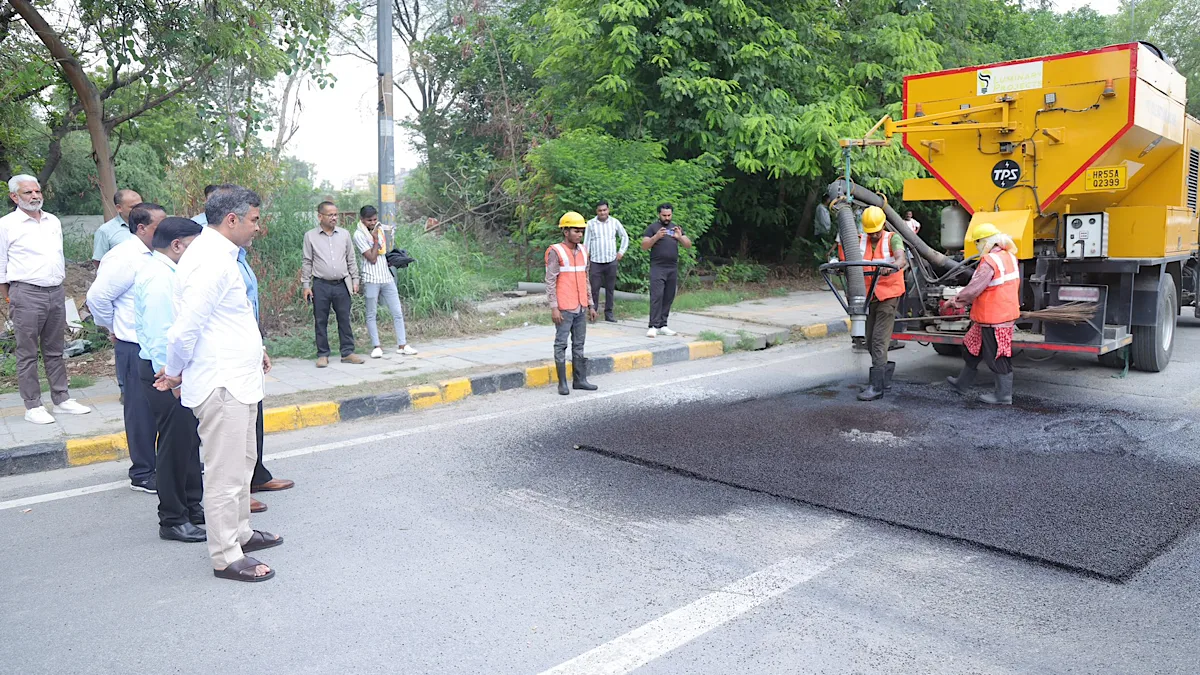
Delhi PWD Minister Parvesh Verma on Tuesday witnessed the trial of ‘Spray Injection Patching’ technology, an innovative and fully mechanised solution for repairing potholes in an effective and long-lasting manner.
Verma noted that the technology offers faster, more durable and all-weather road maintenance with minimal inconvenience to the commuters. He said if the trial meets expectations, the department will explore its wider adoption to strengthen Delhi’s road maintenance system.
Advertisement
“Our focus is to embrace proven modern technologies that deliver better roads, greater efficiency and a smoother travel experience for the people of Delhi,” he added.
The spray injection patching is a fully mechanised single-machine method for lasting pothole repairs. In this process, the machine cleans the pothole with high-velocity air, applies a bonding coat of bitumen emulsion, and injects emulsion-coated aggregate under high pressure, achieving compaction through injection velocity itself, with no rolling required.
Notably, with the use of this technology, each pothole is repaired in just 2 to 5 minutes and the road opens to traffic immediately. This features durable, permanent repairs, as the emulsion bonds the fill material to the pothole walls, giving a repair life of several years, compared to conventional cold mix patches that typically fail within weeks.
Interestingly, with its all-weather capability, the method works in wet and cold conditions, allowing repairs to continue through the monsoon, when potholes form fastest and conventional methods cannot be used.
This also has a high output as a single machine with a small crew can repair 100–150 potholes per day, covering a large road network in lesser time.
Being a mobile and self contained operation, it also enables minimal traffic disruption with no lane closures, and the road open within minutes.
The process is also said to be eco-friendly as it involves a cold-applied process with no hot mix plant operation, significantly lower fuel consumption and emissions, and zero material wastage since only the required quantity is mixed and sprayed.
Notably, the technology is well established internationally and has already been widely adopted by road agencies across Haryana, Jammu and Kashmir, Maharashtra, Madhya Pradesh, Goa, Karnataka and Telangana, for rapid, durable and sustainable road maintenance.