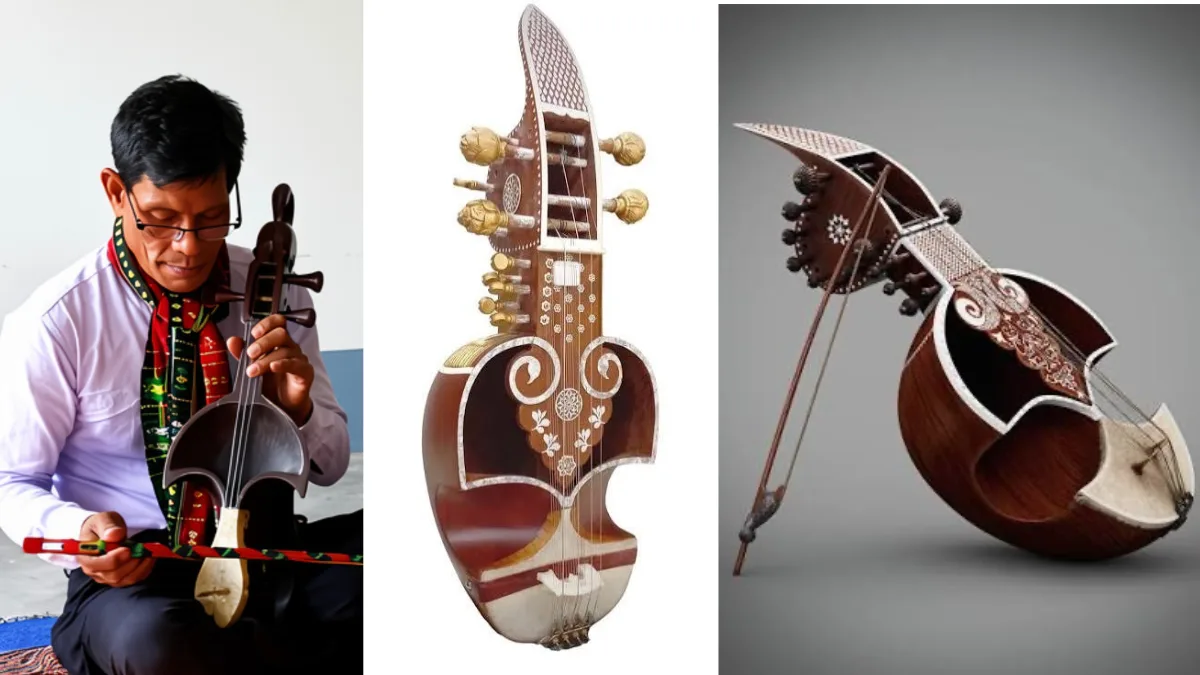
For decades, the survival of ‘Sarinda’, Tripura’s ancient stringed instrument, rested precariously on the calloused hands of a few tribal craftsmen. Carving it out from a single block of wood required gruelling physical labour and the financial return was never enough to even cover a family’s basic necessities.
The younger generation often traded this traditional carving bow for a city retail job which gradually led to the extinction of the music of the hills.
Advertisement
But a recently finalised legal document has just changed the equations. By securing a Geographical Indication (GI) tag, Tripura has turned their traditional tribal music into a legally protected luxury asset.
Advertisement

This move has not only helped Tripura economically but has also drawn a line against cheap, factory-made imitations, turning a regional heritage into a premium livelihood opportunity.
Unlike musical instruments like violin or guitar, assembled from pieces of treated wood, a ‘Sarinda’ is an exercise in hyper-local raw artisanship.
A master craftsman first starts with a single, solid log of local wood which is usually taken from the Gamari or Jackfruit tree by simply using hand tools. Then they gradually hollow out the lower body creating a skin-covered resonator, while the top of it is sculpted into an elegant, birds-in-flight motif.
It is a long-term process and yet in the unregulated Northeast handicraft market, Sarinda was sold out to the tourists or the middlemen at a cheap price.
“You cannot expect a young man to sit and carve wood for months if he can make triple that amount working at a shopping mall in Guwahati or Delhi,” a cultural researcher based in Agartala said.
“The tragedy of Sarinda was not a lack of cultural pride rather it was simply a failure of economics and the Northeast handicraft market. The craft was bleeding its youth,” he added.
The GI tag thus disrupts this unfortunate cycle by introducing the concept of legal exclusivity. Selling a mass-produced synthetic stringed instrument as an authentic Tripura Sarinda is now a punishable offense just like counterfeiting a luxury watch is.
This immediately creates an economic leverage for the tribal craftsmen. With this legal collective, the weavers and luthiers of Tripura can bypass these exploitative middlemen. This GI tag serves as the global stamp of authenticity, allowing these artisans to demand a hefty price from collectors, musicians and institutions all across the world.
This strategy can be considered as a part of a larger and highly calculated economic playbook by the state. The Sarinda now follows the successful commercialisation of their other indigenous assets like the Tripura Risha and Tripura Queen Pineapple.
Tripura Risha is the state’s traditional handwoven tribal fabric, once just a local wear, now used for national fashion runways. Similarly Tripura Queen Pineapple, a local agricultural product, now commands premium prices in global export markets.
With the addition of Sarinda to Tripura’s portfolio, the state is now weaponising intellectual property to build a unifying, premium brand for their tribal economy.
The ultimate success of the GI tag won’t be measured by certificates in government offices, but definitely by the kitchen tables of the tribal luthiers. If this legal shield can multiply the market value of a hand carved Sarinda, then it would undoubtedly transform the instrument from merely a dying relic into an elite career choice.
Even for the youth of Tripura this will not just be a cultural preservation but also financial stability which can transform their lives. This would provide them a reason to stay in the hills, in their native land, pick up the adze and chisel and follow the footsteps of their ancestors.
As this melancholic pull of the Sarinda bow has long been described as the voice of Tripura’s soul, now the piece of legal paperwork finally voices the financial muscle to ensure that it never gets silenced.
Advertisement