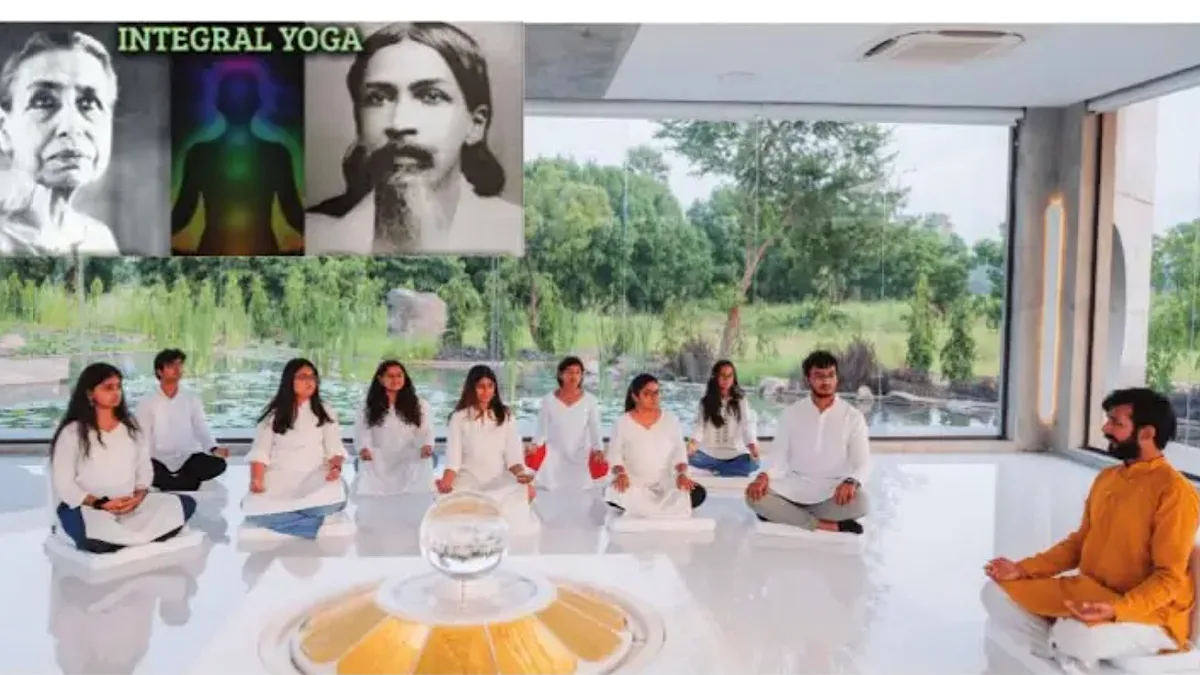
In an age marked by rapid technological advancement, material aspirations, and existential uncertainty, the search for deeper meaning and spiritual fulfillment has gained renewed urgency. Among the many philosophical and spiritual systems that seek to reconcile the material and the transcendental, the Integral Yoga propounded by Sri Aurobindo stands out as a profound and transformative vision. It is not merely a system of meditation or renunciation, but a comprehensive philosophy of life that aims at the total transformation of human consciousness.
Instead of fighting narrow battles of religious or spiritual influences of superiority so common in the present times where no two religious or spiritual leaders speak the same language of the universal man, Sri Aurobindo’s Integral Yoga embraces every caste, creed, race and gender with equal fervor since his yoga does not see man as a product of a narrow religious or divisive creed, but as a potentially perfect consciousness waiting for fulfilment. Sri Aurobindo (1872-1950), one of India’s foremost philosopher-sages, envisioned a spiritual evolution that transcends traditional socio-religious boundaries. Unlike classical yoga systems that often emphasize liberation from the cycle of birth and death (moksha) through withdrawal from worldly life, Integral Yoga advocates an active engagement with life.
Advertisement
It seeks not escape from the world, but the divinization of life itself. In a series of articles, later collected in The Life Divine, Sri Aurobindo expounds the concept of ‘yoga’ in all its manifestations, from the perspective of physical well-being to the progressive evolution of the human consciousness freed from caste, creed, dogma or narrow confines of religion. Sri Aurobindo is perhaps the best person in modern times to comment on the relevance of yoga, having experienced vocations as diverse as academics, politics, freedom movement, literature and philosophy, and also guiding the evolution of a spiritual community that runs to this very day inspired by his principles at Puducherry.
At the heart of Integral Yoga lies the idea that human beings are transitional entities in an ongoing process of cosmic evolution. According to Sri Aurobindo, consciousness is not static but dynamic, evolving from matter to life, from life to mind, and ultimately towards a higher, supramental consciousness. This supramental state represents a plane of truth-consciousness where knowledge, will, and delight are unified. The purpose of Integral Yoga is to accelerate this evolutionary process within the individual. One of the distinguishing features of Integral Yoga is its integrative approach. It does not reject the traditional paths of Bhakti (devotion), Jnana (knowledge), or Karma (action), but harmonizes them into a unified discipline.
The practitioner is encouraged to cultivate devotion to the Divine, seek knowledge of the ultimate reality, and perform actions with a spirit of selfless dedication. This synthesis allows for a more holistic spiritual development, addressing all aspects of human nature ~ emotional, intellectual, and physical. Central to this yoga is the concept of the “psychic being,” the evolving soul within the individual that acts as a guide in the spiritual journey. By turning inward and establishing contact with this psychic centre, the practitioner can align with the divine will and experience a deeper sense of purpose and harmony.
This inward movement is accompanied by a gradual purification and transformation of the outer nature, including thoughts, emotions, and physical habits. Another key aspect of Integral Yoga is the transformation of the physical body. While many spiritual traditions regard the body as an obstacle or illusion, Sri Aurobindo considered it an essential instrument for the manifestation of the divine on earth. The ultimate aim is not only spiritual enlightenment but also the transformation of the body into a vessel capable of expressing higher consciousness.
This idea challenges the conventional dichotomy between spirit and matter, proposing instead a unity where both are expressions of the same divine reality. The practice of Integral Yoga does not follow a rigid set of techniques or rituals. Instead, it is a dynamic and individualized process guided by aspiration, rejection, and surrender. Aspiration refers to the sincere longing for spiritual growth; rejection involves the conscious refusal of negative tendencies and egoistic impulses; and surrender denotes the offering of one’s entire being to the Divine.
These three movements form the core discipline of the yoga. Integral Yoga also has significant social implications. In a world divided by conflict, inequality, and environmental crises, Sri Aurobindo’s vision offers a path toward collective transformation. He believed that spiritual evolution is not limited to individuals but extends to humanity as a whole. The emergence of a higher consciousness could lead to a more harmonious and unified global society, transcending divisions of race, religion, and nationality. The practical expression of this philosophy can be seen in the establishment of the Sri Aurobindo Ashram in Puducherry and the international township of Auroville.
These communities aim to embody the principles of Integral Yoga in daily life, fostering an environment of spiritual growth, collective harmony, and sustainable living. They serve as living laboratories for the exploration of human unity and higher consciousness. Critics may argue that the goals of Integral Yoga are too idealistic or unattainable. The notion of transforming human nature and achieving a supramental consciousness may seem distant from the realities of everyday life.
However, Sri Aurobindo did not present his vision as an immediate solution but as a long-term evolutionary possibility. He acknowledged the challenges and complexities involved, emphasizing patience, perseverance, and faith. In contemporary times, the relevance of Integral Yoga is increasingly evident. As individuals grapple with stress, alienation, and a sense of fragmentation, the need for an integrated approach to life becomes more pressing. By addressing the totality of human existence ~ body, mind, and spirit ~ Integral Yoga offers a comprehensive framework for personal and collective transformation.
Moreover, the emphasis on inner change as a precursor to outer transformation resonates with modern psychological and philosophical thought. The idea that lasting social change must begin with individual consciousness aligns with contemporary movements advocating mindfulness, self-awareness, and ethical living. Integral Yoga of Sri Aurobindo represents a bold and visionary attempt to redefine the purpose of human life.
It challenges us to move beyond limited conceptions of spirituality and embrace a path that integrates all aspects of existence. While its goals may appear lofty, they also inspire a deeper reflection on our potential as human beings. In a world searching for meaning and direction, Sri Aurobindo’s Integral Yoga offers not just a philosophy, but a transformative journey toward the realization of a higher consciousness and a more harmonious world.
(The writer is Assistant Professor in English, Pritilata Waddedar Mahavidyalaya, Nadia)