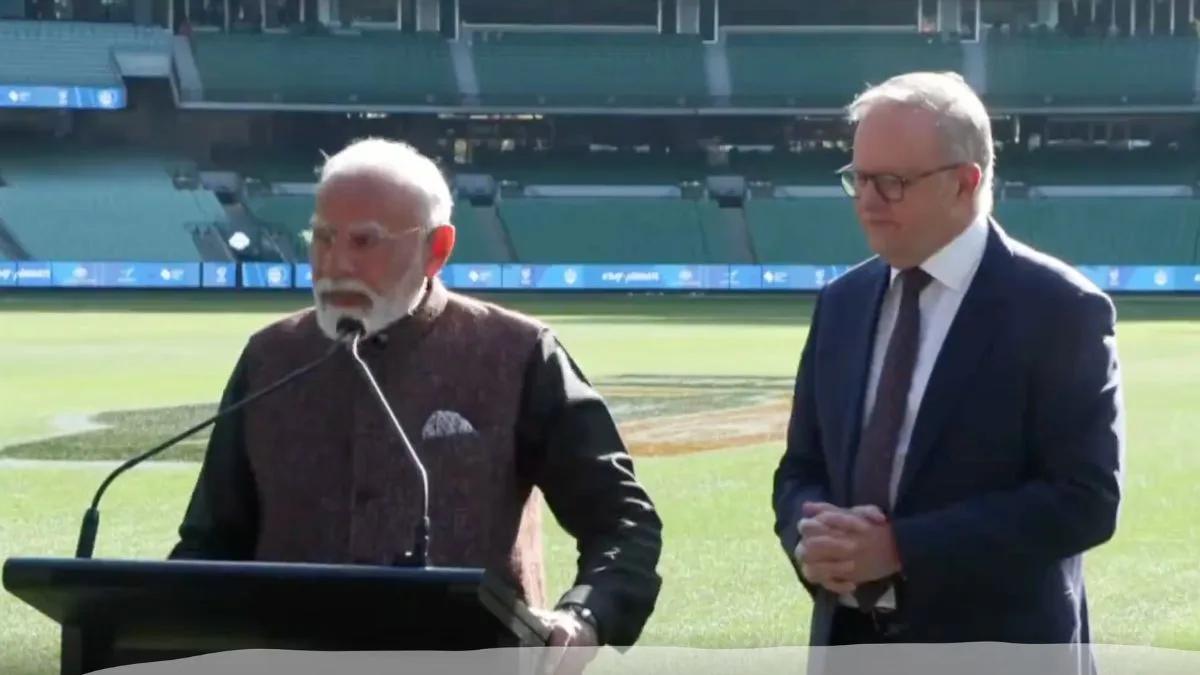
Prime Minister Narendra Modi on Friday visited the iconic Melbourne Cricket Ground (MCG), where he interacted with young cricketers, signed jerseys and met Australia’s international mascot ‘Ruby the Roo’ after holding talks with Australian Opposition Leader Angus Taylor on expanding India-Australia ties.
Australian Prime Minister Anthony Albanese accompanied PM Modi during the MCG visit. Former Australia men’s cricket captain Steve Waugh also joined the leaders at the stadium, along with Victorian Premier Jacinta Allan and former Australian cricketer Lisa Sthalekar.
The two Prime Ministers launched the India-Australia Sports Collaboration Roadmap at the venue, placing sports training, science, technology, infrastructure and athlete development at the centre of a new phase of bilateral cooperation.
The visit to one of Australia’s most recognisable sporting venues comes as India prepares to host the 2030 Commonwealth Games and Australia gears up for the 2032 Olympic Games in Brisbane. India is also seeking to host the 2036 Olympics.
MCG visit puts sports partnership in focus
During his visit to the stadium, PM Modi interacted with young cricketers, signed their jerseys and met ‘Ruby the Roo’, Australia’s international mascot.
Addressing the gathering, PM Modi said the MCG held a special emotional connection for Indians because cricket was a shared passion in both countries.
“After coming to the Melbourne Cricket Ground, any Indian naturally thinks of two things: the thrill of an India-Australia cricket match and the feeling that in both our countries, cricket is not just a game but a shared passion. But today, there is no pressure here; today there is only happiness and the excitement of our shared friendship,” he said.
Launching the roadmap alongside Albanese, PM Modi described sports as a strong link in India-Australia relations.
“Sports is a strong link in the relations between India and Australia. Today, it gives me great joy to launch the India-Australia Sports Collaboration Roadmap alongside Prime Minister Albanese. Under this, we will strengthen cooperation not only in cricket but also in other sports,” he said.
The Prime Minister said the partnership would cover sports training, science and technology as well as cooperation beyond the field.
“We will move forward together in sports training, sports science, and technology. Along with on-field, we will also strengthen our off-field partnership. In India, we have not only democratised technology but also sports,” he said.
He pointed to the Khelo India programme and said sporting talent was now emerging from small towns, villages and ordinary families across the country.
“Through the Khelo India Programme, people from small towns, villages, and ordinary families are getting a platform to dream big. Today, sporting talent in India is not limited to a few big cities. It is emerging from every corner and every background of the country,” PM Modi said.
Earlier, Foreign Secretary Vikram Misri had said PM Modi and Albanese would use the MCG visit to unveil the India-Australia Sports Collaboration Roadmap.
“Prime Minister Modi and Prime Minister Albanese will visit the iconic Melbourne Cricket Ground to highlight one of the other subjects, a growing sector of cooperation between the two countries, which is sports, and they will take this opportunity to unveil the India-Australia sports collaboration roadmap,” Misri had said.
He noted that sports presents significant opportunities for cooperation, particularly with India set to host the Commonwealth Games in 2030 and Australia preparing for the 2032 Olympic Games.
PM Modi said the two major sporting events would require extensive infrastructure and create opportunities for both countries to exchange expertise.
“In 2030, India is going to host the Commonwealth Games. We are also making efforts to host the 2036 Olympics in India. Brisbane will host the Olympics in 2032. To host these global events, sports infrastructure will be prepared on a mega scale. This means that in the coming years, we will get numerous new opportunities to learn from each other and work together,” he said.
Chennai to host first Big Bash League match outside Australia
PM Modi and Albanese also unveiled a historic Big Bash League fixture during their MCG visit, with Chennai set to host the opening match of the 2026-27 season.
Melbourne Renegades will face Perth Scorchers at the MA Chidambaram Stadium on December 12. It will be the first BBL match played outside Australia.
The Renegades will be the home team for the season opener, which will be held after the fourth day’s play in the first Test between Australia and New Zealand in Perth.
“I am happy that a Big Bash League match will be hosted in Chennai, India. Hosting a match in India for any league guarantees a massive reach and viewership,” Modi said.
The fixture is partly funded through a grant from the Centre for Australia-India Relations. Chennai was selected with the involvement of the Board of Control for Cricket in India and Australian Consul-General Silai Zaki.
Cricket Australia said it would aim to fill the 38,000-seat stadium. Australian broadcasters are expected to send commentary teams to Chennai, while JioStar will televise the match for Indian audiences.
Alistair Dobson, Cricket Australia’s general manager of Big Bash Leagues, said the fixture reflected the strong connection between cricket communities in India and Australia.
“Our sport has such an authentic connection in India. This game is also part of a much bigger initiative across both our governments and shows that cricket is a connector for both our countries, and that both the Australian and Indian governments see that and want to be part of it. We’re hugely excited by the opportunity and we expect the match will be the most-watched game in Australian domestic league history for any sport,” Dobson said.
PM Modi meets Australian Opposition leader Angus Taylor
Earlier today, PM Modi met Australia’s Opposition Leader Angus Taylor, with both sides discussing the expanding India-Australia Comprehensive Strategic Partnership.
Sharing details of the meeting, Ministry of External Affairs spokesperson Randhir Jaiswal said on X, “Prime Minister Narendra Modi met Mr. Angus Taylor MP, Leader of the Opposition of Australia. They held productive discussions on the growing India-Australia Comprehensive Strategic Partnership.”
He added, “The warm and cordial meeting reflected the strong bipartisan support in Australia for deepening ties with India.”
PM Modi also shared details of the interaction on X.
“Met Mr. Angus Taylor, Leader of the Opposition of Australia. We had an engaging conversation on the growing strength of India-Australia ties and the many opportunities ahead. I deeply value the warmth and broad support that our partnership enjoys across Australia,” the Prime Minister said.
Taylor had welcomed PM Modi’s visit a day earlier, writing on X, “Welcome to Australia, Prime Minister Narendra Modi. Our nations share a great friendship, a proud Australian-Indian community and a future full of opportunity.”
Defence, maritime security among key summit outcomes
The meeting with Taylor followed PM Modi’s engagements with Australian Prime Minister Anthony Albanese during the Third India-Australia Annual Summit.
Among the major outcomes announced after the summit were the adoption of the India-Australia Joint Declaration on Defence and Security Cooperation and the India-Australia Maritime Security Collaboration Roadmap. The two countries also agreed to operationalise the civil nuclear agreement that enables uranium exports to India.
The defence and maritime frameworks were among 18 deliverables announced after the summit. The agreements covered energy, cyber security, advanced technologies, mining, higher education, scientific research and cultural exchanges.
According to Foreign Secretary Vikram Misri, the two defence initiatives recognise the need for the partnership to evolve in response to changing strategic circumstances and deepen defence and security cooperation between the two countries.
“These constitute recognition that the partnership must evolve to meet changing strategic circumstances, and they reflect a commitment to advancing our defence and security partnership,” Misri said.