Chronobiology and the Ghost Shift of the Modern Eye
Technology has granted us the ultimate modern freedom: the ability to conquer darkness.
Physicists have long been fascinated with dark matter. Scientists discovered that observable matter, stars, galaxies, nebulae, and planets, can only account for 5% of the universe’s structure.




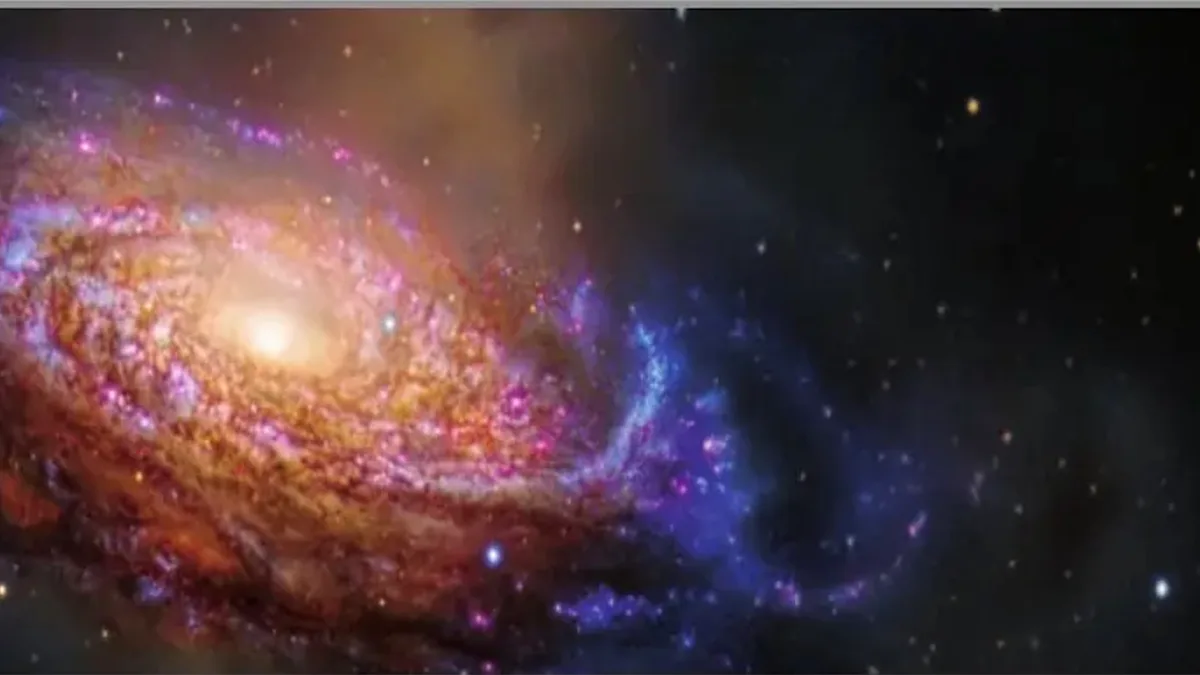
Photo:SNS
Physicists have long been fascinated with dark matter. Scientists discovered that observable matter, stars, galaxies, nebulae, and planets, can only account for 5% of the universe’s structure. The rest comprises around 68% dark energy and 27% a mystery material known as dark matter (DM).
They are invisible to us because they neither absorb nor transmit light. However, their gravitational pull is obvious. No traditional model of the cosmos has been able to explain it adequately. Despite being compatible with several experimental and observational datasets on universality, the Lambda Cold Dark Matter (�CDM) model has yet to provide a solid explanation. G. Liang and R. Caldwell of Dartmouth College recently offered a novel concept that may fundamentally alter our comprehension of the formation of dark matter.
Advertisement
Their article was published in the Physical Review Letters on May 14, 2025. Their idea involves interacting fermions (a type of elementary particle with odd-half-integer spin) that could exist in a condensate similar to the one formed by Cooper pairs in the BardeenCooper-Schrieffer (BCS) theory of superconductivity, which explains how some materials conduct electricity without any resistance and push out magnetic fields (the Meissner effect) below a critical temperature. The Cooper pair is a widely recognized concept in superconductivity. The two electrons near the Fermi surface combine without any hindrance to conduct electricity below critical temperatures. Electrons are fermions, which repel each other due to their similar charges.
Advertisement
Despite this repulsion, the pairing occurs because the phonon-mediated attraction is stronger than Coulombian repulsion under specific conditions, especially below certain critical temperatures. This concept served as a significant source of inspiration for Liang and his professor in the development of this work. Their findings indicate that DM emerged shortly after the Big Bang, during a period when the universe was predominantly composed of massless particles, similar to photons, moving at exceptionally high velocities. The investigation commenced with an examination of novel fermions arising in the Nambu–Jona-Lasinio model (NJL model) of quantum field theory (QFT), which delineates the low-energy dynamics of quarks and mesons.
This model suggests that a specific category of particles, referred to as Dirac fermions, may pair similarly to the Cooper pairs formed by electrons in superconductors. This theory draws inspiration from the BCS theory. Recent cosmological studies, including those on inflation, dark matter, and dark energy, have extensively employed this model. Liang and Caldwell describe a scenario in which NJL fermions decouple from the Standard Model at high temperatures, evolving similarly to radiation.
As the temperature decreases, fermions exhibit increased rigidity. As the universe expands and the temperature decreases beyond a specific threshold, fermions experience a phase transition, resulting in their pairing and the formation of a cold, massive condensate similar to cold dark matter, which contributes to the formation of large-scale structures such as galaxies. The researchers proposed that dark matter particles may create a signature on the cosmic microwave background (CMB) under conditions of very low temperatures and low pressures. The CMB represents the earliest form of light or radiation in the universe, released following the Big Bang.
Despite being a very faint form of radiation, it is dispersed in all directions throughout the universe and can be observed by telescopes located on Earth. Liang and his professor grounded the theoretical calculations of their model on widely accepted concepts, such as the expansion of the universe and the decrease in energy density over time. They assert that they have developed this simple, robust mathematical model without employing any specialized complex variables. Earlier, scientists believed that DM consisted of heavy, slow-moving giant particles.
But Liang’s research says that it was almost as swift as light and massless in the beginning. Later, it cooled down and turned into a heavy particle. This new theory not only explains the origin of dark matter but also explains how the mass density of various cosmic structures increases. The universe’s energy density is diminishing over time! They also expect that data obtained by the Simons Observatory in Chile or telescopes of the upcoming CMB Stage 4 will be able to validate their suggested model in the near future. Caldwell and Liang’s idea, combining particle physics and cosmology, is expected to pave the way for fresh research into dark matter in the near future.
THE AUTHOR IS A SCIENCE WRITER AND RESEARCHER.
Advertisement