How cancelling plans became the best thing Indians do
Someone just cancelled on you. You pretended to be sad for exactly four seconds. Then you pulled up Netflix, got under the blanket, and had the best Friday night of your month.
The recent austerity appeal of the Hon’ble Prime Minister aligns closely with his global vision of “Lifestyle for Environment” (LiFE), which he consistently advocates on global platforms.




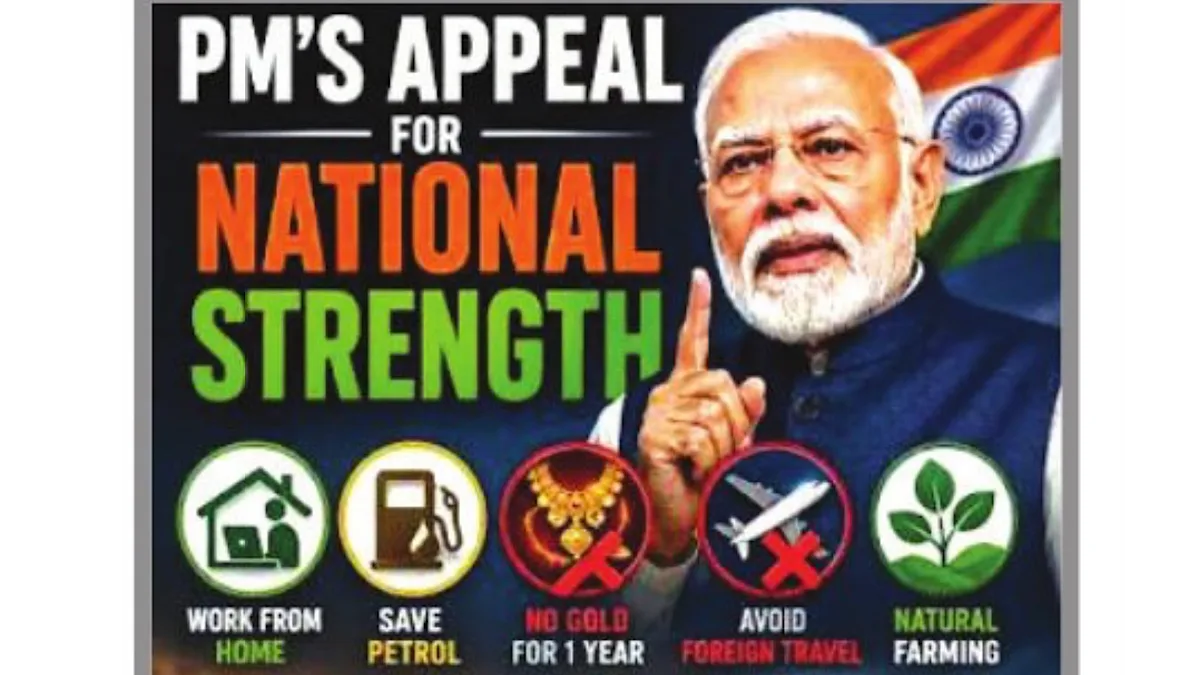
Photo:SNS
The recent austerity appeal of the Hon’ble Prime Minister aligns closely with his global vision of “Lifestyle for Environment” (LiFE), which he consistently advocates on global platforms. The Prime Minister has urged citizens to avoid extravagant expenditure in view of disruptions in global supply chains caused by the West Asia crisis. He appealed to people to postpone, as far as possible, non-essential purchases such as gold and to refrain from organizing expensive weddings abroad. He also encouraged the use of carpooling and public transport such as metro services and buses to reduce the consumption of petrol and diesel.
In addition, he has advised farmers to adopt chemical-free farming practices and to increase the use of natural fertilizers, thereby promoting environmental sustainability in agriculture. These appeals are both timely and visionary. Austerity should not be interpreted as deprivation, but rather as a reflection of wisdom, discipline, and responsibility toward environment. At the core of this message lies a fundamental principle: lifestyles must be need-based rather than greed-based. The Prime Minister’s appeal strongly resonates with the philosophy of climate-conscious living.
Advertisement
The “Lifestyle for Environment” (LiFE) initiative emphasizes that the environment cannot be protected solely through government policies or technological interventions; real transformation must begin with individuals and communities adopting sustainable habits in their daily lives. Paradoxically, even as economic growth reaches unprecedented levels, environmental stability and mental well-being are declining. Need-based living offers a balanced alternative. It encourages responsible consumption, minimization of waste, and respect for ecological limits. Far from opposing development, it promotes sustainable progress where economic growth and environmental protection move together. Indian civilization has long upheld such values.
Advertisement
A key pathway to realizing this vision is the adoption of a circular economy as an integral part of economic systems. The conventional linear model of “take, make, use, and dispose” has led to severe environmental degradation. It has resulted in excessive waste generation, pollution, and depletion of natural resources. In contrast, a circular economy offers a sustainable alternative. It focuses on reducing waste, reusing materials, recycling products, repairing goods, and enhancing resource efficiency. In such a system, products are designed for durability, repairability, and recyclability, ensuring that waste from one process becomes an input for another. India has the potential to emerge as a global leader in the circular economy.
The culture of reuse and repair has historically been embedded in society. With the support of modern technology and innovation, these traditional practices can be significantly strengthened. The benefits of a circular economy are wide-ranging. It reduces pressure on natural resources, lowers carbon emissions, creates green employment opportunities, fosters innovation, and strengthens economic resilience. Most importantly, it ensures that development does not come at the cost of environmental destruction. Therefore, environmental protection must become a shared global responsibility. Governments, institutions, industries, and citizens all have a role to play.
Small individual actions – such as conserving electricity, reducing fuel consumption, avoiding plastic waste, planting trees, and adopting sustainable habits – can collectively lead to transformative change. The Prime Minister’s vision rightly emphasizes that climate action must evolve into a people’s movement rather than remain confined to government programmes. When citizens voluntarily adopt environmentally responsible lifestyles, the impact becomes both widespread and enduring. It is equally important to acknowledge that war remains one of the greatest threats to the environment. Conflicts not only cause immense human suffering but also inflict long-lasting damage on ecosystems and environment.
Bombings destroy cities, industries, forests, and agricultural land. Toxic emissions pollute air and water, while oil spills, fires, and chemical contamination leave lasting environmental scars. Post-war reconstruction further intensifies resource consumption and environmental burden. Wars diverts critical resources away from development and climate action. Funds that could otherwise support environmental protection are instead spent on weapons and destruction. Peace is therefore essential for equitable distribution as well as to protect environment. The appeal for austerity by the Prime Minister in response to global crises should thus be viewed not as a temporary adjustment but as an opportunity for long-term societal transformation. It encourages citizens to rethink priorities, redefine prosperity, and embrace lifestyles that are sustainable, ethical, and environmentally responsible.
By embracing austerity, responsible consumption, circular economy practices, and environmental stewardship, citizens can contribute meaningfully to climate change mitigation and national resilience. The Prime Minister’s vision reflects a deeper aspiration for the nation- where economic resilience, environmental sustainability, and global peace are interconnected. The success of this appeal will depend on its transformation into a mission-mode initiative. The Central Government, State Governments, Members of Parliament, public institutions, and large industrial houses must lead by example as role models to citizens.
Responsible conduct and restraint in displaying wealth and consumption patterns must become the norm, so that the message of austerity is reflected as the acceptable norm. Display of wealth should be seen as repulsive. Only when this vision is embraced collectively, can India can truly advance the “Lifestyle for Environment” (LiFE) mission in both spirit and action. In doing so, India will emerge as a “Vishwa Guru” – not merely through economic strength, but by demonstrating to the world a model of purposeful, sustainable, and responsible living.
(The writer is Director, Indrax-Safety and Energy Solutions, Managing Director, Greenstat Hydrogen India Pvt. Ltd. and former Chairman, EAC – Ministry of Environment, Forest & Climate Change. He can be reached at jeewanprakashgupta@indrax.co.in)
Advertisement