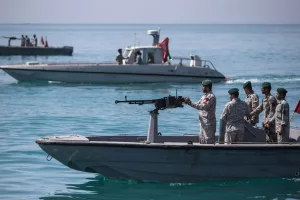
The United States and Iran have agreed to temporarily halt military strikes and will meet in Doha on Tuesday to address tensions over the Strait of Hormuz, according to a report by Axios.
The reported understanding comes after days of military exchanges raised concerns over commercial shipping through one of the world’s most important maritime routes. The upcoming discussions are expected to centre on navigation and security in the Strait rather than Iran’s nuclear programme, which had initially been the focus of the negotiations.
Advertisement
According to Axios, citing US officials, both countries have agreed to stand down “for now”, allowing commercial vessels to move freely while technical discussions continue.
The talks were originally scheduled to take place in Switzerland. However, renewed tensions in the Strait of Hormuz led to the venue being shifted to Doha, Qatar, with shipping security becoming the immediate priority, according to the report.
Axios also reported that negotiators had previously agreed in Switzerland to establish a direct “hotline” between the US military and Iran’s Islamic Revolution Guard Corps to help coordinate vessel movements through the strategic waterway. The communication channel, however, had not become operational as of Saturday.
Military exchanges preceded reported breakthrough
The diplomatic push follows another round of military action between the two countries.
According to the US, it carried out strikes on Iranian targets on Friday and Saturday after accusing Tehran of continuing attacks on commercial shipping in the Strait of Hormuz. Iran responded by targeting US military positions in the region.
On Saturday, US President Donald Trump said American forces had launched fresh air strikes against Iranian military infrastructure after accusing Tehran of violating the ceasefire by attacking the Panama-flagged tanker M/T Kiku, which was carrying more than two million barrels of crude oil.
The US Central Command (CENTCOM) said the tanker was struck by what it described as a one-way Iranian attack drone while transiting near the Strait of Hormuz.
In a post on Truth Social, Trump said US aircraft had targeted Iranian missile and drone storage facilities along with coastal radar installations.
“United States aircraft just struck Iranian missile and drone storage locations, and coastal radar sites, for violating the Cease Fire Agreement, AGAIN! It is very possible that they will never learn!”
“There may come a point when we are no longer able to be reasonable, and will be forced to militarily complete the job that we very successfully started. If that happens, the Islamic Republic of Iran will no longer exist!” he wrote.
CENTCOM said Iran had been given an opportunity to comply with the ceasefire after US strikes carried out in response to an earlier attack on M/V Ever Lovely.
Iran asserts role in managing Strait
Meanwhile, Axios reported that both governments had agreed to stop “all the kinetic activity”, quoting a senior US official.
Another official told the publication that both sides would stand down “for now” while negotiations continue.
Meanwhile, Iranian Foreign Minister Abbas Araghchi said Iran has the exclusive right to manage traffic through the Strait of Hormuz under what The Wall Street Journal described as a preliminary peace agreement.
According to The Wall Street Journal, Tehran maintains that it will oversee arrangements for the safe passage of commercial vessels and determine the future administration of maritime services in consultation with regional countries. The United States has disputed that interpretation and has argued that navigation through the international waterway must remain unrestricted.
The reported Doha meeting comes as both sides seek to prevent further escalation around the strategically important shipping corridor.