Father-son relationships are not new in Indian cinema. But few remain etched in our memory as unforgettable slices of life seen through the lens of a movie camera and from the perspective of a director. One of the more recent and memorable films that explores the father- child relationship across three generations is Buddhadeb Dasgupta’s Kaalpurush (2008). It is a poetic saga of a son, Sumanto (Rahul Bose) and his dead father Ashwini (Mithun Chakraborty) who dream of a dream village called Kusumpur they wish to visit or live in some day.
Kaalpurush details a father-son relationship that crosses borders of time and space, the terrestrial and extra-terrestrial, the dead and the living and raises questions about ‘success’ and ‘failure.’ Buddadeb Dasgupta uses an anti-narrative, non-linear structure to tell a linear story. The film closes on an optimistic note with Sumanto and the kids on a beach with the nonsense rhyme playing on the soundtrack. Is the dead Ashwini visiting his son to purge himself of the desire to talk to him? Or does he exist only in Sumanto’s imagination? Words unsaid, actions misunderstood, expressions read differently, dreams fulfilled and unfulfilled, make the core of this film.
Advertisement
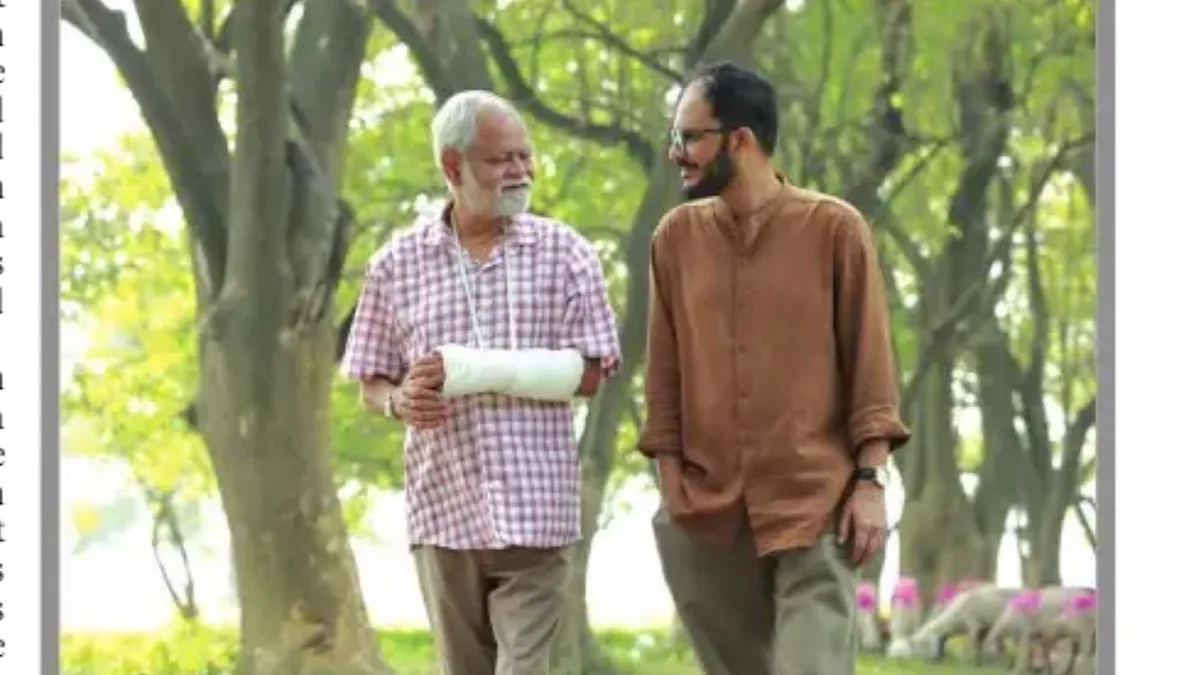
Phera is also a father-son story where the father, Pannalal (Sanjay Mishra) is a football coach deeply interested in having his club compete in a forthcoming tournament. His grown so Polash (Ritwik Chakraborty) lives in Kolkata, holds an ordinary job and is somewhat distanced from his father’s life. But the ancestral home in which Pannalal lives is in desperate need of repairs as a roof is leaking, the plaster on the walls are peeling off and the home is becoming impossible to live in. When Pannalal’s pleas for help from Polash goes unheeded, the old man visits his son in Kolkata appealing to him for funds but Polash says he can only raise the funds with a loan. Pannalal needs to prolong his stay because he takes a bad fall and fractures his arm.
This circumstantial ‘togetherness’ bring the father and son together to suggest not only that a father and son who do not look eye-to-eye can still love each other and care for each other deeply. The son scolds his father when his father ’s manners se em unsophisticated to him. But at the same time, he takes him regularly to the orthopedist for his dressing. There are a few beautiful touches such as the father-son strolling in a park and enjoying ice candies together, or, the son both irritated and worried when the father locks himself outside by mistake and is forced to wait for his son’s return in the young landlady’s flat.
These are the small bits and pieces of the sweet-and-sour rapport between an unambitious son and a father with the very simple dream of coaching his football pupils to victory and of rebuilding his ancestral home to make it at least livable. Director Pritha Chakraborty keeps total control over her understated screenplay and even when there was a slight possibility of romance, she steers clear of it choosing to keep her focus to tally on the father- s on relationship. They even share a peg or two together but their financial needs remain wanting.
The sub-track of the young landlady (Sohini Sarkar) and her squabbles with her husband could have been clipped as it adds little to the main plot though Sohini is wonderful in her cameo. Rather, her bonding with the old man is a good addition to the main story. Sanjay MIshra as the father and Ritwik Chakraborty as the son come out with brilliant performances that are both spontaneous and organic in every sense. The football ground in the village, the meeting among the local club’s elderly higher-ups, Pannalal’s friendship with his cat and her kittens, the brambles and bushes around the house embellish the physical ambience aptly.
Polash’s city flat, a rented one, is darker in comparison. One good point is that except for one or two scenes, Polash’s office situation is kept in the margins. Ritwick Chakraborty is an actor without the glamour of ever becoming a superstar. But it is this very lack of glamour and X-factor that makes him one of the most-in-demand actors in Bengali cinema today. The entire film never shouts or screams or even whispers but keeps the pitch and volume of the dialogue quite low-key yet audible. The cinematography (Subhankar Bhar) captures the scenes of the tea-stall, the emptiness of the landlady’s apartment, quite naturally without any pomp or show which might have disturbed the low-key scenario.
The editing (Subhajit Singha) moves seamlessly between and among the city and the small town and also the crowded lanes of the city to finally land in front of an open beach in Mumbai where Polash meets a migrant Bengali who misses home and he makes his final decision – he wants to return. The only handicap the film suffers from – and it is more a hurdle than a handicap, is the very hard-hitting Bengali spoken by Sanjay MIshra who is not Bengali at all. He has tried his best to acquire the finer nuances but sadly, it is not a language that can be mastered so easily and so soon.
Dubbing the dialogue by a Bengali actor would have lifted the film’s quality by quite a few notches. Or, perhaps showing him as a Bihar migrant married to a Bengali ages ago. According to the young director Pritha Chakraborty, Phera is “a story of quiet reckonings — of what we call success, of how much we leave behind, and what remains when the noise fades. It is about the awkward poetry of returning — not to glory, but to someone who still saves you a seat. Some lives don’t arc. They echo.”
(THE REVIEWER IS A VETERAN FILM CRITIC)