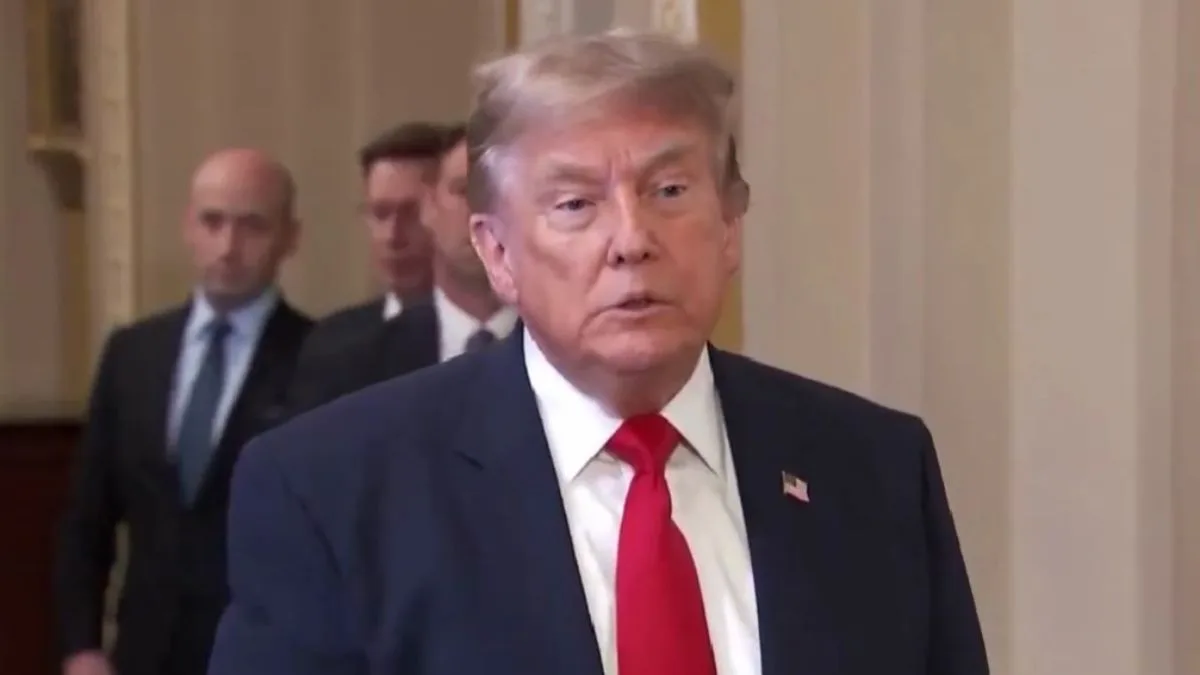
US President Donald Trump on Wednesday claimed Iran was accepting American demands in ongoing negotiations and asserted that Washington was making significant progress in its engagement with Tehran. He also made it clear that the United States would not accept any future agreement allowing Iran to levy charges on shipping through the Strait of Hormuz.
Speaking at multiple engagements in Washington, including meetings with Republican lawmakers at the Capitol and later with NATO Secretary General Mark Rutte at the White House, Trump projected confidence about the negotiations. At the same time, he warned that military action remained an option if diplomacy failed.
Advertisement
Trump says Iran making ‘very big concessions’
Before a lunch meeting with Republican lawmakers, Trump described the negotiations in optimistic terms.
“The war is going very well. As you know, we’re winning by a lot,” he said.
“Iran is making very big concessions. We’ll see what happens, but it’s been very, very, very powerful and it’s going very, very well.”
Later, after meeting lawmakers, Trump claimed Tehran continued to accommodate US demands.
“Iran is being very nice. They’re agreeing to everything that I want, and they have to. Otherwise, we just go back and do what we have to do,” he said.
Trump also noted that oil prices had fallen to around USD 70 a barrel during the conflict.
“I see that oil just broke the $70 number. Who would have thought that was going to happen? And that’s during a war,” he said.
Strait of Hormuz shipping charges ‘unacceptable’
During his Oval Office meeting with NATO Secretary General Mark Rutte, Trump rejected the possibility of any agreement that would allow Iran to impose fees on shipping through the Strait of Hormuz.
Asked whether such a provision would affect a final deal, he replied, “Yeah it would be unacceptable to me because we have numerous straits that if you did that for them you’d have to do it for other people… I wouldn’t allow it there either. Yeah it would be a game changer.”
The Strait of Hormuz is one of the world’s busiest maritime routes for global crude oil shipments.
Trump also criticised efforts in the US Congress to advance an Iran war resolution, saying it sent an unnecessary message during negotiations.
“So Iran sees that, and they go, what’s that all about? Now, you know, it’s meaningless, right?” he said.
NATO chief backs US position on Iran
Rutte endorsed Trump’s approach towards Iran and said preventing Tehran from acquiring nuclear weapons remained the central objective.
“I really want to make clear how important it is, what you are doing on Iran,” Rutte said.
He described Iran as “a country which is exporting chaos” and “exporting terrorism” and said it had come close to obtaining nuclear capability.
“Iran having its hands on the nuclear capability… would be a danger to the whole world, particularly the region, Israel, and to Europe, but also the rest of the world,” he said.
“This is about security, about safety.”
Trump comments on Minab school strike investigation
Trump was also questioned about the investigation into the strike on a school in Minab, Iran.
He said he had not seen any findings suggesting the attack involved a US missile.
“I have not seen it no,” Trump said.
“I don’t know that they’re ever going to solve that problem… because there were missiles flying all over the place.”
When asked further, Trump said he did not believe the final investigation would conclude that the United States was responsible.
“I don’t think it’s going to be us. I don’t think it was us. There were a lot of missiles being fired at that time,” he said.
US Defence Secretary Pete Hegseth said the Pentagon was treating the inquiry seriously and would release its findings “at the appropriate time.”
Separately, Iran’s Foreign Ministry spokesperson Esmaeil Baqaei criticised US policy in the region in a post on X, saying lasting peace would not be possible while “American militarism and interventionism persist.”